
Best 10 Free Chinese Reading Materials for Beginners to Learn to Read Mandarin

Learning to read Mandarin can be a rewarding yet challenging journey, especially for beginners. Fortunately, there are numerous free resources available to help build foundational skills in Chinese reading. From simplified texts and graded readers to children’s books and online articles, these materials are designed to make the learning process engaging and accessible. Whether you’re looking to practice characters, expand vocabulary, or improve comprehension, the right resources can make all the difference. In this article, we’ve compiled a list of the 10 best free Chinese reading materials tailored for beginners, offering a variety of formats to suit different learning styles and preferences.
- Best 10 Free Chinese Reading Materials for Beginners to Learn to Read Mandarin
- What are the best resources to learn Mandarin?
- How to start learning Chinese on your own?
- What is the most commonly used method for beginning language learners to read Chinese?
- How to learn Mandarin Chinese books?
- Frequently Asked Questions (FAQ)
Best 10 Free Chinese Reading Materials for Beginners to Learn to Read Mandarin
Learning to read Mandarin as a beginner can be challenging, but with the right resources, it becomes much easier. Below, we’ve compiled a list of the best free Chinese reading materials tailored for beginners. These resources will help you build vocabulary, improve comprehension, and familiarize yourself with Chinese characters in a structured way.
1. Du Chinese – Graded Readers for All Levels
Du Chinese offers graded reading materials designed specifically for learners at different proficiency levels, including beginners. Each story comes with pinyin, English translations, and audio recordings, making it easier to follow along. The app also allows you to track your progress.
See AlsoHow Many Sections Are In Duolingo Portuguese In 2025?| Feature | Description |
|---|---|
| Graded Levels | Stories categorized by difficulty (Beginner to Advanced) |
| Pinyin & Translations | Helps with pronunciation and understanding |
| Audio Support | Native speakers read stories aloud |
2. The Chairman’s Bao – News-Based Learning
The Chairman’s Bao provides simplified news articles written for Mandarin learners. The articles are graded by HSK level, making them ideal for beginners. Each piece includes pinyin, definitions, and audio, helping learners grasp new vocabulary in context.
| Feature | Description |
|---|---|
| HSK-Aligned | Content matches HSK vocabulary levels |
| Interactive Exercises | Reinforces learning with quizzes |
| Daily Updates | Fresh content regularly added |
3. Chinese Reading Practice – Short Stories & Essays
Chinese Reading Practice is a website offering short stories and essays with English translations and vocabulary lists. The texts are beginner-friendly and cover everyday topics, helping learners improve comprehension naturally.
| Feature | Description |
|---|---|
| Beginner-Friendly | Simple sentences and common vocabulary |
| Vocabulary Lists | Key words highlighted and explained |
| Cultural Insights | Stories reflect Chinese culture |
4. Mandarin Bean – Interactive Reading Exercises
Mandarin Bean offers interactive reading exercises with instant feedback. The platform includes short passages, dialogues, and quizzes to test comprehension. Beginners can learn at their own pace while reinforcing new characters and grammar.
See AlsoMy best advice on how to learn Chinese characters| Feature | Description |
|---|---|
| Interactive Quizzes | Tests understanding immediately |
| Audio & Pinyin | Supports listening and reading |
| Progress Tracking | Monitors learning development |
5. HSK Reading – Exam-Focused Materials
HSK Reading provides HSK-level-based reading materials, perfect for beginners preparing for the official proficiency test. The content includes pinyin, vocabulary breakdowns, and practice questions to ensure retention.
| Feature | Description |
|---|---|
| HSK-Focused | Aligned with exam requirements |
| Vocabulary Breakdowns | Key terms explained in detail |
| Practice Tests | Simulates real exam conditions |
What are the best resources to learn Mandarin?

Best Online Platforms for Learning Mandarin
Several online platforms offer structured courses for learning Mandarin, catering to different proficiency levels. Here are some of the most effective:
See AlsoTop 8 Ways Chinese Teachers Can Use ChatGPT to Create Lesson Plans- Duolingo: A free, gamified app ideal for beginners to build vocabulary and basic grammar.
- HelloChinese: Focuses on speaking and listening with interactive exercises.
- Coursera: Hosts university-level courses like Mandarin for Beginners from Peking University.
Recommended Textbooks for Mandarin Learners
Textbooks provide a systematic approach to mastering Mandarin. These are highly regarded:
- Integrated Chinese: A comprehensive series used in many universities.
- New Practical Chinese Reader: Combines grammar, vocabulary, and cultural insights.
- HSK Standard Course: Aligns with the official HSK exam levels.
Effective Language Exchange Tools
Practicing with native speakers accelerates fluency. Consider these language exchange resources:
- Tandem: Connects learners with native Mandarin speakers for conversation practice.
- HelloTalk: A chat app with built-in translation and correction features.
- italki: Offers paid tutoring sessions with professional teachers.
YouTube Channels for Mandarin Learning
YouTube hosts numerous channels dedicated to teaching Mandarin. Top picks include:
See AlsoDuolingo User Count: Global Language Learning Statistics- ChinesePod: Covers practical phrases and cultural context.
- Yoyo Chinese: Breaks down complex grammar into simple lessons.
- Learn Chinese with Emma: Focuses on pronunciation and daily conversations.
Flashcard Apps for Vocabulary Building
Memorizing characters is easier with flashcard apps. These are the most effective:
- Anki: Customizable decks for HSK vocabulary and sentence patterns.
- Pleco: Includes a dictionary, flashcards, and OCR for reading practice.
- Memrise: Uses spaced repetition and multimedia clips for retention.
How to start learning Chinese on your own?
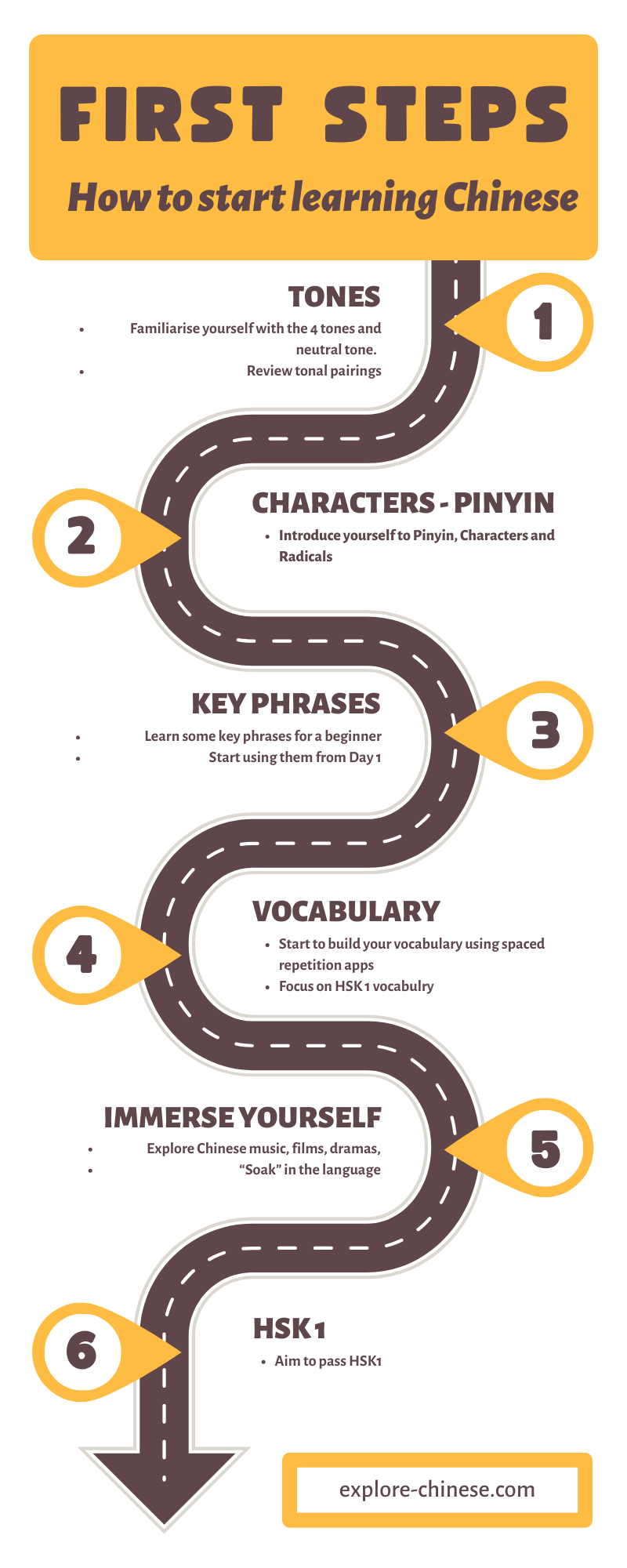
1. Set Clear Goals for Learning Chinese
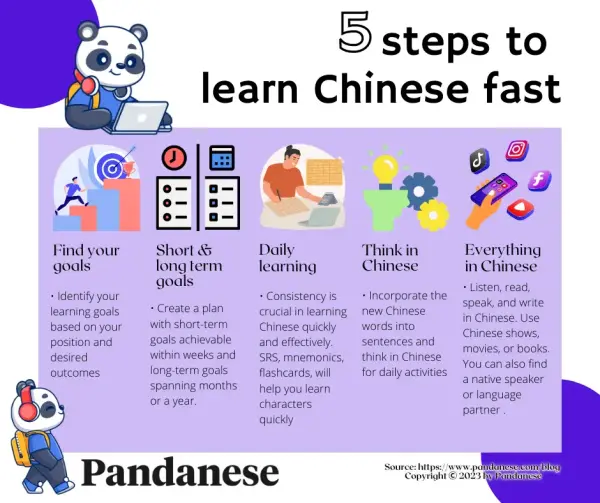
Before diving into learning Chinese, it's essential to define your objectives. Are you learning for travel, business, or personal interest? Setting clear goals helps tailor your study plan. Consider the following steps:
See AlsoHow is National Day Celebrated in China?- Identify your motivation: Determine why you want to learn Chinese to stay focused.
- Choose a focus area: Prioritize speaking, writing, or reading based on your needs.
- Set milestones: Break your learning into achievable short-term and long-term goals.
2. Learn Pinyin and Basic Pronunciation
Pinyin is the Romanization system for Chinese characters and is crucial for mastering pronunciation. Start with these steps:
- Study Pinyin charts: Familiarize yourself with initials, finals, and tones.
- Practice tones daily: Mandarin has four tones, and mispronunciation can change meanings.
- Use audio resources: Listen to native speakers and mimic their pronunciation.
3. Build a Foundation with Common Vocabulary
Begin with high-frequency words and phrases to quickly gain conversational skills. Follow this approach:
- Start with greetings: Learn phrases like 你好 (nǐ hǎo) and 谢谢 (xiè xie).
- Use flashcards: Apps like Anki or Pleco can help memorize vocabulary efficiently.
- Label objects: Stick Chinese words on everyday items to reinforce learning.
4. Study Basic Grammar and Sentence Structure
Chinese grammar is simpler than many languages, but it has unique rules. Focus on these key areas:
- Learn sentence patterns: Master basic structures like Subject-Verb-Object (SVO).
- Understand particles: Words like 了 (le) and 的 (de) are essential for meaning.
- Practice with simple sentences: Start with short phrases and gradually expand.
5. Immerse Yourself in the Language
Immersion accelerates learning by exposing you to real-world usage. Try these methods:
- Watch Chinese media: Movies, TV shows, and YouTube videos help with listening skills.
- Listen to podcasts/music: Improves comprehension and pronunciation.
- Join language exchanges: Platforms like Tandem or HelloTalk connect you with native speakers.
What is the most commonly used method for beginning language learners to read Chinese?
Introduction to Pinyin as a Foundation
The most commonly used method for beginning language learners to read Chinese is through Pinyin, a romanization system that represents the sounds of Mandarin using the Latin alphabet. This system helps learners associate characters with their pronunciations before tackling the complex writing system.
- Pinyin breaks down characters into syllables, making pronunciation accessible.
- It includes tone marks to teach the four Mandarin tones, crucial for meaning.
- Many textbooks and apps use Pinyin alongside characters for gradual learning.
Graded Readers for Progressive Learning
Graded readers are another popular tool, offering texts tailored to different proficiency levels. These books often include Pinyin annotations and English translations to support comprehension.
- They start with simple vocabulary and short sentences.
- Gradually introduce more complex characters and grammar.
- Some include audio for listening practice alongside reading.
Flashcards for Character Recognition
Using flashcards is a widely adopted technique to memorize Chinese characters. Tools like Anki or physical cards help learners associate characters with meanings and sounds.
- Focus on high-frequency characters first.
- Include Pinyin and English definitions.
- Spaced repetition systems improve retention.
Mobile Apps for Interactive Learning
Apps like Duolingo, HelloChinese, and Pleco provide interactive ways to practice reading Chinese. They combine visuals, audio, and quizzes to reinforce learning.
- Gamification keeps learners engaged.
- Many apps integrate Pinyin and character recognition.
- Offer bite-sized lessons for daily practice.
Structured Courses with Textbooks
Formal textbooks like Integrated Chinese or New Practical Chinese Reader provide a systematic approach. These often include reading exercises, dialogues, and cultural notes.
- Start with basic dialogues and build complexity.
- Include Pinyin in early chapters, then phase it out.
- Workbooks reinforce reading and writing skills.
How to learn Mandarin Chinese books?

Best Books to Learn Mandarin Chinese for Beginners
For beginners, selecting the right book is crucial to build a strong foundation in Mandarin Chinese. Here are some highly recommended options:
- Integrated Chinese by Cheng & Tsui: A widely used textbook with clear explanations, dialogues, and exercises.
- New Practical Chinese Reader: Focuses on practical communication skills and includes audio resources.
- Colloquial Chinese by Kan Qian: A great choice for self-learners with structured lessons and cultural insights.
Advanced Mandarin Chinese Learning Books
Advanced learners need materials that challenge their comprehension and fluency. Consider these books:
- Advanced Chinese: Intention, Strategy, and Communication: Enhances nuanced language use in complex scenarios.
- A Primer for Advanced Beginners of Chinese: Bridges intermediate to advanced levels with in-depth grammar and vocabulary.
- Chinese Grammar Wiki BOOK: A comprehensive reference for mastering advanced grammar rules.
Books for Learning Mandarin Chinese Characters
Mastering Chinese characters requires dedicated practice. These books simplify the process:
- Remembering the Hanzi by James Heisig: Uses mnemonics to help memorize characters effectively.
- The First 100 Chinese Characters: Focuses on the most frequently used characters with stroke order guides.
- Chinese Character Practice Book: Provides ample space for writing practice and reinforcement.
Mandarin Chinese Workbooks for Practice
Workbooks are essential for reinforcing lessons. Here are top picks:
- Practice Makes Perfect: Basic Chinese: Offers drills and exercises for grammar and vocabulary.
- Chinese for Beginners Workbook: Aligns with textbook lessons for additional practice.
- HSK Standard Course Workbooks: Tailored for HSK exam preparation with structured exercises.
Children’s Books for Learning Mandarin Chinese
Introducing Mandarin Chinese to kids can be fun with these engaging books:
- My First Mandarin Words: Colorful illustrations and simple phrases for young learners.
- Chinese for Kids by Ana Lomba: Interactive stories and activities to build early language skills.
- Mandy and Pandy series: Bilingual books that make learning enjoyable for children.
Frequently Asked Questions (FAQ)
What are the best free Chinese reading materials for beginners?
The best free Chinese reading materials for beginners include resources like Du Chinese, The Chairman's Bao, and Mandarin Bean. These platforms offer graded readers tailored to different proficiency levels, making it easier for learners to practice reading Mandarin without feeling overwhelmed. Additionally, websites like Chinese-Tools and HSK Reading provide short stories and articles with pinyin and translations, which are perfect for building foundational skills.
How can beginners improve their Mandarin reading skills with these materials?
Beginners can improve their Mandarin reading skills by consistently practicing with graded readers and simplified texts available on platforms like Graded Chinese Reader or Chinese Breeze. These materials often include vocabulary lists and comprehension questions to reinforce learning. It's also helpful to read aloud to practice pronunciation and use tools like Pleco or Google Translate for unfamiliar words. Setting small, daily reading goals can significantly boost reading fluency over time.
Are there any free apps for reading Mandarin as a beginner?
Yes, several free apps are excellent for beginners learning to read Mandarin. Du Chinese and The Chairman's Bao offer mobile versions with interactive features like audio support and word highlighting. Another great option is HelloChinese, which combines reading with other language skills. For offline practice, apps like Pleco (with its built-in reader) or Beelinguapp provide parallel-text stories in Chinese and English, making comprehension easier for new learners.
What makes graded readers effective for learning Mandarin?
Graded readers are highly effective for learning Mandarin because they are designed to match a learner's proficiency level, using controlled vocabulary and grammar. Resources like Mandarin Companion or Chinese Breeze offer stories that gradually increase in difficulty, helping beginners build confidence and reading stamina. The inclusion of pinyin, footnotes, and audio support in many graded readers also enhances comprehension and reinforces listening skills simultaneously.
Leave a Reply
Related Posts