
Is Learning Chinese Hard? The 5 Critical Points

Learning Chinese is often perceived as one of the most challenging languages to master, especially for native English speakers. With its unique characters, tonal system, and grammatical structures, it’s no surprise that many learners feel intimidated. However, understanding the key hurdles can make the journey more manageable. This article explores the five critical points that determine whether learning Chinese is hard or achievable: the writing system, pronunciation, grammar, cultural context, and learning strategies. By breaking down these elements, we aim to provide clarity and practical insights for anyone considering taking on this fascinating yet demanding language. Let’s dive in.
Is Learning Chinese Hard? The 5 Critical Points
1. The Complexity of Chinese Characters
One of the biggest challenges in learning Chinese is mastering its characters. Unlike alphabetic languages, Chinese uses a logographic system where each character represents a word or a meaningful part of a word. There are thousands of characters, and each has its own stroke order and pronunciation. However, with consistent practice and the use of mnemonics, learners can gradually build their character recognition skills.
| Aspect | Difficulty Level |
|---|---|
| Number of Characters | High (3,000+ for fluency) |
| Stroke Order | Moderate (rules must be followed) |
| Memorization Techniques | Helpful (mnemonics, repetition) |
2. Tonal Nature of the Language
Mandarin Chinese is a tonal language, meaning that the pitch or intonation used when pronouncing a word can change its meaning. There are four main tones and a neutral tone, which can be difficult for non-native speakers to distinguish and reproduce accurately. Mispronouncing tones can lead to misunderstandings, but with focused listening and speaking practice, learners can improve their tonal accuracy.
See AlsoDuolingo Free: Zero-Cost Language Learning Guide [2025 Features]| Tone | Example (Pinyin) |
|---|---|
| First Tone (High Flat) | mā (mother) |
| Second Tone (Rising) | má (hemp) |
| Third Tone (Falling-Rising) | mǎ (horse) |
| Fourth Tone (Falling) | mà (scold) |
3. Grammar Structure Differences
Compared to English, Chinese grammar is relatively simple in some aspects, such as the lack of verb conjugations or gendered nouns. However, the sentence structure, use of measure words, and context-dependent meanings can be challenging. For example, Chinese relies heavily on word order and particles to convey tense and mood, which requires adjustment for English speakers.
| Feature | Chinese vs. English |
|---|---|
| Verb Conjugation | None in Chinese / Complex in English |
| Measure Words | Mandatory in Chinese / Rare in English |
| Word Order Importance | Critical in Chinese / Flexible in English |
4. Listening and Speaking Challenges
Listening comprehension in Chinese can be difficult due to the speed of native speakers, regional accents, and the tonal nature of the language. Similarly, speaking fluently requires not only correct pronunciation but also the ability to think in Chinese to avoid translation delays. Regular exposure through media and conversation practice is essential to overcome these hurdles.
| Challenge | Solution |
|---|---|
| Fast Speech | Listen to slowed-down audio first |
| Regional Accents | Focus on standard Mandarin initially |
| Tonal Mistakes | Practice with native speakers |
5. Cultural Context and Idiomatic Expressions
Understanding Chinese culture is crucial for grasping idiomatic expressions, proverbs, and humor. Many phrases have historical or cultural significance that isn't immediately obvious to learners. Immersing oneself in Chinese media, literature, and social interactions can help bridge this gap and make the language feel more natural.
See AlsoDuolingo Education: Language Learning Made Simple| Cultural Element | Impact on Language |
|---|---|
| Idioms (成语) | Often derived from ancient stories |
| Formality Levels | Important in social interactions |
| Non-Literal Phrases | Common in daily speech |
What difficulties do you have in learning Chinese?

1. Mastering Chinese Tones
One of the biggest challenges in learning Chinese is mastering its tonal system. Mandarin Chinese has four main tones and a neutral tone, each changing the meaning of a word entirely. Mispronouncing a tone can lead to misunderstandings. For example:
- First tone (high and flat): mā (妈) means mother.
- Second tone (rising): má (麻) means hemp.
- Third tone (falling-rising): mǎ (马) means horse.
- Fourth tone (sharp falling): mà (骂) means scold.
2. Memorizing Chinese Characters
Chinese characters are logograms, each representing a word or a concept. Unlike alphabetic systems, memorizing thousands of characters is time-consuming. Key difficulties include:
See AlsoReading aloud in Chinese is really hard- Stroke order: Characters must be written in a specific sequence.
- Radicals: Components within characters hint at meaning or pronunciation.
- Homophones: Many characters sound the same but have different meanings.
3. Grasping Chinese Grammar
While Chinese grammar is simpler than many languages, its sentence structure and lack of verb conjugations can be confusing. Challenges include:
- Word order: Time phrases often come before the verb.
- Measure words: Required when counting nouns (e.g., yí ge rén – one person).
- Context reliance: Tenses are implied rather than explicitly marked.
4. Building Listening Comprehension
Understanding spoken Chinese is difficult due to fast speech, regional accents, and homophones. Key obstacles are:
- Dialect variations: Mandarin differs from Cantonese or other dialects.
- Slang and idioms: Colloquial phrases often don’t translate literally.
- Lack of pauses: Native speakers often blend words together.
5. Practicing Speaking Fluently
Developing fluency requires constant practice, but learners face hurdles like:
- Fear of mistakes: Tone errors can lead to embarrassment.
- Limited immersion: Few opportunities to speak outside class.
- Sentence flow: Combining tones and grammar naturally takes time.
Is Chinese the hardest writing system?
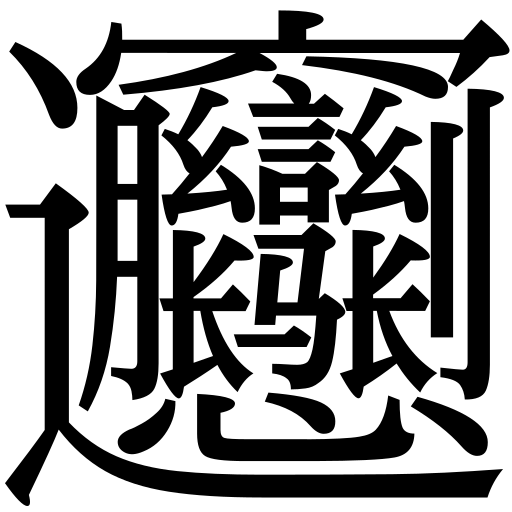
What Makes the Chinese Writing System Complex?
The Chinese writing system is often considered one of the most complex due to its use of logograms instead of an alphabet. Each character represents a word or a meaningful part of a word, requiring memorization of thousands of symbols. Key factors contributing to its difficulty include:
- Stroke order: Characters must be written in a specific sequence, which can be challenging for learners.
- Homophones: Many characters sound the same but have different meanings, adding confusion.
- Lack of phonetic clues: Unlike alphabetic systems, characters often don’t indicate pronunciation directly.
How Does Chinese Compare to Other Writing Systems?
Compared to alphabetic systems like English or Spanish, Chinese is more demanding due to its non-phonetic nature. However, other scripts, such as Japanese kanji or Arabic, also present unique challenges. Key comparisons include:
- Japanese kanji: Borrows Chinese characters but adds two phonetic scripts (hiragana and katakana).
- Arabic: Uses an abjad system with cursive writing and vowel omissions.
- Korean hangul: An alphabet with a logical structure, making it easier to learn.
Is Memorization the Biggest Challenge in Learning Chinese Characters?
Memorization is a significant hurdle, as learners must recall thousands of characters to achieve fluency. However, other aspects also contribute to the difficulty:
- Character components: Radicals and strokes must be combined correctly.
- Contextual usage: The same character can have multiple meanings depending on context.
- Writing speed: Handwriting characters fluently requires extensive practice.
Are There Any Advantages to the Chinese Writing System?
Despite its complexity, the Chinese writing system offers unique benefits, such as:
- Universal comprehension: Characters are understood across dialects, even if pronunciations differ.
- Historical continuity: Ancient texts remain accessible to modern readers.
- Efficiency: A single character can convey more meaning than a word in alphabetic systems.
Can Technology Make Learning Chinese Characters Easier?
Modern technology has introduced tools to simplify learning Chinese characters, including:
- Pinyin input: Typing using Romanized pronunciation reduces memorization pressure.
- Apps and flashcards: Spaced repetition systems aid retention.
- OCR and handwriting recognition: Helps learners identify and practice characters in real-time.
Frequently Asked Questions (FAQ)
Is Chinese one of the hardest languages to learn?
Learning Chinese is often considered challenging due to its unique writing system and tonal nature. Unlike alphabetic languages, Chinese uses characters, which require memorization of strokes and meanings. Additionally, the four tones in Mandarin can change the meaning of words, making pronunciation crucial. However, with consistent practice and the right resources, many learners achieve fluency.
How long does it take to become fluent in Chinese?
The time required to achieve fluency in Chinese varies based on factors like prior language experience, study intensity, and immersion. On average, it may take 2-4 years of dedicated study to reach conversational fluency. Mastering advanced proficiency, including reading and writing, often takes longer. Structured lessons and daily practice significantly accelerate progress.
What are the biggest challenges when learning Chinese?
The most common hurdles include mastering the tones, memorizing characters, and understanding grammar structures. Unlike English, Chinese relies heavily on context, and word order can be flexible. Additionally, the lack of cognates (similar words between languages) makes vocabulary acquisition slower. Overcoming these challenges requires patience, repetition, and immersive learning techniques.
Can I learn Chinese without focusing on writing characters?
While it's possible to learn spoken Chinese without mastering characters, doing so limits your comprehension and cultural understanding. Characters are essential for reading signs, menus, and texts. However, beginners can prioritize pinyin (Romanized Chinese) to build speaking skills first. Eventually, learning characters enhances fluency and unlocks deeper engagement with the language.
Leave a Reply
Related Posts