
Why you need goals to learn Chinese efficiently

Learning Chinese efficiently requires more than just dedication—it demands clear, well-defined goals. Without a roadmap, the complexity of tones, characters, and grammar can quickly become overwhelming. Setting specific objectives helps structure your study, measure progress, and maintain motivation. Whether aiming to hold a basic conversation, pass a proficiency test, or read Chinese literature, goals provide direction and focus. They break the learning process into manageable steps, ensuring consistent improvement. By identifying what you want to achieve and why, you create accountability and purpose. In a language as intricate as Chinese, goals aren’t just helpful—they’re essential for sustained, effective learning.
Why Setting Clear Goals is Essential for Learning Chinese Efficiently
1. Goals Provide Direction and Focus
Setting clear goals helps you stay focused on what you want to achieve in your Chinese learning journey. Without goals, you might waste time on irrelevant materials or lose motivation. A well-defined objective, such as reach HSK 3 in six months, keeps your study sessions structured and purposeful.
| Benefit | Example |
|---|---|
| Prevents aimless studying | Focusing only on HSK vocabulary |
| Encourages consistency | Daily 30-minute practice |
2. Goals Help Measure Progress
Tracking your progress is crucial for staying motivated. Measurable goals, like learning 20 new characters per week, allow you to see tangible improvements. This prevents frustration and helps you adjust your study methods if needed.
See AlsoHow To Get Duolingo Math On Windows: Step-by-Step Guide| Goal Type | Measurement |
|---|---|
| Short-term | Weekly vocabulary quizzes |
| Long-term | Monthly speaking tests |
3. Goals Increase Motivation and Accountability
Having a specific target, such as holding a 5-minute conversation in Chinese, keeps you accountable. Motivation naturally increases when you see yourself getting closer to your goal. Breaking big goals into smaller milestones also makes them less overwhelming.
| Motivation Factor | Example |
|---|---|
| Reward system | Treat yourself after passing HSK 2 |
| Accountability partner | Weekly study sessions with a friend |
4. Goals Optimize Time and Resources
With defined objectives, you can prioritize the most useful resources, such as textbooks, apps, or tutors. This prevents wasting time on ineffective methods and ensures you invest effort where it matters most.
| Resource | Best Used For |
|---|---|
| Anki flashcards | Vocabulary retention |
| Language exchange | Speaking practice |
5. Goals Prepare You for Real-Life Situations
If your goal is to use Chinese professionally, you’ll focus on business vocabulary and formal writing. Alternatively, travel-focused learners prioritize conversational phrases. Tailoring goals to real-life needs makes learning practical and rewarding.
See AlsoGuide to the Duolingo App: Learn Languages Effectively & Enjoyably| Scenario | Learning Focus |
|---|---|
| Business | Formal emails & presentations |
| Travel | Survival phrases & directions |
How to learn Chinese more effectively?
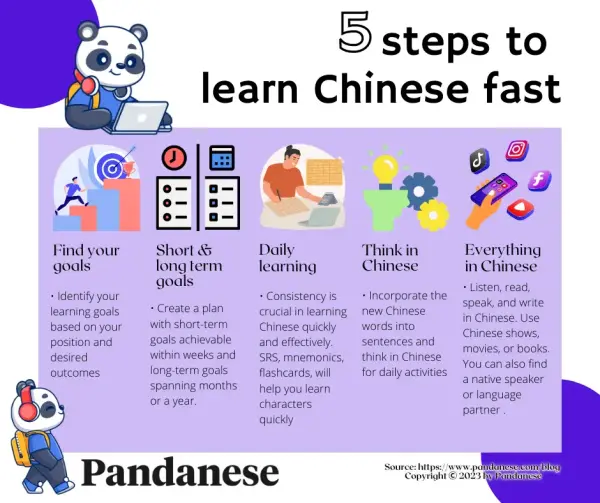
Set Clear and Achievable Goals
To learn Chinese effectively, start by defining specific goals. Whether it's mastering basic conversations, passing a proficiency test, or reading Chinese literature, having a clear target keeps you motivated. Break your goals into smaller milestones to track progress.
- Identify your purpose (e.g., travel, business, or academic reasons).
- Set short-term and long-term objectives (e.g., learn 50 words per week).
- Measure progress regularly with self-assessments or mock tests.
Immerse Yourself in the Language
Immersion accelerates learning by exposing you to authentic Chinese in real-life contexts. Surround yourself with the language through media, conversations, and cultural experiences.
See Also5 Measure Words Explained- Watch Chinese movies or TV shows with subtitles to improve listening skills.
- Listen to Chinese music or podcasts to familiarize yourself with tones and pronunciation.
- Engage with native speakers through language exchange platforms or local communities.
Master Pinyin and Tones Early
Pinyin (Romanization of Chinese characters) and tones are foundational. Mispronouncing tones can change meanings entirely, so prioritize accuracy from the start.
- Practice tone pairs to distinguish between similar-sounding words.
- Use apps like Pleco or HelloChinese for interactive pinyin drills.
- Record yourself and compare with native speakers to refine pronunciation.
Build Vocabulary Strategically
Focus on high-frequency words and phrases to maximize efficiency. Avoid memorizing random characters without context.
- Learn radicals first to understand character composition.
- Use flashcards (Anki or Quizlet) for spaced repetition.
- Group related words (e.g., food, travel) to create mental connections.
Practice Writing Characters Consistently
Writing Chinese characters reinforces memory and improves recognition. Dedicate time daily to handwriting practice.
- Start with stroke order rules to build proper habits.
- Use grid paper to maintain proportion and structure.
- Incorporate characters into daily notes or journaling for practical use.
Why should you learn Chinese language and what it will beneficial you in the future?

Economic Opportunities and Career Advancement
Learning Chinese opens doors to vast economic opportunities, especially as China is a global economic powerhouse. Many multinational companies seek employees who can bridge language and cultural gaps. Here’s how it benefits your career:
- Competitive edge: Bilingual professionals are highly valued in industries like trade, finance, and technology.
- Higher salaries: Proficiency in Chinese often leads to better-paying jobs or promotions.
- Global networking: Communicating with Chinese partners or clients strengthens business relationships.
Cultural Understanding and Travel Experiences
Mastering Chinese deepens your appreciation of one of the world’s oldest cultures. It also enhances travel experiences in Chinese-speaking regions:
- Authentic interactions: Engage with locals beyond tourist hotspots.
- Historical insights: Access untranslated literature, films, and historical texts.
- Cultural respect: Understanding language nuances fosters mutual respect.
Academic and Intellectual Growth
Studying Chinese challenges the brain and expands cognitive abilities, offering unique academic advantages:
- Improved memory: Learning characters enhances memory retention.
- Multidisciplinary skills: Connects to fields like linguistics, history, and politics.
- Research opportunities: Access to China’s vast academic resources and scholarships.
Technological and Innovation Advantages
China leads in technology and innovation. Knowing the language provides a strategic edge:
- Tech industry access: Understand cutting-edge developments in AI, 5G, and robotics.
- Startup collaboration: Partner with or invest in Chinese tech ventures.
- Patent and research: Navigate Chinese scientific journals and patents.
Geopolitical Influence and Diplomacy
China’s growing geopolitical influence makes Chinese language skills crucial for future leaders:
- Diplomatic careers: Work in international relations or global organizations.
- Policy analysis: Decipher China’s domestic and foreign policies firsthand.
- Conflict resolution: Mediate cross-cultural misunderstandings effectively.
Why is it important to learn about China?

Understanding China's Global Economic Influence
China is the world's second-largest economy and a major player in global trade. Learning about its economic strategies, growth models, and market dynamics is crucial for businesses, policymakers, and investors. Here’s why:
- Trade partnerships: China is a key trading partner for over 120 countries, influencing global supply chains.
- Innovation hub: It leads in sectors like technology, renewable energy, and manufacturing.
- Investment opportunities: Understanding China’s policies helps in identifying profitable ventures.
Exploring China's Rich Cultural Heritage
China boasts a 5,000-year-old civilization with profound contributions to art, philosophy, and science. Learning about its culture fosters global appreciation and cross-cultural communication.
- Historical legacy: Discoveries like paper, gunpowder, and the Silk Road shaped world history.
- Philosophical traditions: Confucianism and Taoism influence modern ethics and governance.
- Artistic expressions: Calligraphy, opera, and literature offer unique aesthetic insights.
China's Role in Geopolitics and International Relations
As a rising superpower, China’s foreign policy impacts global stability. Understanding its stance on issues like territorial disputes and climate change is essential.
- Diplomatic strategies: Initiatives like the Belt and Road Initiative reshape global alliances.
- Security policies: Its military and cyber capabilities affect international security.
- Climate commitments: China’s environmental policies influence global sustainability efforts.
The Importance of Learning Mandarin Chinese
Mandarin is the most spoken language globally, and proficiency opens doors in business, diplomacy, and academia.
- Career advantages: Bilingual professionals are in high demand.
- Cultural access: Direct engagement with Chinese media and literature.
- Global communication: Facilitates interactions in multinational settings.
China's Technological and Scientific Advancements
China is a leader in AI, 5G, and space exploration, making its innovations critical to global progress.
- Cutting-edge research: Breakthroughs in quantum computing and biotechnology.
- Infrastructure development: High-speed rail and smart cities set global benchmarks.
- Space ambitions: Missions to the Moon and Mars expand human knowledge.
Frequently Asked Questions (FAQ)
Why are goals important for learning Chinese efficiently?
Goals provide a clear sense of direction and purpose when learning Chinese. Without them, learners may struggle to stay motivated or measure progress. Efficiency comes from focusing on specific objectives, such as mastering daily conversations or passing a proficiency test, rather than aimlessly studying. Well-defined goals help prioritize what to learn, ensuring time and effort are spent on the most relevant vocabulary, grammar, and skills.
How do goals improve motivation in Chinese language learning?
Setting achievable milestones keeps learners engaged by providing a sense of accomplishment. For example, reaching a goal like ordering food in Chinese or reading a short article reinforces progress and boosts confidence. Motivation naturally increases when learners see tangible results, making it easier to stay committed to long-term study. Without goals, the learning process can feel overwhelming or stagnant, leading to frustration.
What types of goals should I set for learning Chinese effectively?
Short-term goals, like memorizing 10 new characters a week, and long-term goals, such as achieving HSK 4 proficiency, work together to create a balanced approach. Specific, measurable, and time-bound objectives, such as hold a 5-minute conversation in 3 months, are far more effective than vague ambitions like get better at Chinese. Tailoring goals to personal interests, like watching a drama without subtitles, also enhances engagement.
Can goals help with overcoming plateaus in Chinese learning?
Yes, structured goals break through plateaus by introducing new challenges. When progress slows, revisiting or adjusting goals—such as switching from textbook exercises to real-life practice—reignites improvement. Consistent evaluation of goals helps identify weaknesses, allowing learners to refocus efforts on areas needing attention. Without goals, plateaus can lead to discouragement, but with them, they become opportunities for growth.
Leave a Reply
Related Posts