
How to improve your Chinese handwriting

Improving your Chinese handwriting can seem daunting, but with the right techniques, it becomes an achievable goal. Whether you're a beginner or looking to refine your skills, mastering stroke order, consistency, and proper structure is essential. Chinese characters are built on precise strokes and balanced proportions, making practice and patience key. This guide will walk you through practical steps to enhance your handwriting, from understanding fundamental principles to advanced tips for elegance and clarity. By focusing on deliberate practice and leveraging helpful tools, you’ll gradually develop a more natural and polished style. Let’s explore how to transform your Chinese characters from messy scribbles to confident, beautiful writing.
How to Improve Your Chinese Handwriting: Essential Tips and Techniques
1. Understand the Basic Strokes and Stroke Order
Improving your Chinese handwriting starts with mastering the basic strokes and following the correct stroke order. Each Chinese character is composed of specific strokes written in a particular sequence. Learning these fundamentals ensures your characters look balanced and natural. Practice writing each stroke slowly and pay attention to direction and pressure.
| Stroke Type | Example | Description |
|---|---|---|
| Horizontal (一) | 一 | Left to right, slightly upward |
| Vertical (丨) | 十 | Top to bottom, straight |
| Dot (丶) | 主 | Small downward stroke |
2. Practice with Grid Paper
Using grid paper (like Tianzige) helps maintain consistent character proportions. The squares guide you in spacing strokes evenly and keeping characters symmetrical. Start with larger grids for beginners, then gradually move to smaller ones as your control improves.
See AlsoPleco (App Review) - Update On The Chinese Dictionary| Grid Type | Purpose |
|---|---|
| Tianzige (田字格) | Divides characters into quadrants for balance |
| Mizige (米字格) | Adds diagonal lines for stroke alignment |
3. Copy Model Characters Regularly
Repetition is key. Copy model characters from textbooks or calligraphy sheets to internalize proper form. Focus on quality over speed—write each character multiple times, comparing it to the original to spot differences.
| Resource | Benefit |
|---|---|
| Calligraphy books | Shows professional stroke techniques |
| HSK writing workbooks | Provides graded practice material |
4. Use the Right Tools: Brushes, Pens, and Paper
The right writing tools impact your handwriting. Beginners can start with pencil or gel pens for control, while advanced learners may try brushes to explore calligraphic styles. Choose smooth paper to prevent ink bleeding.
| Tool | Best For |
|---|---|
| Mechanical pencil | Precision and easy corrections |
| Fountain pen | Fluid stroke variation |
5. Analyze and Correct Common Mistakes
Identify recurring errors like misaligned strokes or incorrect proportions. Keep a journal to track progress and note areas needing improvement. Seek feedback from teachers or native speakers.
See AlsoHow To Get A Taxi in China - Keywords and Things To Know| Common Mistake | Solution |
|---|---|
| Crooked horizontals | Practice with grid guidelines |
| Uneven spacing | Slow down and count strokes |
How do I make my Chinese handwriting better?
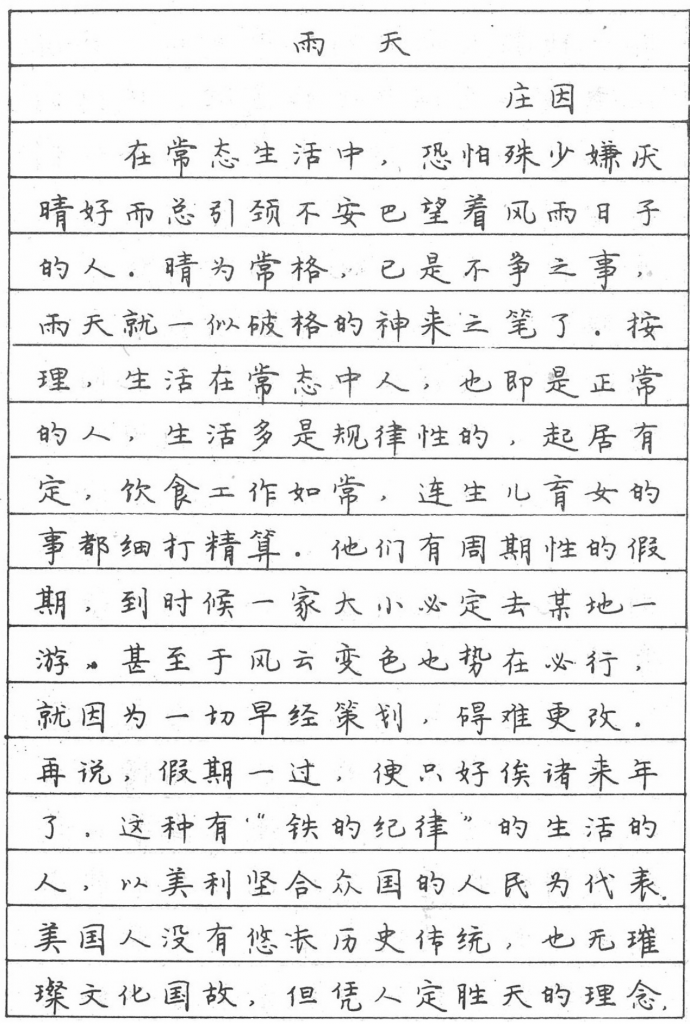
Understand the Basic Strokes of Chinese Characters
To improve your Chinese handwriting, start by mastering the basic strokes. Each character is built from a combination of these strokes, and proper execution ensures clarity and balance.
- Practice horizontal (一) and vertical (丨) strokes first, as they appear frequently.
- Learn diagonal strokes like 撇 (piě, left-falling) and 捺 (nà, right-falling).
- Study hook strokes (钩, gōu) and turning strokes (折, zhé) for more complex characters.
Use Grid Paper for Proper Structure
Writing on grid paper (like Tianzige) helps maintain consistent character proportions and alignment, which is crucial for readability.
See AlsoThe forking path: A human approach to learning Chinese- Use square grids to visualize the space each character occupies.
- Keep strokes centered within the grid for balance.
- Pay attention to spacing between components in compound characters.
Copy Model Characters Regularly
Repetition is key to developing muscle memory. Copying model characters from textbooks or calligraphy sheets ensures accuracy.
- Trace over printed examples before freehand writing.
- Focus on stroke order (笔顺, bǐshùn) to maintain natural flow.
- Compare your work to the model and correct mistakes immediately.
Slow Down and Focus on Precision
Rushing leads to sloppy handwriting. Slow, deliberate practice ensures each stroke is clear and intentional.
- Write each stroke methodically, pausing between them if needed.
- Avoid skipping or merging strokes, which distorts characters.
- Gradually increase speed only after mastering accuracy.
Study Calligraphy Techniques
Learning Chinese calligraphy (书法, shūfǎ) principles can elevate your everyday handwriting.
- Observe how brush pressure creates thick and thin lines.
- Emulate the rhythm and flow of professional calligraphers.
- Experiment with different scripts (楷书, 行书) to find your style.
Is Chinese handwriting hard?
Why is Chinese handwriting considered difficult?
Chinese handwriting is often perceived as challenging due to its complex characters, which require precise strokes and proper stroke order. Unlike alphabetic systems, each character is a unique combination of strokes, radicals, and components. Key reasons include:
- Thousands of characters: Learners must memorize thousands of distinct characters for basic literacy.
- Stroke order rules: Incorrect stroke order can make characters unrecognizable or aesthetically unpleasing.
- Lack of phonetic clues: Characters often don’t directly indicate pronunciation, unlike alphabetic systems.
How does stroke order affect Chinese handwriting?
Stroke order is critical in Chinese handwriting because it ensures consistency, speed, and legibility. Following the correct sequence helps maintain balance and structure in characters. Important points:
- Top-to-bottom, left-to-right: This is the foundational rule for most characters.
- Horizontal before vertical: Strokes written horizontally usually come before vertical ones.
- Enclosures before contents: The outer frame of a character is typically drawn first.
What are the most challenging aspects of writing Chinese characters?
The difficulty in writing Chinese characters stems from several factors, including memory load and fine motor control. Key challenges include:
- Similar-looking characters: Minor differences in strokes can change meaning entirely (e.g., 未 vs. 末).
- Proportions and spacing: Characters must be balanced to avoid looking distorted.
- Writing speed: Achieving fluency requires years of practice to write quickly without sacrificing accuracy.
How do radicals simplify Chinese handwriting?
Radicals, the building blocks of Chinese characters, help learners categorize and memorize characters more efficiently. They provide clues about meaning and pronunciation. Key benefits:
- Organizational structure: Radicals group characters into logical categories (e.g., water-related radicals like 氵).
- Memory aid: Recognizing radicals reduces the need to memorize every stroke individually.
- Predictive power: Some radicals hint at a character’s meaning or sound.
Can technology make Chinese handwriting easier?
Modern tools like input methods and handwriting apps have reduced the necessity of mastering handwriting, but they don’t eliminate the challenge entirely. Technological aids include:
- Pinyin input: Typing using Romanized pronunciation bypasses handwriting but requires knowing pronunciation.
- Handwriting recognition: Apps like Pleco allow users to draw characters, providing instant feedback.
- Digital practice tools: Apps break down characters into strokes, offering guided practice.
How can I improve my Chinese reading and writing?
Build a Strong Vocabulary Foundation
To improve your Chinese reading and writing, start by expanding your vocabulary. Focus on learning high-frequency words and characters used in daily conversations and texts.
- Use flashcards with characters, pinyin, and meanings to reinforce memorization.
- Read graded readers tailored to your proficiency level to encounter new words in context.
- Practice writing characters daily to improve recognition and recall.
Read Chinese Material Regularly
Consistent exposure to Chinese texts enhances comprehension and familiarity with sentence structures.
- Start with children's books or news articles for beginners.
- Highlight unknown words and look them up to build vocabulary.
- Summarize passages in your own words to reinforce understanding.
Practice Writing Daily
Regular writing practice helps solidify character recognition and improves fluency.
- Keep a journal in Chinese to practice forming sentences.
- Copy well-written texts to learn proper grammar and style.
- Use writing prompts to challenge yourself with new topics.
Engage with Native Content
Immersing yourself in authentic Chinese materials accelerates learning.
- Watch Chinese shows with subtitles to connect spoken and written language.
- Follow Chinese social media to see informal and modern usage.
- Join language forums to read and interact with native speakers.
Use Language Learning Tools
Leverage technology to enhance your reading and writing skills efficiently.
- Install Pleco or other dictionary apps for quick word lookups.
- Try Anki for spaced repetition of vocabulary.
- Use handwriting input on your device to practice character writing.
How to learn Chinese writing fast?

Understanding Chinese Characters: The Basics
To learn Chinese writing quickly, start by understanding the structure of characters. Chinese characters are logograms, meaning each represents a word or a meaningful part of a word. Focus on these key aspects:
- Radicals: Learn common radicals, the building blocks of characters, as they often hint at meaning or pronunciation.
- Strokes: Master the basic stroke order rules to write characters correctly and efficiently.
- Pinyin: Use Pinyin (Romanization) to associate sounds with characters, aiding memorization.
Daily Practice Techniques for Faster Learning
Consistency is key when learning Chinese writing. Implement these daily habits to accelerate progress:
- Flashcards: Use apps like Anki or physical flashcards to review characters regularly.
- Writing drills: Dedicate 15-30 minutes daily to writing characters by hand to reinforce muscle memory.
- Labeling: Label objects in your environment with their Chinese characters to create immersive learning.
Leveraging Mnemonics and Memory Tricks
Mnemonics can significantly speed up character memorization. Here’s how to use them effectively:
- Storytelling: Create vivid stories linking a character’s shape to its meaning (e.g., 木 (tree) resembles a tree).
- Visual associations: Connect characters to images (e.g., 山 (mountain) looks like peaks).
- Word grouping: Learn characters in thematic groups (e.g., weather-related words) to build connections.
Using Technology and Apps for Efficient Learning
Modern tools can streamline your Chinese writing journey. Consider these resources:
- Pleco: A powerful dictionary app with stroke-order animations and flashcards.
- Skritter: An app focused on writing practice with instant feedback.
- HelloChinese: Combines writing exercises with gamified learning for engagement.
Immersion and Real-World Application
Applying Chinese writing in real contexts reinforces learning. Try these methods:
- Journaling: Write daily entries using new characters to practice contextually.
- Reading practice: Start with children’s books or graded readers to see characters in use.
- Language exchange: Partner with a native speaker to exchange written messages and corrections.
Frequently Asked Questions (FAQ)
What are the best techniques to improve Chinese handwriting?
Consistent practice is the cornerstone of improving your Chinese handwriting. Start by mastering stroke order, as it ensures characters look balanced and natural. Use grid paper to maintain proper proportions, and trace characters to build muscle memory. Additionally, slow, deliberate writing helps reinforce correct form before increasing speed. Over time, your handwriting will become more fluid and accurate.
How long does it take to see improvement in Chinese handwriting?
The timeline varies depending on dedication and practice frequency. With daily practice, noticeable improvements can appear in a few weeks, but achieving elegant, consistent handwriting may take several months or even years. Patience is key—focus on gradual progress rather than quick results.
What tools or materials can help enhance Chinese handwriting?
Using the right tools makes a significant difference. Grid notebooks help with character structure, while brush pens or fountain pens encourage proper stroke pressure. Apps like Skritter or Pleco provide interactive practice, and calligraphy workbooks offer guided exercises. Combining these tools maximizes learning efficiency.
How can I avoid common mistakes when writing Chinese characters?
Many learners struggle with incorrect stroke order or misaligned components. To avoid these, study basic radicals first, as they form the building blocks of characters. Regularly compare your writing to model characters from textbooks or native speakers. Lastly, seek feedback from teachers or language partners to correct errors early.
Leave a Reply
Related Posts