
Learning how to learn Chinese through self-experimentation

Learning Chinese can seem daunting, but self-experimentation offers a personalized approach to mastering the language. By testing different methods—whether flashcards, immersion, or spaced repetition—learners can identify what works best for their unique learning style. This article explores how self-directed experimentation can accelerate progress, from building vocabulary to improving pronunciation. Through trial and error, learners gain insights into their strengths and weaknesses, allowing them to refine their strategies over time. Whether you're a beginner or an advanced student, adopting a mindset of curiosity and adaptability can transform the challenge of learning Chinese into an engaging and rewarding journey. Discover how to tailor your study habits for maximum efficiency.
Mastering Chinese Through Self-Experimentation: A Practical Guide
1. The Power of Self-Experimentation in Language Learning
Self-experimentation allows learners to tailor their Chinese learning process based on personal strengths and weaknesses. By testing different methods—such as spaced repetition, immersion, or mnemonics—you can identify what works best for you. Keeping a learning journal helps track progress and refine strategies over time.
| Method | Benefit |
|---|---|
| Spaced Repetition | Improves long-term retention |
| Immersion | Enhances listening and speaking skills |
| Mnemonics | Simplifies character memorization |
2. Setting Clear and Measurable Goals
Goal-setting is crucial for effective self-experimentation. Break down your Chinese learning into specific objectives, such as mastering 100 characters per month or holding a 5-minute conversation. Use SMART criteria (Specific, Measurable, Achievable, Relevant, Time-bound) to stay on track.
See AlsoImmersion at home or: Why you don’t have to go abroad to learn Chinese| Goal Type | Example |
|---|---|
| Short-term | Learn 10 new words daily |
| Long-term | Pass HSK 3 in 6 months |
3. Leveraging Technology for Self-Directed Learning
Apps and online tools like Anki, Pleco, and HelloTalk can accelerate your progress. Experiment with different platforms to find the ones that align with your learning style. For example, Anki is great for flashcards, while HelloTalk connects you with native speakers.
| Tool | Use Case |
|---|---|
| Anki | Customizable flashcards |
| Pleco | Dictionary and character recognition |
4. The Role of Consistency and Routine
Consistency is key in language learning. Establish a daily routine, even if it’s just 15 minutes of practice. Over time, small efforts compound into significant progress. Track your habits using apps like Habitica or a simple spreadsheet.
| Activity | Frequency |
|---|---|
| Character practice | Daily |
| Listening exercises | 3x per week |
5. Analyzing and Adapting Your Approach
Regularly evaluate your progress and adjust your methods. If a technique isn’t working, pivot to something else. For example, if rote memorization feels ineffective, try contextual learning through TV shows or podcasts.
See AlsoHow knowing your best performance in Chinese can help you improve| Challenge | Solution |
|---|---|
| Forgetting characters | Use mnemonics or writing practice |
| Poor pronunciation | Practice with native speakers |
Is it possible to self learn Chinese?

Can You Learn Chinese Without a Teacher?
Yes, it is entirely possible to self-learn Chinese, though it requires dedication, structured resources, and consistent practice. Many learners have achieved fluency using online tools, textbooks, and immersion techniques.
- Online courses and apps like Duolingo, HelloChinese, and Coursera provide structured lessons.
- Textbooks and workbooks offer in-depth grammar and vocabulary explanations.
- Immersion through media, such as Chinese dramas, podcasts, and music, helps improve listening skills.
What Are the Best Resources for Self-Learning Chinese?
Choosing the right resources is crucial for effective self-study. A mix of digital and traditional materials can enhance learning.
See AlsoUseful And Easy To Use Chengyu 成语- Anki or Pleco for flashcards and vocabulary retention.
- YouTube channels like ChinesePod or Yoyo Chinese for free video lessons.
- Grammar guides such as Integrated Chinese or HSK Standard Course books.
How Long Does It Take to Self-Learn Chinese?
The time required depends on learning intensity, prior language experience, and goals (e.g., conversational vs. fluency).
- Basic proficiency (HSK 3) may take 1-2 years with consistent study.
- Intermediate level (HSK 4-5) often requires 2-4 years.
- Advanced fluency (HSK 6) can take 5+ years of dedicated effort.
What Are the Biggest Challenges of Self-Learning Chinese?
Self-learners face unique obstacles, including tones, characters, and lack of feedback.
- Tonal pronunciation is difficult without a teacher’s correction.
- Memorizing characters requires repetitive practice and mnemonics.
- Speaking practice may be limited without a language partner.
How Can You Stay Motivated While Self-Learning Chinese?
Motivation is key to long-term success. Setting clear goals and tracking progress helps maintain momentum.
See AlsoAdvanced listening and reading with Skeptoid Chinese- Set milestones, like passing an HSK exam or holding a 5-minute conversation.
- Join online communities (e.g., Reddit’s r/ChineseLanguage) for support.
- Reward progress with cultural experiences, like trying Chinese cuisine.
How can I learn Chinese fast by myself?
Set Clear Goals and a Study Plan
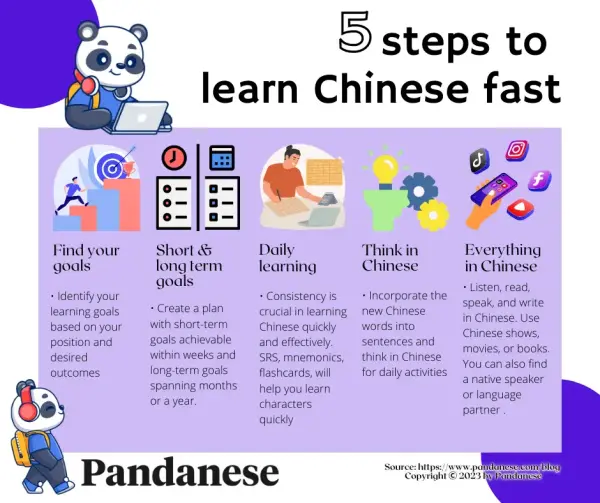
To learn Chinese quickly, start by defining specific goals, such as mastering basic conversations or passing the HSK exam. Create a structured study plan with daily or weekly targets to stay consistent.
- Identify priorities: Focus on essential vocabulary, grammar, or pronunciation first.
- Allocate time: Dedicate at least 30-60 minutes daily to practice.
- Track progress: Use apps or journals to monitor improvements.
Immerse Yourself in the Language
Immersion accelerates learning by exposing you to authentic Chinese daily. Surround yourself with the language through media, music, and real-life practice.
See AlsoHow to find more time to practise Chinese listening- Watch Chinese shows: Use subtitles initially, then gradually remove them.
- Listen to podcasts/music: Improves listening skills and tones.
- Label your environment: Stick notes with Chinese words on objects at home.
Use Effective Learning Tools and Apps
Leverage technology to make learning interactive and efficient. Many apps and tools specialize in teaching Chinese characters, tones, and grammar.
- Anki or Pleco: For flashcards and vocabulary retention.
- HelloTalk or Tandem: Practice with native speakers.
- Duolingo or Memrise: Gamified lessons for beginners.
Master Pronunciation and Tones Early
Mandarin tones are crucial for clear communication. Mispronouncing tones can change meanings entirely, so prioritize tone practice from the start.
- Mimic native speakers: Repeat after audio or video clips.
- Use tone drills: Practice minimal pairs (e.g., mā vs. mà).
- Record yourself: Compare your pronunciation with natives.
Practice Writing and Characters Daily
Learning Chinese characters requires repetition and understanding of radicals. Consistent writing practice helps reinforce memory and recognition.
- Start with radicals: Learn common components of characters.
- Write by hand: Use grid paper to practice stroke order.
- Use spaced repetition: Review characters regularly to avoid forgetting.
What is the fastest way to learn Chinese?
Immerse Yourself in a Chinese-Speaking Environment
The fastest way to learn Chinese is to surround yourself with the language daily. Immersion forces your brain to adapt quickly. Here’s how:
- Live or travel to a Chinese-speaking country to practice constantly.
- Switch your phone, TV, and social media to Mandarin.
- Join language exchange groups or find a native speaker to converse with.
Prioritize High-Frequency Vocabulary and Phrases
Focusing on the most commonly used words accelerates practical communication. Key steps:
- Learn essential phrases like greetings, questions, and daily expressions first.
- Use flashcards or apps like Anki to memorize high-frequency words.
- Practice sentence patterns instead of isolated words for context.
Leverage Technology and Language Apps
Modern tools can streamline your learning process. Effective resources include:
- Apps like Duolingo, HelloChinese, or Pleco for structured lessons.
- YouTube channels or podcasts for listening practice.
- Speech recognition tools to refine pronunciation and tones.
Practice Speaking from Day One
Overcoming the fear of speaking early is crucial. Strategies:
- Repeat aloud dialogues or shadow native speakers.
- Record yourself to identify and correct mistakes.
- Use platforms like iTalki or Tandem for real conversations.
Study Chinese Characters Strategically
Mastering characters efficiently requires a systematic approach:
- Start with radicals (building blocks of characters) to recognize patterns.
- Learn pinyin first to associate sounds with characters.
- Write characters repeatedly using spaced repetition techniques.
Is 2 years enough to learn Chinese?

Can You Become Fluent in Chinese in 2 Years?
Achieving fluency in Chinese within two years is ambitious but possible with intensive study and immersion. Factors like prior language experience, daily practice, and learning methods play a crucial role.
- Daily commitment: Spending 2-3 hours daily on listening, speaking, reading, and writing accelerates progress.
- Immersion: Living in a Chinese-speaking environment or consuming native media (TV, podcasts) enhances comprehension.
- Structured learning: Following a curriculum with textbooks, tutors, or apps (e.g., Pleco, Anki) ensures balanced skill development.
What Level of Chinese Can You Reach in 2 Years?
In two years, a dedicated learner can reach an intermediate to upper-intermediate level (HSK 4-5). Mastery of conversational Chinese and basic literacy is realistic.
- HSK 4: Ability to discuss everyday topics and read simple texts.
- Vocabulary: 1,200-2,500 words, covering common phrases and grammar structures.
- Limitations: Advanced topics or nuanced expressions may still be challenging.
Key Challenges When Learning Chinese in 2 Years
Chinese presents unique hurdles, such as tones, characters, and grammar, which require focused strategies.
- Tones: Mispronunciation can change meanings; consistent practice with native speakers is vital.
- Characters: Memorizing 3,000+ symbols demands spaced repetition and writing drills.
- Grammar: Unlike English, Chinese lacks verb conjugations but uses measure words and word order nuances.
Effective Methods to Learn Chinese Quickly
Maximizing progress in two years requires efficient techniques tailored to Chinese’s complexity.
- Spaced repetition: Tools like Anki reinforce vocabulary and character retention.
- Language exchange: Partnering with native speakers improves fluency and cultural understanding.
- Targeted practice: Focusing on high-frequency words and situational dialogues boosts practicality.
Is 2 Years Enough for Professional Chinese?
While basic professional communication is achievable, specialized fields may require more time.
- Business Chinese: Learning industry-specific terms and formal expressions takes additional effort.
- Networking: Building confidence in meetings or emails often extends beyond two years.
- Certification: Passing exams like HSK 5 or BCT (Business Chinese Test) validates proficiency for careers.
Frequently Asked Questions (FAQ)
What is the best way to start learning Chinese through self-experimentation?
Self-experimentation is a powerful method for learning Chinese because it allows you to tailor your approach based on your personal strengths and weaknesses. Start by setting clear goals, such as mastering basic vocabulary or improving pronunciation. Then, experiment with different techniques, like spaced repetition for memorization or immersion through media. Track your progress and adjust your methods regularly to find what works best for you.
How can I stay motivated while learning Chinese on my own?
Motivation can be challenging when learning independently, but self-experimentation helps by making the process more engaging. Try gamifying your learning with apps or setting small, achievable milestones. Incorporate real-life practice, such as speaking with native speakers or watching Chinese shows. Celebrate your progress, no matter how small, to maintain enthusiasm and commitment.
What are the most effective self-experimentation techniques for mastering Chinese tones?
Tones are a critical aspect of Chinese, and self-experimentation can help you master them. Start by recording yourself and comparing your pronunciation to native speakers. Use tools like pinyin charts with audio or tone-pair drills. Experiment with mnemonic devices or associating tones with visual cues. Regular practice and feedback, even if self-assessed, will improve your tonal accuracy over time.
Can self-experimentation replace traditional Chinese language classes?
While self-experimentation offers flexibility and personalization, it may not completely replace traditional classes, especially for beginners needing structured guidance. However, it can be a highly effective supplement or alternative for intermediate and advanced learners. Combining both approaches—such as taking occasional lessons for feedback while experimenting independently—can provide a balanced and efficient learning experience.
Leave a Reply
Related Posts