
The Basics of Chinese Stroke Order, Explained

Mastering Chinese characters involves more than just memorizing shapes—it requires understanding stroke order, a fundamental aspect of writing correctly and efficiently. Stroke order refers to the sequence and direction in which lines are drawn to form a character, following specific rules that ensure clarity and consistency. Proper stroke order not only improves handwriting but also aids in character recognition and learning efficiency. Whether you're a beginner or refining your skills, grasping these basics is essential for writing Chinese with confidence. This guide breaks down the key principles of stroke order, offering clear explanations and practical tips to help you build a strong foundation in Chinese calligraphy.
The Basics of Chinese Stroke Order, Explained
Why Is Stroke Order Important in Chinese Characters?
Understanding stroke order is crucial for writing Chinese characters correctly and efficiently. Proper stroke order ensures legibility, maintains character balance, and speeds up writing. It also helps when learning calligraphy or using digital input methods like Pinyin or handwriting recognition.
| Reason | Explanation |
|---|---|
| Legibility | Follows traditional writing standards |
| Efficiency | Reduces hand fatigue |
| Digital Input | Improves recognition accuracy |
What Are the Fundamental Stroke Order Rules?
Chinese stroke order follows eight basic rules, such as writing from top to bottom and left to right. These rules create consistency across characters. For example, horizontal strokes (一) usually come before vertical ones (丨).
See AlsoShapeshifting Chinese characters| Rule | Example |
|---|---|
| Top to Bottom | 三 (sān) |
| Left to Right | 明 (míng) |
How Does Stroke Order Affect Character Balance?
Correct stroke order ensures characters look balanced and proportional. For instance, writing the outer frame before inner strokes (like in 国) maintains symmetry. Incorrect order may distort the character’s shape.
| Character | Correct Order |
|---|---|
| 水 (shuǐ) | Center stroke first |
What Are Common Stroke Order Mistakes?
Beginners often reverse stroke directions or missequence complex characters. For example, writing 口 (kǒu) with a single stroke instead of three is incorrect.
| Mistake | Correction |
|---|---|
| Bottom-up strokes | Always top-down |
How Can You Practice Stroke Order Effectively?
Use grid paper or apps like Skritter to drill stroke order. Start with basic characters (e.g., 人, 大) before advancing. Repetition and muscle memory are key.
See AlsoHow I used a notebook to learn more Chinese, and why you should too| Tool | Benefit |
|---|---|
| Tracing sheets | Guides hand movements |
What is the stroke order in Chinese simplified?

Basic Principles of Chinese Stroke Order
The stroke order in Chinese Simplified follows specific rules to ensure correct and efficient writing. Here are the foundational principles:
- Top to bottom: Vertical strokes are written from the top downward.
- Left to right: Horizontal strokes are written from left to right.
- Outside before inside: Enclosing strokes are written before inner components.
Common Stroke Order Mistakes to Avoid
Many learners make errors when writing Chinese characters. Below are frequent mistakes:
See AlsoIs Duolingo Good For Russian: Real Worth & Results Revealed (2025)- Incorrect direction: Writing strokes right-to-left or bottom-to-top.
- Skipping strokes: Omitting minor strokes, altering the character's meaning.
- Mixing stroke types: Confusing horizontal and vertical stroke sequences.
Stroke Order Rules for Compound Characters
For complex characters, stroke order becomes more nuanced. Key guidelines include:
- Component priority: Write the left or top radical first.
- Center before sides: Middle strokes precede flanking ones.
- Closure last: Final enclosing strokes complete the character.
Importance of Stroke Order in Chinese Calligraphy
Stroke order is crucial for aesthetic and practical reasons in calligraphy:
- Consistency: Ensures uniformity in handwriting.
- Speed: Proper order improves writing efficiency.
- Legibility: Correct strokes prevent misreadings.
Tools to Practice Chinese Stroke Order
Several resources help master stroke order in Chinese Simplified:
See AlsoThe importance of counting what counts when learning Chinese- Grid paper: Provides structure for balanced characters.
- Mobile apps: Interactive guides with animations.
- Workbooks: Step-by-step practice for reinforcement.
What are the 8 basic strokes in Chinese?
:max_bytes(150000):strip_icc()/625px-8_Strokes_of_Han_Characters.svg-56a5e0065f9b58b7d0dedaa0.png)
The 8 Basic Strokes in Chinese Calligraphy
The 8 basic strokes in Chinese calligraphy form the foundation for writing Chinese characters. These strokes are essential for mastering both handwriting and artistic calligraphy. Below is a detailed breakdown:
- Dot (点, Diǎn): A small, downward or sideways press of the brush.
- Horizontal (横, Héng): A straight line drawn from left to right.
- Vertical (竖, Shù): A straight line drawn from top to bottom.
- Hook (钩, Gōu): A small upward flick at the end of another stroke.
- Rising (提, Tí): A short, upward diagonal stroke.
- Left Falling (撇, Piě): A sweeping stroke from top-right to bottom-left.
- Right Falling (捺, Nà): A sweeping stroke from top-left to bottom-right.
- Turning (折, Zhé): A stroke that changes direction sharply, combining two strokes.
Understanding the Dot (点, Diǎn) Stroke
The Dot stroke is one of the simplest yet most versatile strokes in Chinese calligraphy. It can vary in shape and direction depending on the character. Key features include:
See AlsoDuolingo Leaderboard: Compete & Track Your Language Progress- Often used to represent small details or accents.
- Can be written with a quick press or a slight drag.
- Appears in characters like 心 (xīn, heart) and 火 (huǒ, fire).
Mastering the Horizontal (横, Héng) Stroke
The Horizontal stroke is fundamental for creating balance in Chinese characters. It is typically written from left to right with a steady hand. Important aspects:
- Must be straight and even in thickness.
- Often serves as the base for other strokes.
- Found in characters like 一 (yī, one) and 天 (tiān, sky).
The Importance of the Vertical (竖, Shù) Stroke
The Vertical stroke provides structure and stability to Chinese characters. It is drawn from top to bottom without wavering. Key points:
- Can be short or long, depending on the character.
- Often paired with horizontal strokes for balance.
- Appears in characters like 十 (shí, ten) and 中 (zhōng, middle).
Exploring the Hook (钩, Gōu) Stroke
The Hook stroke adds a dynamic finish to other strokes, often appearing at the end of vertical or horizontal lines. Characteristics include:
- A small, sharp upward flick.
- Enhances the flow and energy of the character.
- Seen in characters like 小 (xiǎo, small) and 水 (shuǐ, water).
The Role of the Turning (折, Zhé) Stroke
The Turning stroke combines two strokes into one, creating a sharp change in direction. It is crucial for complex characters. Details:
- Requires precise control to maintain clarity.
- Often used in characters with angular shapes.
- Examples include 口 (kǒu, mouth) and 日 (rì, sun).
Why does Chinese stroke order matter?
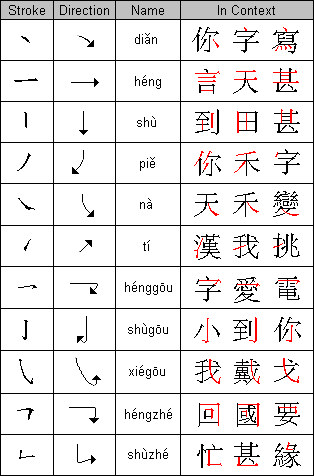
The Importance of Stroke Order in Chinese Writing
Stroke order is a fundamental aspect of writing Chinese characters correctly and efficiently. It ensures consistency, legibility, and speed when writing by hand. Following the proper stroke order helps learners memorize characters more effectively and write them more naturally. Additionally, it plays a crucial role in maintaining the aesthetic balance of the characters.
- Consistency: Standardized stroke order allows everyone to write characters uniformly, making them recognizable.
- Legibility: Correct strokes prevent messy or unclear handwriting, ensuring others can read your writing.
- Efficiency: Proper stroke order enables faster and smoother writing, reducing hand fatigue.
How Stroke Order Affects Character Recognition
Using the correct stroke order is essential for both human readers and digital input methods. Many handwriting recognition systems rely on stroke order to accurately identify characters. Deviating from the standard order can lead to misinterpretation or errors in digital applications.
- Handwriting Recognition: Input methods like Pinyin or handwriting apps depend on correct stroke sequences.
- Learning Efficiency: Knowing the right order helps learners distinguish similar-looking characters.
- Cultural Preservation: Maintaining traditional stroke order respects historical writing conventions.
The Role of Stroke Order in Calligraphy
In Chinese calligraphy, stroke order is not just functional but also artistic. Proper strokes contribute to the flow, balance, and beauty of the written character. Calligraphers emphasize stroke order to achieve harmony and expressiveness in their work.
- Artistic Flow: Correct strokes create smooth, connected lines that enhance visual appeal.
- Structural Balance: Following order ensures characters are proportionally balanced.
- Tradition: Calligraphy masters adhere to stroke order to preserve classical techniques.
Common Mistakes in Stroke Order and How to Avoid Them
Many learners make errors in stroke order, such as writing strokes out of sequence or skipping essential steps. Recognizing and correcting these mistakes early improves writing accuracy and fluency.
- Top-to-Bottom Rule: Always start from the top before moving downward.
- Left-to-Right Rule: Horizontal strokes should be written from left to right.
- Enclosures First: Draw the outer frame before filling in internal strokes.
Stroke Order and Muscle Memory in Learning Chinese
Mastering stroke order helps develop muscle memory, making writing more intuitive over time. Repeated practice reinforces the correct sequence, allowing learners to write characters effortlessly.
- Repetition: Practicing strokes in order trains the hand to move naturally.
- Speed: Muscle memory enables faster writing without conscious effort.
- Retention: Proper stroke order aids in long-term memorization of characters.
What are the essential stroke rules order in Mandarin?
Basic Stroke Order Principles in Mandarin
The essential stroke rules in Mandarin follow a logical sequence to ensure characters are written correctly and efficiently. Here are the foundational principles:
- Top to bottom: Strokes are written from the top of the character downward.
- Left to right: Horizontal strokes are written from left to right.
- Horizontal before vertical: When strokes cross, horizontal ones are written first.
Stroke Order for Enclosed Characters
Enclosed or boxed characters require specific rules to maintain structure:
- Outside first: Draw the enclosing frame before adding inner strokes.
- Close the box last: Complete the bottom stroke of the enclosure after filling the interior.
- Exceptions apply: Some characters (e.g., 日) prioritize inner strokes before closing.
Diagonal and Symmetrical Strokes
Characters with diagonal or symmetrical strokes follow these guidelines:
- Left-falling before right-falling: Strokes like 丿 (piě) come before 乀 (nà).
- Center before wings: Middle strokes are written first in symmetrical characters (e.g., 小).
- Crossing diagonals last: Intersecting strokes are finalized after primary lines.
Compound Stroke Order Rules
For compound characters (multiple components), the order is:
- Left component first: Write the radical or left side before the right.
- Top component first: Upper sections precede lower ones.
- Largest part last: Dominant components are completed after smaller details.
Exceptions and Special Cases
Some characters defy standard rules due to historical or structural reasons:
- Dot strokes last: Dots (e.g., in 玉) are often written after main strokes.
- Bottom-line priority: Characters like 走 (zǒu) emphasize the base stroke early.
- Memorization required: Irregular characters (e.g., 必) must be learned individually.
Frequently Asked Questions (FAQ)
Why is stroke order important in Chinese characters?
Stroke order is a fundamental aspect of writing Chinese characters because it ensures consistency, legibility, and efficiency. Following the correct sequence helps learners memorize characters more effectively and write them more fluidly. Additionally, proper stroke order is essential for calligraphy and digital input methods, as some systems rely on stroke patterns to recognize characters.
What are the basic rules of Chinese stroke order?
The basic rules of Chinese stroke order include writing from top to bottom, left to right, and horizontal before vertical. Other key principles involve completing enclosures before filling in the inside and closing them last, as well as prioritizing diagonal strokes in specific directions. Mastering these rules ensures characters look balanced and are written correctly.
How does stroke order affect handwriting speed?
Adhering to proper stroke order significantly improves handwriting speed over time. While it may feel slow initially, the logical progression of strokes allows for smoother, more natural movements. Experienced writers develop muscle memory, enabling them to write quickly without sacrificing accuracy or readability.
Can incorrect stroke order lead to misunderstandings?
While incorrect stroke order may not always cause misunderstandings in meaning, it can make characters appear distorted or unrecognizable, especially in handwriting. In some cases, deviations from standard stroke order may confuse learners or automated systems, such as those used in OCR technology or handwriting recognition software.
Leave a Reply
Related Posts