
Online Resources for Learning Chinese

Learning Chinese has never been more accessible, thanks to the wealth of online resources available today. Whether you're a beginner or an advanced learner, digital tools offer flexible and interactive ways to master Mandarin. From language apps like Duolingo and HelloChinese to comprehensive platforms such as Coursera and edX, there are options for every learning style. YouTube channels, podcasts, and virtual tutors provide additional support, while flashcards and grammar guides help reinforce key concepts. With the convenience of learning anytime, anywhere, these resources make it easier than ever to achieve fluency. Explore the best online tools to start or enhance your Chinese language journey today.
- Best Online Resources for Learning Chinese Effectively
- What is the best resource to learn Chinese?
- How can I learn Chinese by myself?
- What is the best way to learn Chinese quickly?
-
Is rosetta stone good for learning Mandarin?
- Does Rosetta Stone Provide Effective Mandarin Pronunciation Practice?
- How Comprehensive Is Rosetta Stone’s Mandarin Vocabulary?
- Is Rosetta Stone’s Approach to Mandarin Grammar Effective?
- Does Rosetta Stone Offer Real-Life Mandarin Conversation Practice?
- Is Rosetta Stone Worth the Cost for Learning Mandarin?
- Frequently Asked Questions (FAQ)
Best Online Resources for Learning Chinese Effectively
Learning Chinese has become more accessible than ever thanks to a wide range of online resources designed for different proficiency levels. Whether you're a beginner or an advanced learner, these tools offer interactive lessons, vocabulary builders, and cultural insights to enhance your language skills. Below, we explore some of the most effective platforms and methods for mastering Chinese online.
1. Interactive Language Learning Platforms
These platforms provide structured courses with gamified lessons to make learning engaging. Many include speech recognition to improve pronunciation and progress tracking to monitor improvement.
See AlsoMaking progress in Chinese in spite of praise| Platform | Key Features |
|---|---|
| Duolingo | Gamified lessons, bite-sized exercises |
| Rosetta Stone | Immersive learning, speech recognition |
| Memrise | User-generated content, video clips |
2. Chinese Video Lessons and YouTube Channels
Video-based learning is excellent for visual and auditory learners. Many YouTube channels offer free lessons, covering grammar, vocabulary, and cultural tips.
| Channel | Focus Area |
|---|---|
| ChinesePod | Conversational Chinese, real-life scenarios |
| Yoyo Chinese | Structured courses, pronunciation guides |
| Learn Chinese with Emma | Beginner-friendly, cultural insights |
3. Mobile Apps for Learning Chinese On-the-Go
Mobile apps allow learners to practice anytime, anywhere. Many include flashcards, quizzes, and offline modes for convenience.
| App | Best For |
|---|---|
| HelloChinese | Interactive exercises, handwriting practice |
| Pleco | Dictionary, OCR text recognition |
| Anki | Custom flashcards, spaced repetition |
4. Online Tutors and Language Exchange Platforms
Practicing with native speakers accelerates learning. Platforms like iTalki and Tandem connect learners with tutors and language partners for real-time practice.
See AlsoFocusing on Chinese tones without being distracted by Pinyin| Platform | Features |
|---|---|
| iTalki | Professional tutors, flexible scheduling |
| Tandem | Language exchange, text/voice chat |
| Preply | Personalized lessons, tutor reviews |
5. Chinese Learning Websites with Free Resources
Several websites offer free study materials, including worksheets, grammar guides, and listening exercises for self-paced learning.
| Website | Resources |
|---|---|
| ChineseGrammarWiki | Detailed grammar explanations |
| HSK Online | Exam preparation, mock tests |
| The Chairman's Bao | News articles, graded readers |
What is the best resource to learn Chinese?

Best Online Platforms for Learning Chinese
Online platforms offer flexibility and structured lessons for learning Chinese. Here are the top choices:
See AlsoCan I Learn Chinese by Playing the Genshin Impact Game?- Duolingo: Gamified lessons for beginners, focusing on vocabulary and basic grammar.
- HelloChinese: Interactive app with speech recognition for pronunciation practice.
- ChineseClass101: Audio and video lessons covering all proficiency levels.
Best Books for Learning Chinese
Books provide in-depth explanations and systematic learning. Recommended options include:
- Integrated Chinese: A comprehensive textbook series used in universities.
- HSK Standard Course: Aligned with the HSK exam, ideal for test preparation.
- Practical Audio-Visual Chinese: Focuses on real-life conversations and listening skills.
Best YouTube Channels for Learning Chinese
YouTube offers free and engaging content for learners. Top channels are:
- Yoyo Chinese: Clear explanations and practical phrases for daily use.
- Mandarin Corner: In-depth grammar breakdowns and cultural insights.
- Learn Chinese with Emma: Beginner-friendly lessons with pronunciation guides.
Best Language Exchange Platforms for Chinese
Practicing with native speakers accelerates fluency. The best platforms include:
See AlsoHow long have you studied Chinese?- Tandem: Connects learners with native speakers for text, voice, and video chats.
- HelloTalk: Language exchange app with correction features and translation tools.
- italki: Offers both professional tutors and community language partners.
Best Podcasts for Learning Chinese
Podcasts are great for listening practice and learning on the go. Top recommendations:
- ChinesePod: Lessons for all levels, from beginner to advanced.
- Slow Chinese: News and stories spoken slowly for comprehension.
- Learn Mandarin Daily: Short episodes focusing on practical vocabulary.
How can I learn Chinese by myself?
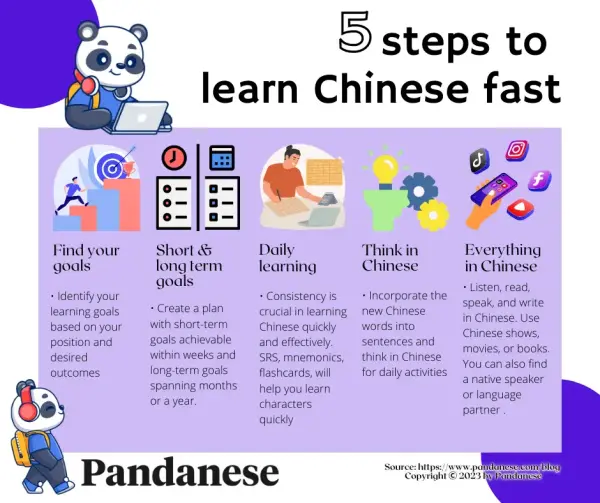
1. Start with the Basics: Pinyin and Tones
To learn Chinese effectively, begin with Pinyin, the romanization system for Mandarin. Mastering tones is crucial because they change word meanings. Here’s how to approach it:
See AlsoBeing a Vegetarian in China- Use apps like HelloChinese or Pleco to practice pronunciation and tones.
- Listen to native speakers on platforms like YouTube or ChinesePod to mimic sounds.
- Record yourself and compare with native audio to identify improvements.
2. Build a Strong Vocabulary Foundation
Expanding your vocabulary is key to understanding and speaking Chinese. Focus on high-frequency words first:
- Learn HSK-level words (start with HSK 1) using flashcards like Anki.
- Label everyday objects with their Chinese names to reinforce memory.
- Use spaced repetition systems (SRS) to retain words long-term.
3. Practice Listening and Speaking Daily
Immersion accelerates learning. Prioritize listening and speaking to develop fluency:
- Watch Chinese dramas or movies with subtitles to train your ear.
- Join language exchange platforms like Tandem or HelloTalk to converse with natives.
- Repeat dialogues from podcasts or audiobooks to improve pronunciation.
4. Learn Chinese Characters Step by Step
Characters are challenging but essential. Break them down systematically:
- Start with radicals (building blocks of characters) to recognize patterns.
- Practice writing characters using grids and apps like Skritter.
- Focus on common characters first (e.g., 你, 好) before complex ones.
5. Use Structured Self-Study Resources
Consistency is easier with a structured plan. Leverage these tools:
- Follow textbooks like Integrated Chinese or New Practical Chinese Reader.
- Set daily goals (e.g., 10 new words, 1 grammar point) using a study planner.
- Track progress with apps like Duolingo or Memrise.
What is the best way to learn Chinese quickly?
Immerse Yourself in the Language
To learn Chinese quickly, immersion is key. Surround yourself with the language as much as possible to accelerate comprehension and fluency. Here’s how:
- Watch Chinese media like movies, TV shows, or news with subtitles to improve listening skills.
- Listen to Chinese music or podcasts daily to train your ear to tones and pronunciation.
- Change your device language to Chinese to familiarize yourself with common vocabulary.
Practice Speaking Daily
Speaking is crucial for mastering Chinese, especially due to its tonal nature. Consistent practice helps reinforce memory and confidence.
- Find a language partner or tutor for regular conversation practice.
- Repeat phrases aloud to perfect tones and pronunciation.
- Use language exchange apps like Tandem or HelloTalk to connect with native speakers.
Master Pinyin and Tones Early
Understanding Pinyin (Romanization of Chinese characters) and the four tones is foundational for accurate pronunciation.
- Study tone pairs to grasp how tones change in context.
- Use flashcards with audio to associate sounds with characters.
- Practice with tongue twisters to improve tonal clarity and speed.
Learn High-Frequency Vocabulary First
Focusing on high-frequency words ensures you can communicate effectively early on.
- Prioritize common phrases like greetings, questions, and daily expressions.
- Use spaced repetition systems (SRS) like Anki to retain vocabulary long-term.
- Label objects in your home with their Chinese names for visual reinforcement.
Leverage Structured Learning Resources
Combining structured courses with self-study maximizes efficiency.
- Enroll in a course (online or in-person) for guided lessons.
- Follow a textbook like Integrated Chinese for systematic learning.
- Track progress with apps like Duolingo or Skritter for consistent practice.
Is rosetta stone good for learning Mandarin?

Does Rosetta Stone Provide Effective Mandarin Pronunciation Practice?
Rosetta Stone uses speech recognition technology to help learners practice Mandarin pronunciation. However, it may not fully capture the nuances of tones, which are critical in Mandarin. Here’s why:
- Tonal accuracy is challenging to master without human feedback, and Rosetta Stone’s system may not correct subtle errors.
- The platform focuses on repetition, which helps build muscle memory but lacks contextual tone practice.
- Compared to native speaker interaction, the feedback is limited, making it less ideal for advanced learners.
How Comprehensive Is Rosetta Stone’s Mandarin Vocabulary?
Rosetta Stone covers basic to intermediate vocabulary but lacks specialized or advanced terms. Key points include:
- The program teaches everyday phrases and common words, suitable for beginners.
- It misses cultural context, such as idioms or slang, which are vital for fluency.
- Vocabulary progression is structured, but learners may need supplemental resources for depth.
Is Rosetta Stone’s Approach to Mandarin Grammar Effective?
Rosetta Stone uses an immersive method, teaching grammar intuitively rather than through explicit rules. Considerations:
- This approach helps learners absorb patterns naturally, similar to how children learn.
- However, those who prefer rule-based explanations may find it frustrating.
- Complex grammar topics, like particles or sentence structures, aren’t deeply explained.
Does Rosetta Stone Offer Real-Life Mandarin Conversation Practice?
While Rosetta Stone includes simulated dialogues, it falls short in real-world interaction. Key limitations:
- Dialogue exercises are scripted, lacking spontaneity.
- No live conversation feature with native speakers is available.
- Learners may struggle to apply skills in unpredictable social settings.
Is Rosetta Stone Worth the Cost for Learning Mandarin?
Rosetta Stone’s pricing may not justify its limited advanced content. Factors to weigh:
- It’s expensive compared to alternatives like apps with native tutor access.
- The subscription model requires long-term commitment for full benefits.
- Better for beginners, but serious learners might need additional tools.
Frequently Asked Questions (FAQ)
What are the best online resources for learning Chinese?
Online platforms like Duolingo, HelloChinese, and ChineseClass101 are excellent for beginners. These apps offer interactive lessons, vocabulary drills, and pronunciation practice. For more advanced learners, websites like Yabla and FluentU provide immersive content with real-world videos and subtitles. Additionally, YouTube channels such as Learn Chinese with Emma and Mandarin Corner offer free tutorials on grammar and culture.
Are there free online resources for learning Chinese?
Yes, many free resources are available. Duolingo and Memrise offer free versions with basic lessons. Websites like ChineseGrammarWiki and AllSet Learning provide detailed explanations of grammar rules at no cost. For listening practice, Podcasts like ChinesePod (free episodes) and YouTube channels are invaluable. Libraries and universities also sometimes offer open-access courses for self-study.
How can I practice speaking Chinese online?
To improve speaking skills, use platforms like italki or Preply, where you can book sessions with native tutors. Language exchange apps such as Tandem and HelloTalk connect learners with Chinese speakers for mutual practice. Additionally, speech recognition tools in apps like HelloChinese or Pinyin Trainer help refine pronunciation. Joining online communities or Discord servers focused on Chinese learning can also provide speaking opportunities.
What online resources help with learning Chinese characters?
For mastering Chinese characters, apps like Skritter and Anki (with custom decks) are highly effective for memorization and stroke order. Websites like Arch Chinese and Hanzi Grids offer printable worksheets and writing practice. Tools such as Pleco (a dictionary app) include flashcards and character breakdowns. For context-based learning, platforms like The Chairman's Bao provide graded news articles with pinyin and translations.
Leave a Reply
Related Posts