
How narrow reading and listening can help you bridge the gap to real Chinese

Learning Chinese can feel overwhelming, but narrowing your focus might be the key to success. Narrow reading and listening—engaging deeply with a limited range of topics—helps build comprehension and fluency faster. By repeatedly encountering similar vocabulary and structures, your brain absorbs patterns naturally, bridging the gap between textbook learning and real-world Chinese. Whether it’s watching the same genre of shows, reading articles on familiar subjects, or listening to podcasts about a specific interest, this targeted approach reduces cognitive load and boosts retention. Over time, the repetition builds confidence, making authentic conversations and materials more accessible. Discover how this method can transform your Chinese learning journey.
- How Narrow Reading and Listening Can Help You Bridge the Gap to Real Chinese
- Can you learn Chinese by reading?
- How to revise for Mandarin reading?
- How to study for Chinese reading comprehension?
-
Frequently Asked Questions (FAQ)
- What is narrow reading and listening in the context of learning Chinese?
- How does narrow reading and listening improve comprehension skills in Chinese?
- Can narrow reading and listening help with speaking and writing in Chinese?
- What types of materials are best for narrow reading and listening in Chinese?
How Narrow Reading and Listening Can Help You Bridge the Gap to Real Chinese
1. What Is Narrow Reading and Listening?
Narrow reading and listening involve focusing on a specific topic, genre, or author in your target language—Chinese, in this case. Instead of jumping between unrelated materials, you immerse yourself in similar content repeatedly. This method helps reinforce vocabulary, grammar, and cultural nuances, making it easier to transition from textbook Chinese to real-world usage.
| Key Benefit | Deepens familiarity with context-specific language |
| Example | Reading 10 articles about Chinese cuisine |
---
See AlsoHow to talk about Chinese characters in Chinese2. Why Narrow Input Builds Natural Fluency
By limiting scope, you encounter the same words and structures frequently, which accelerates retention. Unlike scattered learning, narrow input mimics how native speakers absorb language—through repetition in meaningful contexts. Studies show this approach improves comprehension and recall faster than varied but shallow exposure.
| Key Benefit | Enhances retention of high-frequency phrases |
| Example | Listening to multiple podcasts on Chinese history |
---
3. How to Choose Materials for Narrow Learning
Select content that aligns with your interests and proficiency level. For beginners, opt for graded readers or slow-paced podcasts. Intermediate learners might pick a single book series or a YouTube channel on one theme. Advanced learners can dive into news archives or specialized forums.
See AlsoHow to Say the Days of the Week in Chinese| Key Tip | Prioritize materials with transcripts or subtitles |
| Example | Choosing The Journey to the West audiobooks |
---
4. The Role of Repetition in Mastering Chinese
Revisiting the same material multiple times ingrains tones, collocations, and grammar patterns. For instance, rewatching a TV episode with Chinese subtitles helps you notice details missed initially. Repetition bridges the gap between passive understanding and active use.
| Key Benefit | Strengthens neural connections for language retrieval |
| Example | Re-reading a short story until it feels effortless |
---
See AlsoThree ways to improve the way you review Chinese characters5. Measuring Progress with Narrow Techniques
Track improvements by noting increased comprehension speed and fewer lookups. Create a log of mastered vocabulary from your focused materials. Over time, you’ll recognize patterns that signal readiness to expand to slightly broader content.
| Key Metric | Reduction in reliance on translations |
| Example | Understanding 90% of a podcast without pauses |
Can you learn Chinese by reading?
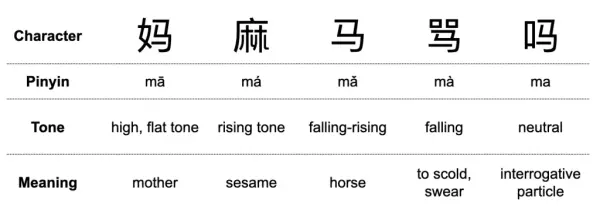
The Role of Reading in Learning Chinese
Reading is a powerful tool for learning Chinese, as it exposes learners to vocabulary, grammar, and sentence structures in context. However, it should be combined with other methods for balanced proficiency.
See AlsoGet to know your Chinese voice to level up your speaking ability- Vocabulary acquisition: Reading helps learners encounter new words repeatedly, reinforcing memory.
- Grammar understanding: Seeing grammar rules applied in texts clarifies their usage.
- Cultural context: Reading materials often include cultural nuances, aiding comprehension.
Types of Chinese Texts for Beginners
Beginners should start with simplified materials to build confidence and avoid frustration.
- Children's books: Use basic vocabulary and repetitive structures.
- Graded readers: Designed for learners, with controlled difficulty levels.
- Bilingual books: Provide translations for easier understanding.
Challenges of Learning Chinese Through Reading
While beneficial, reading alone presents limitations in mastering Chinese.
- Characters complexity: Memorizing thousands of characters is daunting without practice.
- Lack of pronunciation: Reading doesn’t teach tones or spoken fluency.
- Context gaps: Some idioms or phrases require additional explanation.
Supplemental Tools to Enhance Reading-Based Learning
To maximize effectiveness, combine reading with other resources.
See AlsoHow to create mnemonics for general or abstract character components- Pinyin guides: Help associate characters with pronunciation.
- Audio companions: Improve listening and tone recognition.
- Flashcards: Reinforce character and word retention.
Advanced Reading Strategies for Chinese Learners
Intermediate and advanced learners can use complex texts to refine skills.
- News articles: Offer contemporary vocabulary and formal grammar.
- Literature: Exposes learners to advanced syntax and cultural depth.
- Technical texts: Specialized vocabulary for professional or academic goals.
How to revise for Mandarin reading?
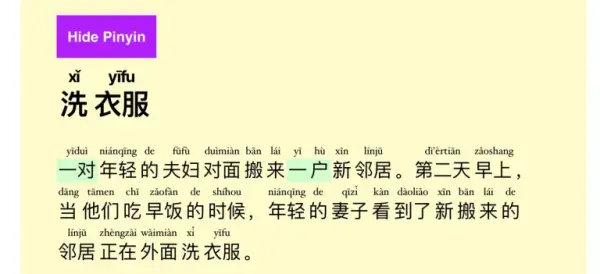
Build a Strong Vocabulary Foundation
To improve your Mandarin reading skills, start by expanding your vocabulary. Focus on high-frequency words and characters commonly used in texts.
- Flashcards: Use apps like Anki or Pleco to memorize characters and their meanings.
- Word Lists: Study HSK vocabulary lists relevant to your proficiency level.
- Contextual Learning: Learn words through sentences or short passages to understand usage.
Practice with Graded Readers
Graded readers are excellent tools for structured learning, as they adapt to your skill level.
- Beginner-Friendly: Choose books labeled for your HSK level (e.g., HSK 1-2 for beginners).
- Repetition: Re-read passages to reinforce comprehension and character recognition.
- Audio Support: Use readers with audio to improve both reading and listening skills.
Analyze Short Texts and Articles
Breaking down short texts helps you understand sentence structure and common phrases.
- News Apps: Read simplified articles from apps like The Chairman’s Bao or Du Chinese.
- Highlight Key Patterns: Note recurring grammar structures or idioms.
- Summarize: Write a brief summary in Mandarin to test comprehension.
Use Annotations and Translation Tools
Annotating texts and leveraging translation tools can clarify difficult passages.
- Pleco’s OCR: Scan characters you don’t recognize for instant translations.
- Margin Notes: Jot down pinyin or English meanings next to unfamiliar words.
- Compare Translations: Check professional translations to verify your understanding.
Take Mock Reading Tests
Simulate exam conditions with mock tests to identify weaknesses and track progress.
- Timed Practice: Complete past HSK reading sections under time constraints.
- Error Review: Analyze mistakes to focus on problem areas (e.g., confusing characters).
- Diverse Materials: Use a mix of formal tests and informal reading exercises.
How to study for Chinese reading comprehension?
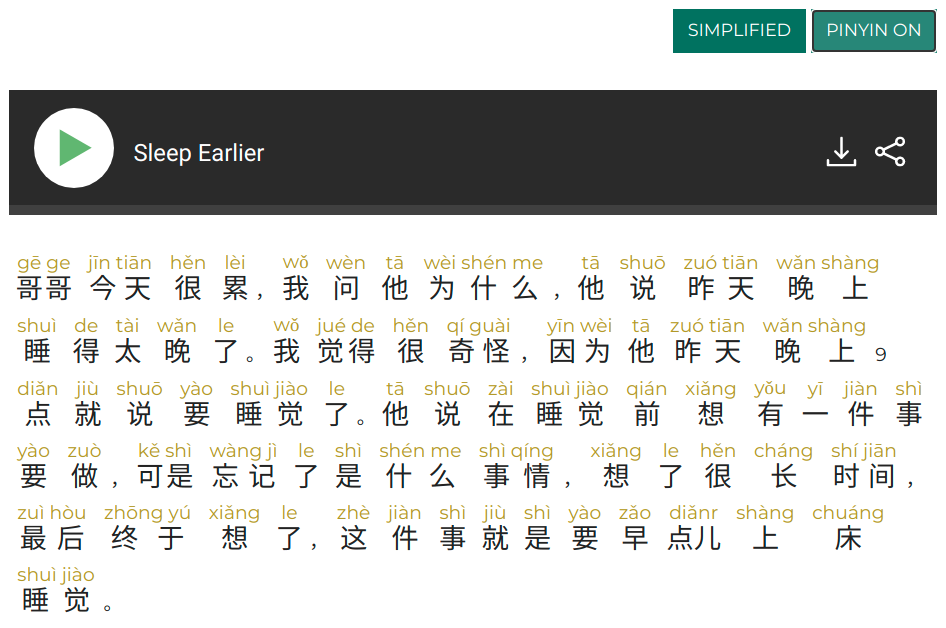
Build a Strong Vocabulary Foundation
To excel in Chinese reading comprehension, you must first develop a robust vocabulary. Focus on learning high-frequency words and characters commonly used in texts. Use flashcards, apps, or spaced repetition systems (SRS) to reinforce retention. Additionally, practice reading simple texts to encounter these words in context.
- Learn radicals and components to decode unfamiliar characters.
- Use context clues to infer meanings of unknown words.
- Review vocabulary daily to ensure long-term retention.
Practice with Graded Readers
Graded readers are excellent tools for improving reading comprehension as they are tailored to different proficiency levels. Start with beginner-level books and gradually progress to more complex texts. Pay attention to sentence structures and common phrases.
- Choose books with pinyin and English translations initially.
- Highlight and note down new vocabulary while reading.
- Re-read passages to improve fluency and understanding.
Analyze Sentence Structure and Grammar
Understanding Chinese grammar and sentence patterns is crucial for comprehension. Break down sentences into subject-verb-object components and identify modifiers. Practice parsing longer sentences to grasp their meaning.
- Study common grammar patterns like 把 (bǎ) and 被 (bèi) constructions.
- Pay attention to particles like 了 (le), 的 (de), and 地 (de).
- Practice rewriting sentences to reinforce understanding.
Engage with Authentic Materials
Expose yourself to authentic Chinese texts such as news articles, blogs, or short stories. These materials reflect real-world language usage and help you adapt to different writing styles and topics.
- Read Chinese news from sources like BBC Chinese or Xinhua.
- Follow social media accounts or forums in Chinese.
- Summarize passages in your own words to test comprehension.
Take Mock Tests and Review Mistakes
Simulate exam conditions by taking practice tests to assess your progress. Analyze incorrect answers to identify weak areas and adjust your study plan accordingly.
- Time yourself to improve reading speed and accuracy.
- Review answer explanations to understand errors.
- Focus on recurring mistakes and target those areas in study sessions.
Frequently Asked Questions (FAQ)
What is narrow reading and listening in the context of learning Chinese?
Narrow reading and listening is a focused language learning technique where you engage with content that revolves around a specific topic, uses repetitive vocabulary, or comes from a single source. For Chinese learners, this means selecting materials like articles, podcasts, or videos that share common themes or language patterns. By limiting the scope, you reduce cognitive overload and reinforce high-frequency words and phrases, making it easier to internalize them. This method bridges the gap to real Chinese by building familiarity with natural language use in a controlled way.
How does narrow reading and listening improve comprehension skills in Chinese?
When you focus on a narrow range of content, your brain spends less energy deciphering new contexts and more on recognizing patterns. For example, reading multiple articles about food in Chinese exposes you to recurring terms like 味道 (taste) or 烹饪 (cooking). Over time, this repetition enhances your reading fluency and listening accuracy. Since the vocabulary and structures are recycled, you gain confidence in understanding authentic materials, moving you closer to real-world Chinese proficiency.
Can narrow reading and listening help with speaking and writing in Chinese?
Absolutely! By immersing yourself in themed content, you absorb not just words but also grammatical structures and collocations native speakers use. For instance, listening to several dialogues about travel will familiarize you with phrases like 订机票 (book a flight) or 打包行李 (pack luggage). This input naturally translates into output—when you speak or write, you’ll draw from these memorized chunks, making your Chinese sound more natural and idiomatic.
What types of materials are best for narrow reading and listening in Chinese?
Choose materials that align with your interests and proficiency level. Beginners might start with children’s stories or graded readers on a single topic, while intermediate learners could explore news segments or YouTube channels dedicated to one subject (e.g., tech reviews). Advanced learners benefit from novels by the same author or podcast series with a consistent host. The key is consistency—sticking to a narrow scope long enough to see tangible progress in your Chinese skills.
Leave a Reply
Related Posts