
Using the HSK as a roadmap to learning Chinese

Learning Chinese can seem daunting, but the Hanyu Shuiping Kaoshi (HSK) provides a clear and structured path to proficiency. As China's standardized Mandarin test for non-native speakers, the HSK divides language learning into six levels, each with defined vocabulary and grammar goals. By using the HSK as a roadmap, learners can track progress, set achievable milestones, and stay motivated. The exam’s tiered system ensures a gradual buildup of skills, from basic communication to advanced fluency. Whether for academic, professional, or personal growth, aligning studies with HSK standards offers a practical and efficient way to master Chinese while building confidence at every stage.
Using the HSK as a Roadmap to Learning Chinese
Detailed Explanation:
The HSK (Hanyu Shuiping Kaoshi) is China's standardized test for non-native speakers to assess their Chinese proficiency. It consists of six levels, from HSK 1 (beginner) to HSK 6 (advanced), each targeting specific vocabulary, grammar, and communication skills. Using the HSK as a roadmap provides a structured approach to learning Mandarin, ensuring gradual progression while covering essential language components. This system helps learners set clear goals, track progress, and prepare for real-world language use or academic requirements.
---
See AlsoNew HSK Exam (Explained For 2025)Understanding the HSK Exam Structure
Detailed Explanation:
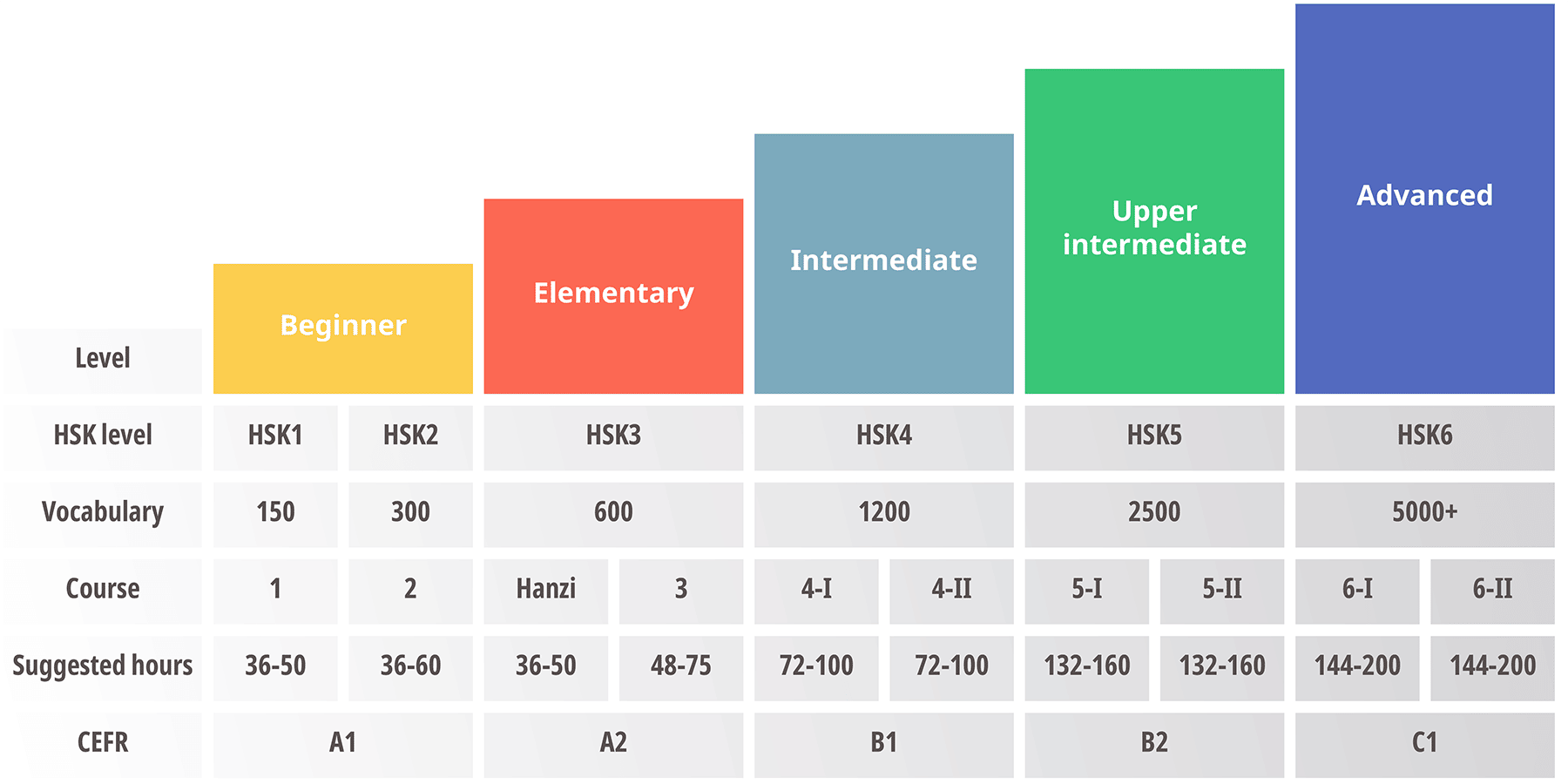
The HSK exam is divided into two main sections: listening and reading (all levels), with writing introduced from HSK 3 onwards. Each level increases in complexity:
- HSK 1-2: Basic sentences, 150-300 words.
- HSK 3-4: Paragraphs, 600-1,200 words.
- HSK 5-6: Essays, 2,500-5,000 words.
| HSK Level | Vocabulary | Skills Tested |
|---|---|---|
| HSK 1 | 150 words | Basic phrases |
| HSK 2 | 300 words | Daily conversations |
| HSK 3 | 600 words | Simple writing |
| HSK 4 | 1,200 words | Debates |
| HSK 5 | 2,500 words | News/articles |
| HSK 6 | 5,000 words | Academic texts |
---
How to Use HSK Vocabulary Lists Effectively
Detailed Explanation:
The HSK vocabulary lists are curated to match each level’s requirements. To maximize retention:
- Group words by themes (e.g., food, travel).
- Use flashcards (Anki, Pleco) for spaced repetition.
- Practice in context (sentences/dialogues).
| Method | Benefit |
|---|---|
| Thematic grouping | Improves recall |
| Flashcards | Boosts long-term memory |
| Contextual practice | Enhances usage |
---
Incorporating HSK Grammar into Daily Practice
Detailed Explanation:
Each HSK level introduces grammar patterns progressively. For example:
- HSK 1: 是 (shì) for to be.
- HSK 3: 因为...所以 (yīnwèi...suǒyǐ) for because...therefore.
- HSK 5: Passive voice with 被 (bèi).
| Level | Grammar Focus |
|---|---|
| HSK 1-2 | Basic sentence structure |
| HSK 3-4 | Compound sentences |
| HSK 5-6 | Advanced connectors |
---
See AlsoDo Chinese Speakers Suffer from Character Amnesia? And Other Random Questions About Chinese LanguageSetting Realistic Goals with HSK Milestones
Detailed Explanation:
Break down learning into achievable targets:
- HSK 1-2: 3-6 months (casual study).
- HSK 3-4: 6-12 months (regular practice).
- HSK 5-6: 1-2 years (intensive study).
| Goal | Timeframe |
|---|---|
| Basic fluency (HSK 3) | 6-12 months |
| Intermediate (HSK 4) | 1 year |
| Advanced (HSK 6) | 2+ years |
---
Resources to Prepare for the HSK Exam
Detailed Explanation:
Key study materials include:
- Official HSK textbooks (e.g., Hanban).
- Mock tests (past papers).
- Apps like HelloChinese, SuperTest.
| Resource | Purpose |
|---|---|
| Textbooks | Structured lessons |
| Mock tests | Exam simulation |
| Apps | Interactive practice |
Are the HSK books good for learning Chinese?

Are HSK Books Effective for Structured Learning?
The HSK books are designed to align with the official HSK exam levels, making them highly effective for structured learning. They provide a clear progression from beginner to advanced levels, ensuring learners build a solid foundation.
- Systematic approach: The books follow the HSK curriculum, covering vocabulary, grammar, and exercises in a logical sequence.
- Exam-focused: They include practice tests and sample questions, which are essential for those preparing for the HSK exam.
- Comprehensive content: Each level introduces new characters, words, and grammar points progressively.
Do HSK Books Cover Practical Vocabulary?
The vocabulary in HSK books is tailored to the exam but also includes practical words and phrases used in daily life. However, some learners may find gaps in colloquial or specialized terms.
- HSK-aligned words: Focuses on the most frequently used characters and phrases in Mandarin.
- Limited slang: Does not heavily include informal or regional expressions.
- Contextual usage: Provides examples of how words are used in sentences, aiding retention.
Are HSK Books Suitable for Self-Study?
HSK books can be used for self-study, but they work best when supplemented with additional resources like audio materials or a tutor.
- Clear explanations: Grammar and vocabulary are explained in a straightforward manner.
- Lack of interactive elements: No built-in pronunciation drills or speaking practice.
- Answer keys: Most books include solutions, allowing learners to check their progress independently.
How Do HSK Books Compare to Other Learning Materials?
Compared to other resources, HSK books are more exam-oriented but may lack the cultural depth or conversational focus found in alternative textbooks.
- Standardized content: Ensures consistency with the HSK exam requirements.
- Less immersive: Does not emphasize cultural context as much as some other books.
- Complementary use: Works well alongside apps, podcasts, or language exchange partners.
Do HSK Books Include Listening and Speaking Practice?
While HSK books provide listening exercises, they are not as robust for speaking practice without additional tools.
- Audio support: Many books come with CDs or online audio for listening comprehension.
- Minimal speaking drills: Few exercises focus on pronunciation or conversational skills.
- Exam-style practice: Listening sections mimic the format of the HSK test.
Is HSK 4 enough to get a job?

What is HSK 4 and Its Proficiency Level?
HSK 4 is an intermediate-level Chinese proficiency test that assesses a learner's ability to communicate in everyday and some professional contexts. It requires knowledge of approximately 1,200 vocabulary words and the ability to discuss topics like work, education, and social issues. While it demonstrates a solid foundation, it may not cover advanced business or technical terminology.
- Vocabulary: Covers 1,200 words, sufficient for basic conversations.
- Grammar: Includes complex sentence structures but lacks specialized jargon.
- Limitations: Not fluent enough for high-level negotiations or technical roles.
Can HSK 4 Help You Land a Job in China?
Having HSK 4 can improve your job prospects in China, particularly for roles that require basic Mandarin communication, such as teaching English, hospitality, or entry-level positions in multinational companies. However, competitive jobs often demand higher proficiency (HSK 5 or 6) or industry-specific language skills.
- Teaching English: Many schools accept HSK 4 if paired with teaching credentials.
- Hospitality/Tourism: Useful for customer-facing roles but may lack depth for management.
- Corporate Jobs: Often require HSK 5+ for nuanced business discussions.
Industries Where HSK 4 Might Be Sufficient
Certain industries prioritize practical skills over advanced language proficiency. For example, roles in export/import, customer service, or translation assistance might accept HSK 4 if combined with other qualifications.
- Export/Import: Basic communication for logistics may suffice.
- Customer Support: Handling simple queries in Mandarin.
- Translation Support: Assisting native translators with foundational tasks.
Limitations of HSK 4 in the Job Market
While HSK 4 is an achievement, it has clear limitations in professional settings. Employers often seek candidates who can handle contracts, presentations, or technical reports, which typically require HSK 5 or higher.
- Legal/Finance Roles: Demands precise terminology beyond HSK 4.
- Engineering/Tech: Technical jargon usually requires advanced proficiency.
- Negotiations: Inadequate for high-stakes discussions.
How to Improve Job Prospects with HSK 4
To compensate for HSK 4's limitations, candidates should highlight additional skills like industry experience, cultural adaptability, or bilingual expertise in other languages. Networking and targeting less language-dependent roles can also help.
- Skill Stacking: Combine HSK 4 with IT, marketing, or trade knowledge.
- Cultural Fit: Emphasize familiarity with Chinese business etiquette.
- Networking: Leverage expat communities or bilingual job platforms.
What HSK level do you need to study in China?
What is the HSK and Why is it Important for Studying in China?
The HSK (Hanyu Shuiping Kaoshi) is a standardized test designed to assess the Chinese language proficiency of non-native speakers. It is essential for studying in China because most universities require proof of language competency for admission. The test evaluates listening, reading, and writing skills, with levels ranging from HSK 1 (beginner) to HSK 6 (advanced).
- HSK certification is mandatory for degree programs taught in Chinese.
- Some scholarships, like the Chinese Government Scholarship, require specific HSK levels.
- Higher HSK levels improve opportunities for academic and career advancement in China.
What HSK Level is Required for Undergraduate Programs in China?
For undergraduate programs taught in Chinese, most universities require at least HSK 4. This level ensures students can handle academic coursework and daily communication. However, competitive programs or top-tier universities may demand HSK 5.
- HSK 4 is the minimum for most bachelor's degrees.
- Some universities may require additional language tests or interviews.
- Science and engineering programs might accept HSK 3 if supplemented with preparatory courses.
What HSK Level is Needed for Graduate Studies in China?
For master's or PhD programs, the requirement is typically HSK 5 or HSK 6, as advanced studies demand higher language proficiency. Research-based programs often require strong reading and writing skills to comprehend academic papers.
- HSK 5 is common for humanities and social sciences.
- HSK 6 may be required for technical or literature-heavy fields.
- Some universities offer conditional admission with mandatory language courses.
Can You Study in China Without HSK Certification?
Yes, but only under specific conditions. Some universities offer English-taught programs that do not require HSK. Alternatively, students can enroll in preparatory language courses before starting their degree.
- English-medium programs often require IELTS or TOEFL instead.
- Language schools provide pathways to achieve the required HSK level.
- Short-term exchange programs may have relaxed language requirements.
How to Prepare for the HSK Exam to Study in China?
Effective preparation involves structured study, practice tests, and immersion. Resources like HSK textbooks, online courses, and language apps can help.
- Take mock exams to identify weaknesses.
- Focus on vocabulary and grammar specific to your target HSK level.
- Practice listening and speaking with native speakers or tutors.
Is HSK 4 enough to study in China?

What is HSK 4 and Its Proficiency Level?
HSK 4 is an intermediate-level Chinese proficiency test that assesses a learner's ability to communicate in everyday situations and handle more complex topics. It requires knowledge of approximately 1,200 vocabulary words and a solid grasp of grammar. While it demonstrates a reasonable level of fluency, it may not cover all academic or technical language needed for higher education in China.
- Vocabulary: Covers daily conversations and some academic terms.
- Grammar: Includes complex sentence structures but may lack specialized terminology.
- Listening/Speaking: Sufficient for basic interactions but may struggle in fast-paced academic discussions.
Can You Study in China with Only HSK 4?
While some universities in China accept HSK 4 for admission, it largely depends on the program and institution. Undergraduate programs in Chinese-taught courses often require HSK 5 or higher, while HSK 4 might suffice for certain preparatory or language courses.
- Undergraduate Programs: Usually require HSK 5 or above.
- Language/Prep Courses: May accept HSK 4 as a starting point.
- English-Taught Programs: Often have lower Chinese proficiency requirements.
Challenges of Studying in China with HSK 4
Students with HSK 4 may face difficulties in fully understanding lectures, participating in discussions, or completing assignments in Chinese. The gap between intermediate and advanced proficiency can be significant in an academic setting.
- Lecture Comprehension: Fast-paced or technical content may be hard to follow.
- Academic Writing: Essays and reports require advanced vocabulary and grammar.
- Group Discussions: Keeping up with native speakers can be challenging.
Universities That Accept HSK 4 for Admission
Some Chinese universities, particularly those offering language programs or foundation courses, may accept HSK 4. However, competitive programs or STEM fields typically demand higher proficiency.
- Language Schools: Often accept HSK 4 for enrollment.
- Non-Degree Programs: Short-term courses may have lower requirements.
- Less Competitive Majors: Humanities or arts programs might be more flexible.
How to Improve Beyond HSK 4 for Academic Success
If you plan to study in China with HSK 4, consider further language training to bridge the gap. Focus on academic vocabulary, listening comprehension, and writing skills to meet university demands.
- Advanced Courses: Enroll in HSK 5 or 6 preparation classes.
- Immersion Programs: Practice with native speakers or study in China beforehand.
- Self-Study: Use academic textbooks and online resources to expand vocabulary.
Frequently Asked Questions (FAQ)
What is the HSK and how can it guide my Chinese learning journey?
The HSK (Hanyu Shuiping Kaoshi) is a standardized test designed to assess the Chinese language proficiency of non-native speakers. It consists of six levels, from HSK 1 (beginner) to HSK 6 (advanced), each outlining specific vocabulary, grammar, and communication skills. By using the HSK as a roadmap, learners can structure their studies with clear milestones, ensuring a progressive and measurable approach to mastering Mandarin. The framework helps identify strengths and weaknesses, allowing for targeted practice in listening, reading, and writing.
How do I choose the right HSK level to start with?
Selecting the appropriate HSK level depends on your current proficiency. If you're a complete beginner, HSK 1 is the ideal starting point, focusing on basic phrases and characters. For those with some prior knowledge, a placement test or self-assessment against the HSK vocabulary lists can help determine the right level. The key is to avoid skipping ahead prematurely—mastering each level's content ensures a solid foundation for more complex material. Many learners also use HSK preparation books or online resources to gauge their readiness.
What resources are best for studying according to the HSK framework?
To align your studies with the HSK standards, use official HSK textbooks and workbooks, which are tailored to each level's requirements. Online platforms like Chinese learning apps (e.g., HelloChinese, Anki) often incorporate HSK vocabulary and mock tests. Additionally, practice tests and past exam papers are invaluable for familiarizing yourself with the test format. Complement these with immersive tools like Chinese podcasts, flashcards, and language exchange partners to reinforce real-world application.
Can passing the HSK exams improve my career or academic opportunities?
Absolutely. Achieving HSK certification, especially at higher levels (HSK 4-6), demonstrates professional proficiency to employers or universities. Many Chinese companies and international organizations value HSK credentials for roles requiring Mandarin skills. For academics, HSK 4 or above is often a prerequisite for scholarships or enrollment in Chinese-taught programs. Beyond formal recognition, the structured learning path enhances practical communication, making you more competitive in global markets.
Leave a Reply
Related Posts