
Does using colour to represent Mandarin tones make them easier to learn?

Learning Mandarin tones can be a significant challenge for non-native speakers, often requiring innovative methods to aid memorization and recall. One such approach involves using color-coding to visually represent the four main tones, potentially simplifying the learning process. By associating each tone with a distinct hue, learners may benefit from enhanced visual memory and quicker recognition. This article explores whether color-based systems effectively improve tone acquisition, examining psychological principles, existing research, and practical classroom applications. Does this method truly offer an advantage, or is it merely a supplementary tool? We delve into the pros and cons to determine if color-coding tones is a game-changer for Mandarin learners.
Does Using Colour to Represent Mandarin Tones Make Them Easier to Learn?
The Role of Visual Aids in Language Learning
Using colour-coding as a visual aid can significantly enhance memory retention. Studies suggest that associating Mandarin tones with distinct colours helps learners differentiate and recall them more effectively. For example, assigning red to the first tone (high-level) and blue to the fourth tone (falling) creates a mental link between sound and visual stimuli.
| Tone | Colour | Example |
|---|---|---|
| 1st Tone (Flat) | Red | mā (妈) |
| 2nd Tone (Rising) | Green | má (麻) |
| 3rd Tone (Falling-Rising) | Yellow | mǎ (马) |
| 4th Tone (Falling) | Blue | mà (骂) |
Psychological Impact of Colour on Memory
Colour psychology suggests that certain hues trigger specific cognitive responses. Warm colours like red and yellow may heighten alertness, making them ideal for high-pitched tones, while cooler colours like blue promote calmness, aligning with falling tones. This subconscious association reinforces tonal recognition.
See AlsoWhat your Chinese course will not teach youComparative Studies: Colour vs. Traditional Methods
Research comparing colour-based learning with traditional methods (e.g., repetition) shows mixed results. While some learners improved accuracy by 20-30% using colours, others relied more on auditory cues. Factors like learning style (visual vs. auditory) play a critical role in effectiveness.
Practical Applications in Teaching Materials
Textbooks and apps increasingly incorporate colour-coded pinyin. For instance, the ChineseSkill app uses a gradient system where tones transition from light to dark shades. This method aligns with spaced repetition techniques, reinforcing tonal patterns over time.
Potential Drawbacks of Colour-Coding
Over-reliance on colours may hinder natural tonal processing in real-world conversations where visual cues are absent. Some argue it creates a crutch, delaying the development of auditory discrimination skills essential for fluency.
See AlsoFive International Brands That Got it Wrong in ChinaHow to learn Chinese tones easily?
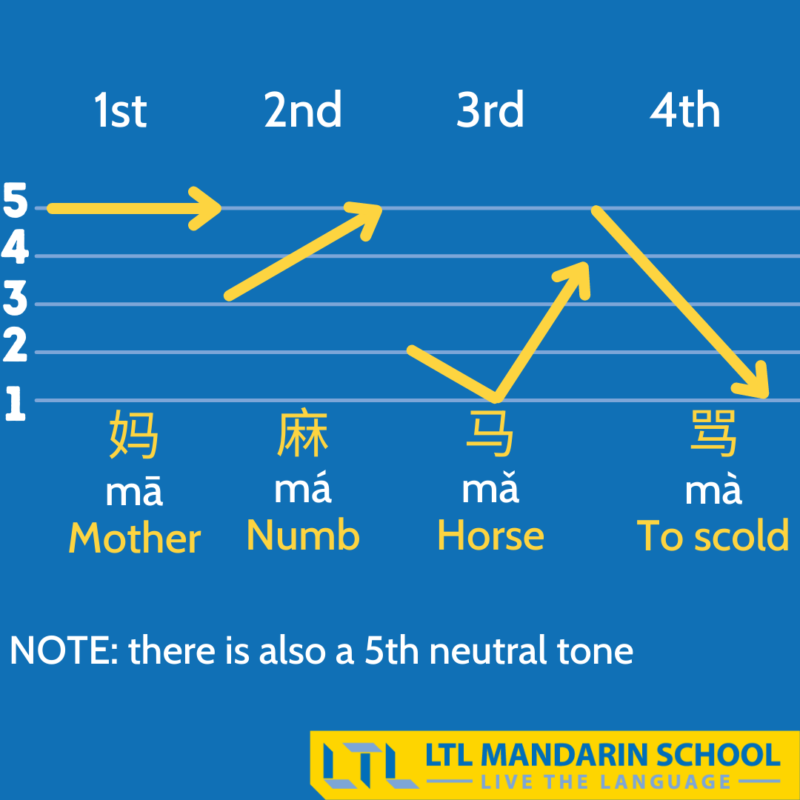
Understand the Basics of Chinese Tones
To learn Chinese tones easily, start by understanding the four main tones and the neutral tone. Each tone has a distinct pitch contour:
- First tone (high-level): A steady, high pitch (e.g., mā 妈).
- Second tone (rising): Starts mid and rises (e.g., má 麻).
- Third tone (falling-rising): Dips low before rising (e.g., mǎ 马).
- Fourth tone (falling): Sharp drop from high to low (e.g., mà 骂).
- Neutral tone: Light and short, often unstressed (e.g., ma 吗).
Practice mimicking native speakers to internalize these patterns.
See AlsoIs This Your Cup of Tea? Important Facts about Chinese Tea Culture!Use Visual and Auditory Aids
Leverage tools like tone diagrams, audio recordings, and apps to reinforce learning:
- Tone graphs: Visualize pitch movements for each tone.
- Pinyin charts with audio: Listen and repeat tones in isolation.
- Language apps (e.g., Pleco, HelloChinese): Interactive tone exercises.
- YouTube tutorials: Watch demonstrations of tone pronunciation.
- Shadowing: Repeat after native speakers in real-time.
Consistency with these tools builds muscle memory.
Practice with Minimal Pairs
Train your ear by comparing minimal pairs—words that differ only by tone:
See AlsoHow to Memorize Chinese Characters Faster with 3 of the Best Apps to Learn Chinese- mā (妈) vs. má (麻): First vs. second tone.
- mǎ (马) vs. mà (骂): Third vs. fourth tone.
- shī (诗) vs. shí (时): First vs. second tone.
- wèn (问) vs. wén (文): Fourth vs. second tone.
- Use flashcards: Test yourself on tone distinctions.
This sharpens your ability to detect and produce subtle differences.
Incorporate Tones into Daily Vocabulary
Integrate tones into every new word you learn:
- Say words aloud: Emphasize the tone while speaking.
- Label flashcards: Include tone marks (e.g., nǐ 你).
- Sing or chant: Use rhythmic repetition to memorize tones.
- Record yourself: Compare your pronunciation to natives.
- Contextualize: Learn tones within phrases, not just single words.
This ensures tones become second nature.
See AlsoLooking up how to use words in Chinese the right wayEngage in Active Listening and Speaking
Immerse yourself in authentic Chinese to refine tone mastery:
- Watch Chinese media: Pay attention to tones in dialogues.
- Language exchange: Practice with native speakers for feedback.
- Tone drills: Read aloud tone-heavy sentences daily.
- Mimic intonation: Copy the melody of natural speech.
- Join pronunciation classes: Get professional guidance.
Active engagement accelerates tone acquisition.
What is the 3-3-3 rule in Mandarin?

What is the 3-3-3 Rule in Mandarin?
The 3-3-3 rule in Mandarin is a learning strategy designed to help beginners memorize and retain Chinese characters more effectively. It involves breaking down the learning process into three key components: recognition, writing, and usage. The rule suggests spending equal time on each of these aspects to build a solid foundation in Mandarin.
- Recognition: Focus on identifying characters by their shape and meaning.
- Writing: Practice writing the characters repeatedly to reinforce muscle memory.
- Usage: Apply the characters in sentences or conversations to understand their context.
Why is the 3-3-3 Rule Effective for Learning Mandarin?
The 3-3-3 rule is effective because it addresses multiple learning modalities—visual, kinesthetic, and auditory. By evenly distributing effort across recognition, writing, and usage, learners can avoid over-relying on one skill while neglecting others.
- Balanced Approach: Ensures comprehensive understanding of characters.
- Retention: Repetition across different methods strengthens memory.
- Practical Application: Prepares learners for real-life communication.
How to Implement the 3-3-3 Rule in Daily Practice
To implement the 3-3-3 rule, divide your study sessions into three equal parts. For example, spend 10 minutes on recognition, 10 minutes on writing, and 10 minutes on usage for a 30-minute session.
- Recognition: Use flashcards or apps to identify characters.
- Writing: Practice with grid paper to maintain proper stroke order.
- Usage: Create simple sentences or engage in dialogue practice.
Common Mistakes to Avoid When Using the 3-3-3 Rule
While the 3-3-3 rule is helpful, learners often make mistakes that reduce its effectiveness. Avoiding these pitfalls can maximize your progress.
- Neglecting Balance: Focusing too much on one component over others.
- Rushing: Not spending enough time on each phase.
- Lack of Review: Failing to revisit previously learned characters.
Tools and Resources to Support the 3-3-3 Rule
Several tools can enhance your practice of the 3-3-3 rule, making learning more efficient and engaging.
- Flashcards: Apps like Anki or Pleco for character recognition.
- Writing Guides: Grid paper or stroke-order diagrams.
- Language Partners: Platforms like HelloTalk for practical usage.
What makes Mandarin difficult to learn?
The Complexity of Mandarin Tones
Mandarin is a tonal language, meaning the pitch or intonation used when pronouncing a word can change its meaning entirely. This is unfamiliar to speakers of non-tonal languages and requires significant practice to master.
- Four main tones: Mandarin has four distinct tones (plus a neutral tone), each altering the meaning of a syllable.
- Minimal pairs: Words like mā (mother) and mà (scold) differ only by tone, leading to confusion.
- Listening comprehension: Rapid speech makes it hard to distinguish tones in natural conversation.
The Challenge of Chinese Characters
Unlike alphabetic systems, Mandarin uses logographic characters, each representing a word or morpheme. Memorizing thousands of characters is time-consuming and demands visual recognition skills.
- Stroke order: Characters must be written in a specific sequence, adding complexity.
- No phonetic clues: Many characters don’t indicate pronunciation, unlike phonetic scripts.
- Homophones: Many characters share the same pronunciation but have different meanings.
Grammatical Differences from English
Mandarin grammar lacks many features common in English, such as verb conjugations, but introduces other complexities.
- No tenses: Time is indicated through context or particles, not verb changes.
- Measure words: Nouns require specific classifiers (e.g., yī běn shū for one book).
- Word order: While generally similar to English, subtle differences can cause errors.
Limited Exposure to Mandarin Sounds
Many sounds in Mandarin don’t exist in English, making pronunciation difficult for beginners.
- Retroflex consonants: Sounds like zh, ch, and sh require tongue positions unfamiliar to English speakers.
- Vowel sounds: Mandarin vowels like ü have no direct English equivalent.
- Aspiration: Distinguishing between aspirated and unaspirated consonants (e.g., p vs. b) is crucial.
Cultural and Contextual Nuances
Mandarin relies heavily on cultural context and idiomatic expressions, which can be opaque to learners.
- Idioms (成语): Four-character phrases often reference historical events or literature.
- Politeness levels: Formality and indirectness play a larger role than in English.
- Regional variations: Dialects like Cantonese or Shanghainese differ significantly from standard Mandarin.
How important are tones in Mandarin?
The Role of Tones in Mandarin Pronunciation
Tones are a fundamental aspect of Mandarin pronunciation because they distinguish the meanings of words that otherwise share the same phonetic spelling. Mandarin has four primary tones and one neutral tone, each altering the pitch contour of a syllable. Mispronouncing a tone can lead to misunderstandings, as the same syllable with different tones can mean entirely different things.
- Tone 1 (High-Level): A steady high pitch, like the sound when singing a note.
- Tone 2 (Rising): Starts mid and rises, similar to the inflection in a question.
- Tone 3 (Falling-Rising): Dips low before rising, creating a curve.
- Tone 4 (Falling): A sharp, quick drop from high to low.
- Neutral Tone: Light and short, often used in unstressed syllables.
How Tones Affect Meaning in Mandarin
In Mandarin, tones change word meanings drastically. For example, the syllable ma can mean mother (妈, mā), hemp (麻, má), horse (马, mǎ), or scold (骂, mà) depending on the tone. Without proper tones, communication becomes ambiguous or incorrect.
- Mā (妈): Means mother in Tone 1.
- Má (麻): Means hemp in Tone 2.
- Mǎ (马): Means horse in Tone 3.
- Mà (骂): Means scold in Tone 4.
Common Challenges for Learners with Mandarin Tones
Non-native speakers often struggle with tone recognition and production, especially if their native language is non-tonal. Common difficulties include confusing similar tones, misplacing tone contours, or failing to distinguish neutral tones.
- Confusing Tone 2 and Tone 3: Both involve rising pitches but differ in contour.
- Overlooking Tone Sandhi: Rules that change tones in specific contexts (e.g., two third tones in a row).
- Ignoring Neutral Tones: Forgetting to lighten unstressed syllables.
Tones in Mandarin vs. Other Chinese Dialects
While Mandarin uses four main tones, other Chinese dialects like Cantonese or Hokkien have more complex tonal systems. Cantonese, for example, has six to nine tones, making it even more challenging for learners.
- Mandarin: 4 tones + neutral tone.
- Cantonese: 6-9 tones, depending on the region.
- Hokkien: 5-7 tones with additional tone sandhi rules.
Tips for Mastering Mandarin Tones
Improving tone accuracy requires consistent practice and exposure. Techniques like shadowing native speakers, using tone drills, and listening to Mandarin media can help reinforce correct pronunciation.
- Shadowing: Repeat after native speakers to mimic tones naturally.
- Tone Pair Drills: Practice common tone combinations (e.g., 1-2, 2-3).
- Listening Practice: Engage with Mandarin songs, podcasts, or shows.
Frequently Asked Questions (FAQ)
Does using colour to represent Mandarin tones improve learning efficiency?
Colour-coding Mandarin tones can significantly enhance learning efficiency by creating visual associations that aid memory retention. Studies suggest that associating each of the four Mandarin tones with a distinct colour helps learners differentiate between them more easily. For example, using red for the first tone, blue for the second tone, green for the third tone, and purple for the fourth tone provides a consistent visual reference. This method leverages multisensory learning, reinforcing auditory input with visual cues, which can be particularly helpful for beginners struggling with tonal distinctions.
What are the potential drawbacks of relying on colour for tone learning?
While colour-based systems can be helpful, over-reliance on them may create a dependency that hinders natural tone recognition. Learners might struggle when colours are absent, such as in standard black-and-white texts or real-life conversations. Additionally, if the colour associations are not standardized across learning materials, confusion may arise. Some argue that ear training and repetition are more effective long-term strategies, as they prepare learners for real-world Mandarin usage where visual aids are unavailable.
Which colours are commonly used to represent Mandarin tones?
There is no universal standard, but many educational resources adopt a consistent colour scheme for clarity. The first tone (high and flat) is often represented in red, symbolizing stability. The second tone (rising) may use blue or yellow, suggesting an upward movement. The third tone (dipping) is frequently green, reflecting its curve, while the fourth tone (falling) might be purple or black to denote a sharp drop. Some systems also incorporate neutral tones with grey or white.
Can colour-coding help with long-term retention of Mandarin tones?
Colour associations can aid short-term memory, but long-term retention depends on consistent practice and exposure. While colours provide an initial learning scaffold, transitioning to non-colour-based methods over time is crucial. Techniques like minimal pair drills, shadowing native speakers, and practical application in conversations reinforce tone mastery. Combining colour-coding with these methods may offer a balanced approach, ensuring learners eventually internalize tones without visual crutches.
Leave a Reply
Related Posts