
Ultimate Chinese Radicals Quiz What Do They All Mean?

Chinese radicals are the building blocks of the written language, each carrying its own meaning and history. Understanding these essential components is key to mastering Chinese characters, as they often hint at pronunciation or definition. Whether you're a beginner or an advanced learner, testing your knowledge of radicals can deepen your comprehension and improve your reading skills. This Ultimate Chinese Radicals Quiz will challenge you to identify and interpret some of the most common and obscure radicals. How well do you know their meanings and functions? Dive in to discover fascinating insights and sharpen your understanding of Chinese characters!
- Ultimate Chinese Radicals Quiz: What Do They All Mean?
- What do Chinese radicals mean?
- How many traditional Chinese radicals are there?
- What is the Chinese radical for female?
- What is the 4 dot radical in Chinese?
-
Frequently Asked Questions (FAQ)
- What are Chinese radicals and why are they important in learning Mandarin?
- How can the Ultimate Chinese Radicals Quiz help me improve my Mandarin skills?
- Are all Chinese radicals related to the meaning of the characters they appear in?
- What is the best way to study radicals before taking the Ultimate Chinese Radicals Quiz?
Ultimate Chinese Radicals Quiz: What Do They All Mean?
1. What Are Chinese Radicals?
Chinese radicals are the building blocks of Chinese characters. They often indicate meaning or pronunciation and help in organizing dictionaries. There are 214 traditional radicals, each with its own significance. Understanding radicals can make learning Chinese characters much easier.
| Radical | Meaning | Example Character |
|---|---|---|
| 氵 (water) | Related to water | 河 (river) |
| 火 (fire) | Related to fire | 炎 (flame) |
2. Why Are Radicals Important in Learning Chinese?
Radicals help learners break down complex characters into manageable parts. They provide clues about a character's meaning (semantic component) or pronunciation (phonetic component). Mastering radicals improves reading, writing, and memorization.
See AlsoAnnouncing the Launch of Our New Website – The Chairman’s Bao| Benefit | Explanation |
|---|---|
| Faster memorization | Recognizing radicals helps recall characters. |
| Better dictionary use | Characters are indexed by radicals. |
3. How Many Chinese Radicals Should You Know?
While there are 214 traditional radicals, not all are equally common. Beginners should focus on the 50 most frequent radicals, which appear in many characters. Advanced learners can study the full set for deeper comprehension.
| Radical Frequency | Number to Learn |
|---|---|
| Basic level | 20-50 radicals |
| Intermediate level | 50-100 radicals |
4. Common Chinese Radicals and Their Meanings
Some radicals appear frequently in Chinese characters. Here are a few essential ones:
| Radical | Meaning | Example |
|---|---|---|
| 人 (person) | Related to people | 你 (you) |
| 口 (mouth) | Related to speech/eating | 吃 (eat) |
5. How to Test Your Knowledge of Chinese Radicals
Taking a Chinese radicals quiz helps reinforce learning. Look for quizzes that cover recognition, meaning, and character formation. Flashcards and writing practice also improve retention.
See AlsoFree and easy audio flashcards for Chinese dictation practice with Anki| Quiz Type | Purpose |
|---|---|
| Matching radicals | Tests recognition skills |
| Meaning recall | Checks understanding of radicals |
What do Chinese radicals mean?
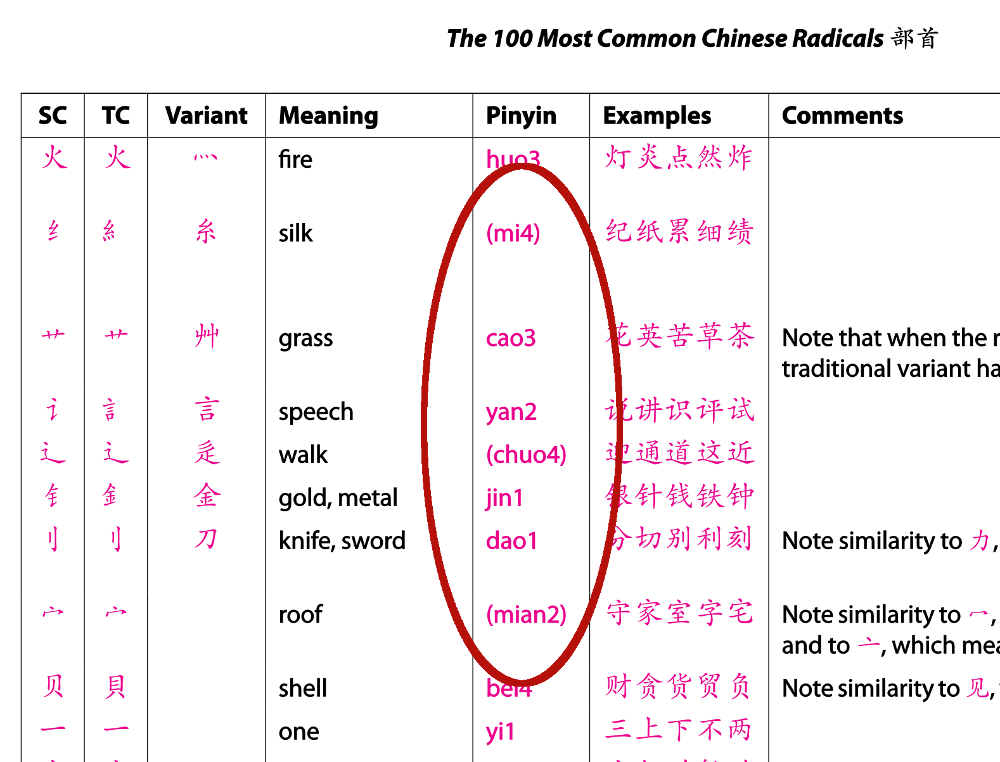
What Are Chinese Radicals?
Chinese radicals are the building blocks of Chinese characters, often providing clues about a character's meaning or pronunciation. They are essential for organizing and looking up characters in dictionaries. Here are key points about radicals:
- Radicals are the semantic or phonetic components of Chinese characters.
- There are 214 traditional radicals used in most dictionaries.
- They help categorize characters and simplify the learning process.
How Do Radicals Function in Chinese Characters?
Radicals serve multiple purposes in Chinese writing, from indicating meaning to aiding pronunciation. Here’s how they function:
See AlsoFoodie Map of China- Semantic indicators: Many radicals hint at the general meaning of the character.
- Phonetic components: Some radicals suggest the pronunciation of the character.
- Organizational role: Radicals help group characters in dictionaries for easier lookup.
Why Are Radicals Important for Learning Chinese?
Understanding radicals is crucial for mastering Chinese characters efficiently. Here’s why they matter:
- Memory aid: Recognizing radicals helps learners remember characters more easily.
- Dictionary navigation: Knowing radicals allows quick character lookup.
- Pattern recognition: Radicals reveal recurring themes in related characters.
Common Examples of Chinese Radicals
Some radicals appear frequently in Chinese characters. Here are notable examples:
- 水 (shuǐ): The water radical, seen in characters like 河 (river).
- 人 (rén): The person radical, appearing in 你 (you).
- 口 (kǒu): The mouth radical, used in 吃 (to eat).
How to Identify Radicals in Chinese Characters
Spotting radicals requires practice. Here’s how to identify them:
See AlsoExpressing All Along with 一直 and 一向- Position: Radicals often appear on the left or top of a character.
- Frequency: Familiarize yourself with common radicals to recognize them faster.
- Dictionary practice: Use dictionaries to verify radicals in unfamiliar characters.
How many traditional Chinese radicals are there?
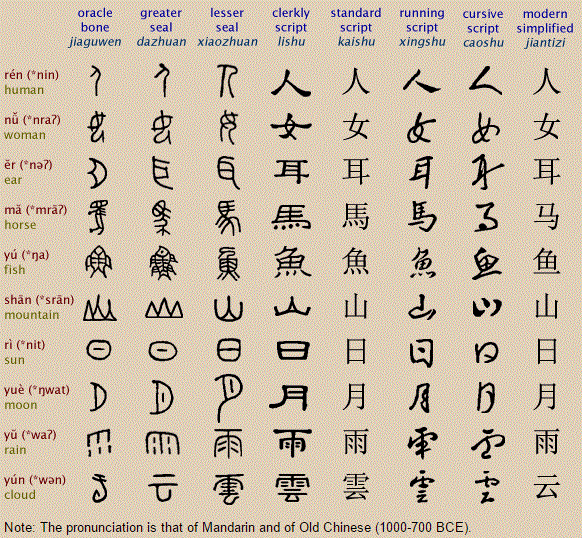
The traditional Chinese writing system uses 214 radicals, which serve as the foundational building blocks for organizing and classifying Chinese characters. These radicals are essential for dictionary lookup and understanding character composition.
What Are Chinese Radicals?
Chinese radicals are key components used to categorize and index characters in dictionaries. They often hint at a character’s meaning or pronunciation.
- Radicals are the roots of Chinese characters.
- They help in searching and memorizing characters.
- Some radicals stand alone as independent characters.
Why Are There 214 Traditional Radicals?
The 214-radical system was standardized during the Kangxi Dictionary (1716) and remains the most widely used classification method.
- The Kangxi Dictionary solidified the radical count.
- Some radicals are rare or obsolete in modern usage.
- This system balances comprehensiveness and simplicity.
How Do Radicals Help in Learning Chinese?
Radicals simplify character recognition and vocabulary building by breaking down complex characters.
- They provide clues to meaning (semantic hints).
- Some radicals indicate pronunciation (phonetic components).
- Grouping characters by radicals aids memory retention.
Are All 214 Radicals Still Used Today?
While the 214-radical system is traditional, modern dictionaries and digital tools sometimes use simplified or adjusted systems.
- Simplified Chinese may merge or omit some radicals.
- Digital input methods rely on stroke count or pinyin.
- Some radicals appear only in historical or rare characters.
How Are Radicals Used in Dictionaries?
Dictionaries organize characters by radical and stroke count, making them easier to locate.
- Characters are grouped under their primary radical.
- Additional sorting is done by remaining strokes.
- Some dictionaries include radical indexes for quick reference.
What is the Chinese radical for female?

The Chinese radical for female is 女 (nǚ). It is one of the most common radicals in Chinese characters and often appears in words related to women, femininity, or female roles.
What Does the Radical 女 (nǚ) Mean?
The radical 女 (nǚ) represents the concept of female or woman. It is used in many Chinese characters to indicate a connection to femininity or female-related concepts.
- It is the 38th radical in the Kangxi dictionary.
- It often appears on the left side of characters.
- Some characters with this radical include 妈 (mā - mother), 姐 (jiě - older sister), and 妹 (mèi - younger sister).
How Is the Radical 女 (nǚ) Used in Chinese Characters?
The radical 女 (nǚ) is a building block for many Chinese characters, often modifying their meanings to relate to women or female attributes.
- It can appear in different positions, such as left (好 - hǎo - good) or bottom (安 - ān - peace).
- Characters with this radical often describe family roles (妻 - qī - wife).
- Some words with this radical have historical or cultural significance (妃 - fēi - imperial concubine).
Common Chinese Characters with the Radical 女 (nǚ)
Many frequently used Chinese characters incorporate the radical 女 (nǚ).
- 她 (tā) - the feminine pronoun she.
- 好 (hǎo) - means good and combines 女 (female) and 子 (child).
- 姓 (xìng) - means surname or family name.
Historical Evolution of the Radical 女 (nǚ)
The radical 女 (nǚ) has evolved over time from ancient pictographs to its modern form.
- In oracle bone script, it resembled a kneeling woman.
- During the bronze script period, it became more stylized.
- Modern writing simplified it to three strokes.
Cultural Significance of the Radical 女 (nǚ)
The radical 女 (nǚ) reflects traditional Chinese views on gender and society.
- It appears in words related to marriage (婚 - hūn).
- Some characters with this radical have positive meanings (好 - good).
- Others reflect historical gender roles (奴 - nú - slave).
What is the 4 dot radical in Chinese?

What is the 4 Dot Radical in Chinese Characters?
The 4 dot radical in Chinese, known as 灬 (huǒ), is a component often found at the bottom of characters. Despite its appearance as four dots, it historically represents fire and is derived from the character 火 (huǒ). This radical influences the meaning of characters, typically relating to heat, light, or cooking.
- Appearance: The radical resembles four distinct dots or small strokes arranged horizontally.
- Origin: Evolved from the pictograph of flames in ancient Chinese script.
- Function: Modifies character meanings to associate with fire-related concepts.
How is the 4 Dot Radical Used in Chinese Characters?
The 4 dot radical appears in characters like 熱 (rè, heat) and 煮 (zhǔ, to boil), linking them to fire or heat. It serves as a semantic indicator, helping categorize characters thematically.
- Semantic Role: Connects characters to fire, cooking, or temperature.
- Examples: 焦 (jiāo, burnt), 煎 (jiān, to fry).
- Position: Almost always placed at the bottom of a character.
Historical Evolution of the 4 Dot Radical
The 4 dot radical traces back to oracle bone script, where it depicted flickering flames. Over time, it stylized into four dots while retaining its fiery connotation.
- Ancient Scripts: Resembled flames in early forms like bronze inscriptions.
- Simplification: Gradually reduced to four strokes for writing efficiency.
- Consistency: Maintained its fire-related meaning across dynasties.
Common Characters Featuring the 4 Dot Radical
Many everyday Chinese characters incorporate the 4 dot radical, emphasizing their connection to fire or heat.
- 熊 (xióng): Bear (historically linked to fire symbolism).
- 熙 (xī): Bright or prosperous (light-related).
- 烹 (pēng): To cook (directly tied to fire).
Misconceptions About the 4 Dot Radical
Some learners mistake the 4 dot radical for water or unrelated elements due to its visual simplicity.
- Not Water: Unlike the three-dot water radical (氵), it signifies fire.
- Not Decorative: Each dot carries historical meaning.
- Variants: Rarely appears outside its standard four-dot form.
Frequently Asked Questions (FAQ)
What are Chinese radicals and why are they important in learning Mandarin?
Chinese radicals are the building blocks of Chinese characters, often providing clues about a character's meaning or pronunciation. They are essential for learners because they help break down complex characters into manageable parts. By understanding radicals, you can decode unfamiliar characters, improve memorization, and enhance your overall comprehension of Mandarin. The Ultimate Chinese Radicals Quiz tests your knowledge of these critical components, ensuring you grasp their significance in the language.
How can the Ultimate Chinese Radicals Quiz help me improve my Mandarin skills?
The Ultimate Chinese Radicals Quiz is designed to reinforce your understanding of radicals by challenging you to identify and interpret them. By practicing with this quiz, you'll develop a stronger foundation for recognizing patterns in Chinese characters. This, in turn, will accelerate your vocabulary acquisition and make reading and writing more intuitive. The quiz also highlights common radicals, ensuring you focus on the most frequently used ones in everyday Mandarin.
While many radicals hint at a character's meaning (semantic radicals), others indicate its pronunciation (phonetic components). However, not all radicals directly correlate with the character's definition. Some have historical or symbolic significance, and others may no longer retain their original meaning due to language evolution. The Ultimate Chinese Radicals Quiz helps you distinguish between these roles, deepening your understanding of how radicals function in context.
What is the best way to study radicals before taking the Ultimate Chinese Radicals Quiz?
To prepare for the Ultimate Chinese Radicals Quiz, start by memorizing the most common radicals and their general meanings. Use flashcards, apps, or writing practice to reinforce recognition. Group characters by their radicals to identify patterns and connections. Additionally, study radicals in context—seeing them within actual characters will help you understand their practical applications. Consistent practice and exposure are key to mastering radicals before tackling the quiz.
Leave a Reply
Related Posts