
How to reach a decent level of Chinese in 100 days

Learning Chinese in just 100 days may seem daunting, but with the right strategy, reaching a decent level is entirely achievable. This guide breaks down a structured approach to mastering essential vocabulary, grammar, and pronunciation efficiently. By focusing on high-frequency words, daily practice, and immersive techniques, you can build a solid foundation in Mandarin. Whether for travel, work, or personal growth, consistency and smart learning methods are key. From pinyin to basic conversations, this article provides actionable steps to accelerate your progress. Discover how to optimize your study time, leverage resources, and stay motivated to hit your language goals in just over three months.
How to Reach a Decent Level of Chinese in 100 Days: A Step-by-Step Plan
1. Set Clear and Achievable Goals
To reach a decent level of Chinese in 100 days, you must define specific objectives. Break down your learning into manageable parts, such as mastering basic vocabulary (500-1000 words), understanding essential grammar, and practicing daily conversations. Use the SMART framework (Specific, Measurable, Achievable, Relevant, Time-bound) to track progress.
| Goal | Time Allocation |
|---|---|
| Vocabulary (500 words) | 20 days |
| Grammar Basics | 30 days |
| Conversation Practice | 50 days |
2. Immerse Yourself in the Language Daily
Immersion is key to accelerating your learning. Surround yourself with Chinese through listening (podcasts, music), reading (simple articles, children's books), and speaking (language exchange partners). Dedicate at least 2 hours daily to active practice.
See AlsoHow translation to another language can help you learn Chinese| Activity | Recommended Time |
|---|---|
| Listening Practice | 30 mins/day |
| Flashcard Review | 20 mins/day |
| Speaking Practice | 40 mins/day |
3. Use Spaced Repetition for Vocabulary Retention
Leverage spaced repetition systems (SRS) like Anki or Pleco to memorize Chinese words efficiently. Focus on high-frequency words first and review them at optimal intervals to ensure long-term retention.
| Tool | Advantage |
|---|---|
| Anki | Customizable flashcards |
| Pleco | Integrated dictionary & SRS |
4. Practice Speaking from Day One
Overcome the fear of speaking by engaging in daily conversations, even if it's just with yourself. Use language apps like HelloTalk or Tandem to connect with native speakers. Record yourself to identify pronunciation mistakes.
| Method | Frequency |
|---|---|
| Shadowing Technique | 10 mins/day |
| Language Exchange | 3 sessions/week |
5. Track Progress and Adjust Strategies
Regularly assess your improvement through self-tests or mock exams. Adjust your study plan if certain methods aren't working. Celebrate small wins to stay motivated.
See AlsoHow to get honest feedback to boost your Chinese speaking and writing| Checkpoint | Action |
|---|---|
| Day 30 | Vocabulary Quiz |
| Day 60 | Mock Conversation |
How long does it realistically take to learn Chinese?
Factors Influencing the Time to Learn Chinese
The time it takes to learn Chinese depends on several factors, including your native language, study methods, and exposure to the language. Here are key considerations:
- Native language: Speakers of languages with similar structures (e.g., Japanese or Korean) may learn faster than those from unrelated language families.
- Study intensity: Dedication matters—full-time learners progress quicker than casual students.
- Immersion: Living in a Chinese-speaking environment accelerates fluency.
Basic Proficiency: Reaching HSK 1-3
Achieving basic proficiency (HSK 1-3) typically takes:
See AlsoChinese Labour Corps: The Forgotten 100,000 Who Fought Alongside Britain in WWI- 6–12 months with consistent study (1–2 hours daily).
- Vocabulary: 600–1,000 words and simple sentence structures.
- Focus areas: Pinyin, tones, and everyday conversations.
Intermediate Level: HSK 4-5
Attaining an intermediate level (HSK 4-5) usually requires:
- 1.5–3 years of regular study and practice.
- Vocabulary: 1,200–2,500 words and complex grammar.
- Skills: Reading news, writing essays, and discussing abstract topics.
Advanced Fluency: HSK 6 and Beyond
Mastering advanced fluency (HSK 6+) often demands:
- 3–5+ years of immersive learning and cultural exposure.
- Vocabulary: 5,000+ words and idiomatic expressions.
- Challenges: Understanding literature, formal speeches, and regional dialects.
Accelerating Your Chinese Learning
To speed up your progress, consider these strategies:
- Daily practice: Use apps, flashcards, or language partners.
- Immersion: Watch Chinese media or join language exchanges.
- Structured courses: Enroll in classes with clear milestones.
How can I improve my Chinese in a short time?
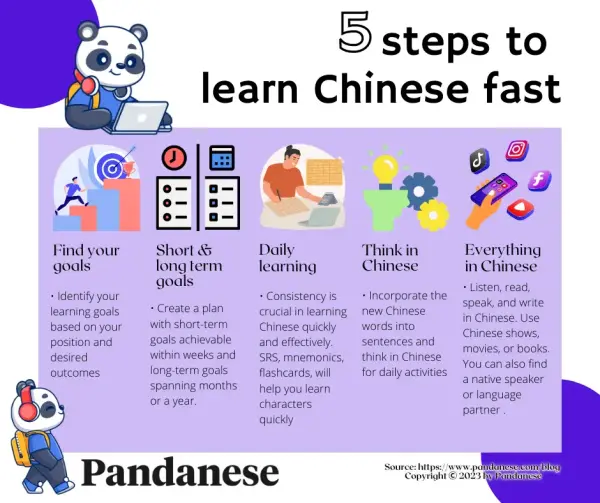
Immerse Yourself in the Language Daily
To improve your Chinese quickly, surround yourself with the language as much as possible. Exposure accelerates learning by reinforcing vocabulary and grammar naturally.
- Watch Chinese TV shows or movies with subtitles to train your ear and pick up colloquial phrases.
- Listen to Chinese podcasts or music during downtime to familiarize yourself with tones and pronunciation.
- Switch your phone or social media settings to Chinese for constant passive learning.
Practice Speaking with Native Speakers
Regular conversation is crucial for fluency. Engaging with native speakers helps refine pronunciation and builds confidence.
- Use language exchange apps like Tandem or HelloTalk to find partners.
- Join local or online Chinese-speaking communities to practice in real-time.
- Record yourself speaking and compare it to native audio for self-correction.
Focus on High-Frequency Vocabulary
Prioritize learning words and phrases you’ll use often to maximize efficiency.
- Study thematic vocabulary lists (e.g., greetings, food, travel) relevant to your goals.
- Use flashcards (Anki or Pleco) to reinforce memorization through spaced repetition.
- Label objects in your home with their Chinese names for visual reinforcement.
Master Pinyin and Tones Early
A solid grasp of Pinyin and tones prevents misunderstandings and improves clarity.
- Drill tone pairs (e.g., mā/má/mǎ/mà) daily to train your ear and mouth.
- Practice with tone-marked texts to associate sounds with characters.
- Use apps like Pinyin Trainer to test your accuracy.
Leverage Structured Learning Resources
Combining self-study with formal tools ensures balanced progress.
- Enroll in an intensive online course (e.g., Coursera, ChineseClass101) for guided lessons.
- Complete textbook exercises (e.g., Integrated Chinese) to solidify grammar rules.
- Track progress with apps like Duolingo or Skritter to stay motivated.
How much Chinese can I learn in 1 year?

What Factors Influence How Much Chinese You Can Learn in 1 Year?
The amount of Chinese you can learn in a year depends on several key factors:
- Time commitment: Daily practice (1-2 hours) yields faster progress than sporadic study.
- Learning methods: Immersion, classes, apps, or tutoring affect retention speed.
- Prior experience: Knowledge of tonal languages or characters accelerates learning.
- Goals: Focusing on conversational fluency vs. reading/writing changes outcomes.
Can You Achieve Conversational Fluency in Chinese in 1 Year?
Reaching conversational fluency in a year is possible with structured effort:
- Basic dialogues: Master 500-1,000 words for everyday topics like shopping or travel.
- Pronunciation: Daily tone drills improve listening/speaking accuracy.
- Grammar patterns: Learn 20-30 core structures to form sentences.
How Many Chinese Characters Can You Learn in 1 Year?
A realistic target for characters in 12 months:
- 300-500 characters: Enough for basic reading (menus, signs, simple texts).
- Radical focus: Learning component meanings boosts memorization.
- Writing practice: Regular handwriting drills reinforce retention.
What Level of HSK Can You Reach in 1 Year?
Progress in the HSK (standardized test) varies:
- HSK 2-3: Achievable with 3-5 hours weekly (basic sentences).
- HSK 4: Possible with intensive study (1,200+ words).
- HSK 5-6: Unlikely without prior experience or full-time study.
What Are the Best Strategies to Learn Chinese in 1 Year?
Optimize progress with these strategies:
- Immersion: Watch shows, listen to podcasts, or join language exchanges.
- Spaced repetition: Use apps like Anki for vocabulary retention.
- Feedback loops: Work with tutors to correct errors early.
Frequently Asked Questions (FAQ)
Is it really possible to reach a decent level of Chinese in just 100 days?
While becoming fluent in Chinese in 100 days is highly ambitious, reaching a decent conversational level is achievable with dedicated effort. The key lies in consistent daily practice, focusing on high-frequency vocabulary, essential grammar, and practical speaking exercises. Immersing yourself in the language through listening and speaking activities, such as watching Chinese media or conversing with native speakers, can significantly accelerate progress. However, success depends on your learning strategy and the amount of time you invest each day.
What are the most effective study methods to learn Chinese quickly?
The most effective methods include spaced repetition (using apps like Anki), active listening (podcasts, TV shows), and speaking practice (language exchange partners or tutors). Prioritize learning pinyin first to master pronunciation, then focus on common phrases and sentence patterns. Writing characters can be time-consuming, so initially, emphasize recognition over production. Combining structured lessons with real-world practice will yield the best results in a short timeframe.
How many hours per day should I study to make progress in 100 days?
To see substantial progress, aim for at least 2-3 hours of focused study daily, divided into shorter sessions to maintain retention. Break down your time into 30-minute blocks for vocabulary, grammar, listening, and speaking. Consistency is more important than marathon sessions—daily exposure reinforces learning. If possible, supplement with passive immersion, like listening to Chinese music or podcasts during downtime. Adjust the intensity based on your schedule, but avoid skipping days to stay on track.
What specific resources or tools are best for rapid Chinese learning?
For fast progress, use a mix of apps, books, and immersion tools. Duolingo or HelloChinese offer gamified lessons, while Pleco is indispensable for dictionary and flashcard use. YouTube channels like ChinesePod or Mandarin Corner provide free listening practice. For speaking, platforms like iTalki or Tandem connect you with native speakers. A structured textbook like Integrated Chinese can guide grammar learning. Lastly, watching Chinese dramas or listening to news (e.g., CCTV) helps train your ear to natural speech.
Leave a Reply
Related Posts