
Best Program to Learn Chinese: The Ultimate Guide

Learning Chinese can be a rewarding yet challenging journey, and choosing the right program is crucial for success. With countless options available—from apps and online courses to immersive classes—finding the best fit can be overwhelming. Whether you're a beginner or looking to advance your skills, this ultimate guide breaks down the top programs to learn Chinese based on effectiveness, flexibility, and user experience. We’ll explore features, pricing, and teaching methods to help you make an informed decision. By the end, you’ll know exactly which program aligns with your goals, learning style, and schedule, setting you on the path to fluency in Mandarin.
Best Program to Learn Chinese: The Ultimate Guide
1. Why Learning Chinese is Worth Your Time
Learning Chinese opens doors to business, culture, and travel opportunities. With over 1 billion native speakers, Mandarin is the most spoken language globally. Mastering it can enhance career prospects, especially in industries like trade, technology, and diplomacy. Additionally, understanding Chinese culture becomes easier when you grasp the language.
| Benefit | Impact |
|---|---|
| Career Growth | High demand in global markets |
| Cultural Insight | Deeper connection with Chinese traditions |
2. Top Features to Look for in a Chinese Learning Program
A good Chinese learning program should include interactive lessons, speech recognition, and structured progression. Look for apps or courses with native speaker audio, character writing practice, and grammar explanations. Gamification and personalized learning paths also improve retention.
See AlsoLearning Chinese through social media| Feature | Importance |
|---|---|
| Speech Recognition | Improves pronunciation accuracy |
| Writing Practice | Essential for mastering Chinese characters |
3. Best Online Platforms for Learning Chinese
Popular platforms like Duolingo, Rosetta Stone, and HelloChinese offer structured courses. For advanced learners, Yabla and ChinesePod provide immersive content. Free options like Memrise are great for vocabulary building.
| Platform | Best For |
|---|---|
| Duolingo | Beginners & gamified learning |
| ChinesePod | Conversational practice |
4. How to Choose Between Mandarin and Cantonese
Mandarin is the official language of China and more widely used, while Cantonese is spoken in regions like Hong Kong and Guangdong. Your choice depends on goals—Mandarin suits business, while Cantonese is useful for regional communication.
| Language | Primary Use |
|---|---|
| Mandarin | Official communication, broader reach |
| Cantonese | Regional dialects, cultural contexts |
5. Free vs. Paid Chinese Learning Programs
Free programs like Duolingo or YouTube tutorials are great for basics. Paid options like Pimsleur or italki tutors offer personalized coaching and advanced materials. Investing in a paid program accelerates fluency.
See AlsoChinese TV Shows || 14 Great Shows for Practicing Chinese| Program Type | Advantage |
|---|---|
| Free | Accessible, good for beginners |
| Paid | Structured, faster progress |
What is the most effective way to learn Chinese?
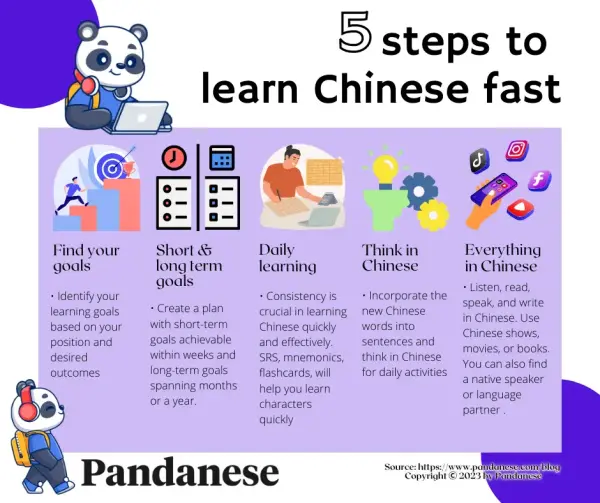
Immerse Yourself in the Language
The most effective way to learn Chinese is through immersion. Surrounding yourself with the language accelerates comprehension and retention. Here’s how:
- Watch Chinese media: Movies, TV shows, and news help you pick up pronunciation and colloquial phrases.
- Listen to Chinese music/podcasts: Improves auditory recognition of tones and vocabulary.
- Engage with native speakers: Practice conversations via language exchange platforms or local communities.
Master Tones and Pronunciation Early
Tones are critical in Chinese, as they change word meanings. Focus on them from the start:
See AlsoReading manga in Chinese for more than just pleasure- Practice with pinyin: Use this romanization system to grasp tones before tackling characters.
- Repeat after native speakers: Mimic audio clips or tutors to refine your accent.
- Use tone-pair drills: Combine different tones to improve fluency and avoid misunderstandings.
Prioritize High-Frequency Vocabulary
Learning commonly used words first builds a practical foundation:
- Focus on daily phrases: Greetings, numbers, and essential verbs are most useful early on.
- Use flashcards: Apps like Anki or Pleco reinforce memory through spaced repetition.
- Learn radicals: Understanding character components simplifies memorization of complex words.
Consistent Practice with Writing
Writing reinforces character recognition and muscle memory:
- Start with stroke order: Proper technique is crucial for legibility and speed.
- Copy characters daily: Repetition helps internalize their structure.
- Use workbooks or apps: Resources like Skritter combine writing with interactive feedback.
Leverage Structured Learning Resources
Combining formal study with self-directed practice maximizes progress:
See AlsoAll the resources you need to learn and teach Chinese stroke order- Enroll in a course: Classes provide accountability and systematic progression.
- Follow textbooks: Series like Integrated Chinese offer graded lessons.
- Track progress: Set milestones (e.g., HSK levels) to measure improvement.
What is the best AI for learning Chinese?

Top AI-Powered Apps for Learning Chinese
AI-powered language apps are among the most effective tools for mastering Chinese. These platforms use adaptive learning algorithms to personalize lessons based on proficiency.
- Duolingo: Uses gamification and AI to reinforce vocabulary and grammar.
- HelloChinese: Focuses on speaking and listening with real-life scenarios.
- LingQ: Leverages AI to analyze texts and track progress.
Best AI Chatbots for Practicing Chinese
AI chatbots simulate conversations, helping learners improve fluency and comprehension.
- ChatGPT: Engages in text-based dialogues with corrections.
- Xiaoice: A Mandarin-specific chatbot for natural interactions.
- Mondly: Offers voice-based chatbot practice.
AI Tools for Chinese Pronunciation Training
Pronunciation accuracy is critical in Chinese, and AI tools provide instant feedback.
- Pinyin Trainer: Analyzes tone accuracy using speech recognition.
- Speechling: Compares recordings to native speakers.
- Elsa Speak: Focuses on tonal and phonetic precision.
AI-Based Platforms for Chinese Character Recognition
Character memorization is streamlined with AI-driven visual learning tools.
- Skritter: Uses spaced repetition for writing practice.
- Hanping: Scans and translates characters via camera.
- Pleco: Integrates OCR for real-time translations.
AI Tutors for Structured Chinese Learning
Personalized tutoring systems adapt to individual learning curves.
- iTalki AI Tutor: Customizes lesson plans dynamically.
- Preply: Pairs learners with AI-enhanced tutors.
- Yabla: Offers video-based lessons with AI subtitles.
What is the best version of Chinese to learn?

Mandarin vs. Cantonese: Which Should You Learn?
The choice between Mandarin and Cantonese depends on your goals. Mandarin is the most widely spoken Chinese dialect, while Cantonese is prominent in regions like Hong Kong and Guangdong. Consider these points:
- Mandarin is China's official language, used in education, media, and business nationwide.
- Cantonese is valuable for cultural connections, especially in diaspora communities.
- Mandarin has simpler tones (4 main tones) compared to Cantonese (6–9 tones).
Simplified vs. Traditional Chinese Characters
Deciding between simplified and traditional characters hinges on location and purpose:
- Simplified characters are used in mainland China and Singapore, ideal for practicality.
- Traditional characters are retained in Taiwan, Hong Kong, and Macau, preferred for cultural depth.
- Learning one system first makes transitioning easier later.
Usefulness of Learning Mandarin for Business
Mandarin dominates global business due to China's economic influence. Key reasons include:
- China's role as a trade powerhouse makes Mandarin essential for negotiations.
- Many multinational companies prioritize Mandarin-speaking employees.
- Government and legal documents in China are exclusively in Mandarin.
Regional Dialects: Are They Worth Learning?
Beyond Mandarin and Cantonese, regional dialects like Hokkien or Shanghainese have niche value:
- Useful for heritage learners reconnecting with family roots.
- Limited formal resources make self-study challenging.
- Most speakers also understand Mandarin, reducing necessity.
Factors to Consider Before Choosing a Chinese Dialect
Evaluate these aspects when selecting a Chinese variant:
- Geographic relevance: Align your choice with target regions (e.g., Taiwan vs. mainland China).
- Career goals: Mandarin suits professionals; Cantonese benefits creatives in film/music.
- Learning resources: Mandarin has abundant textbooks and apps.
Is Rosetta Stone worth it for Chinese?

Does Rosetta Stone Effectively Teach Chinese Pronunciation?
Rosetta Stone uses speech recognition technology to help learners improve their Chinese pronunciation. The program emphasizes immersion, forcing users to think and respond in Mandarin without translations. However, some users find the feedback limited compared to human instructors.
- Pros: Encourages tonal accuracy through repetition and immediate correction.
- Cons: Lacks nuanced feedback on subtle pronunciation errors.
- Alternative: Pairing it with a tutor for personalized adjustments.
How Does Rosetta Stone Handle Chinese Characters?
Rosetta Stone introduces simplified characters (used in mainland China) gradually, with pinyin support. However, it doesn’t deeply teach stroke order or character etymology, which are crucial for memorization.
- Pros: Contextual learning helps associate characters with meanings.
- Cons: Minimal focus on writing practice or traditional characters.
- Alternative: Supplement with apps like Skritter for handwriting.
Is Rosetta Stone’s Immersion Method Suitable for Chinese?
The no-English approach mimics natural language acquisition, which can be challenging but rewarding for Chinese. However, beginners might struggle with the lack of explicit grammar explanations.
- Pros: Builds intuitive understanding of sentence structures.
- Cons: May frustrate learners who prefer rule-based instruction.
- Tip: Use external grammar guides alongside the program.
Does Rosetta Stone Cover Practical Chinese Conversations?
The program focuses on everyday scenarios (e.g., shopping, travel), but some users report the dialogues feel overly scripted. Real-world slang or regional variations aren’t included.
- Pros: Teaches essential phrases for basic communication.
- Cons: Lacks cultural nuances or idiomatic expressions.
- Alternative: Watch Chinese dramas or use HelloTalk for practice.
Is Rosetta Stone Worth the Cost for Learning Chinese?
Rosetta Stone is expensive compared to alternatives like Duolingo or HelloChinese. Its value depends on your learning style—ideal for those who prefer structured immersion but not for budget-conscious learners.
- Pros: High-quality audio and visually engaging content.
- Cons: Subscription model can be costly long-term.
- Tip: Check for discounts or free trials before committing.
Frequently Asked Questions (FAQ)
What is the best program to learn Chinese for beginners?
For beginners, the best program to learn Chinese should focus on foundational skills like pronunciation, basic vocabulary, and simple sentence structures. Duolingo and Rosetta Stone are excellent choices because they use interactive lessons and gamification to make learning engaging. Additionally, HelloChinese is specifically designed for Mandarin learners, offering structured courses with speech recognition to perfect tones early on. Consistency and practice are key, so choose a program that fits your daily routine.
Are paid Chinese learning programs worth it compared to free ones?
Paid programs often provide more comprehensive content, personalized feedback, and structured curricula compared to free alternatives. Platforms like Pimsleur and ChinesePod offer high-quality audio lessons and tutor support, which are invaluable for mastering listening and speaking. However, free apps like Anki (for flashcards) and YouTube channels (for immersion) can supplement learning effectively. If you're serious about fluency, investing in a paid program is usually worthwhile.
How long does it take to learn Chinese using these programs?
The time required depends on your dedication, prior language experience, and the intensity of your study. With consistent daily practice (30-60 minutes), a beginner can reach basic conversational level in about 6-12 months. For intermediate proficiency, it may take 2-3 years. Programs like Yabla (for video immersion) or Italki (for live tutoring) can accelerate progress by providing real-world practice. Remember, Mandarin's tonal nature and characters add complexity, so patience is essential.
Can I become fluent in Chinese using only online programs?
While online programs are powerful tools, achieving full fluency usually requires additional immersion. Apps like HelloTalk or Tandem can connect you with native speakers for practice, but real-world interactions, such as traveling or living in a Chinese-speaking environment, are irreplaceable. Combining programs like Pleco (for dictionaries) with consistent speaking practice will get you close, but fluency often demands cultural exposure and advanced conversational experience beyond digital platforms.
Leave a Reply
Related Posts