
5 websites to help answer your questions about Chinese

When learning about Chinese culture, language, or history, finding reliable answers can be challenging. Fortunately, several online platforms specialize in providing accurate and insightful information. Whether you're curious about Mandarin phrases, ancient traditions, or modern China, these websites offer expert guidance. From interactive language tools to forums with native speakers, each platform caters to different needs. Some focus on quick translations, while others provide in-depth cultural explanations. This article highlights five top websites that can help answer your questions about Chinese efficiently. Explore these resources to deepen your understanding and make your journey into Chinese studies smoother and more enjoyable.
5 Websites to Help Answer Your Questions About Chinese
1. Chinese-Forums
Chinese-Forums is one of the largest online communities for learners of Chinese. It offers discussions on grammar, vocabulary, pronunciation, and cultural insights. Whether you're a beginner or advanced learner, you can ask questions and receive answers from native speakers and experienced learners. The forum also has dedicated sections for textbooks, study plans, and language exchange opportunities.
| Feature | Description |
| Active Community | Thousands of members ready to help |
| Diverse Topics | Grammar, culture, study resources |
| Free Access | No payment required |
2. Pleco
Pleco is a must-have dictionary app for Chinese learners. It provides accurate translations, example sentences, and even handwriting recognition. The app also includes flashcards, audio pronunciations, and add-ons like OCR for scanning text. It's available on iOS and Android, making it a convenient tool for on-the-go learning.
See AlsoChinese listening strategies: Problem analysis| Feature | Description |
| Comprehensive Dictionary | Includes idioms, slang, and technical terms |
| Handwriting Input | Draw characters for instant lookup |
| Flashcard System | Customizable SRS learning |
3. AllSet Learning Wiki
The AllSet Learning Wiki is a fantastic resource for grammar explanations and common mistakes. Created by language experts, it breaks down complex rules into easy-to-understand examples. The wiki also includes comparisons between similar words and structures, helping learners avoid confusion.
| Feature | Description |
| Grammar Guides | Clear explanations with examples |
| Common Mistakes | Highlights frequent learner errors |
| Free Resource | No subscription needed |
4. HiNative
HiNative is a Q&A platform where you can ask native speakers about Chinese. You can post questions about translations, phrases, or cultural nuances and receive quick responses. The app supports audio recordings, making it useful for pronunciation checks.
| Feature | Description |
| Native Speaker Feedback | Get answers from real people |
| Audio Questions | Record and verify pronunciation |
| Multilingual Support | Ask in your native language |
5. MDBG Chinese Dictionary
The MDBG Chinese Dictionary is a free online tool offering detailed word definitions, pinyin, and stroke order animations. It also includes example sentences and decomposition of characters, making it ideal for learners who want to understand the building blocks of Chinese writing.
See AlsoChinese Language Learner Interview Series – Olle Linge| Feature | Description |
| Stroke Order Animations | Learn how to write characters correctly |
| Character Decomposition | Breaks down radicals and components |
| Mobile-Friendly | Works well on smartphones |
How to answer questions in Mandarin?
Understanding Basic Mandarin Question Structures
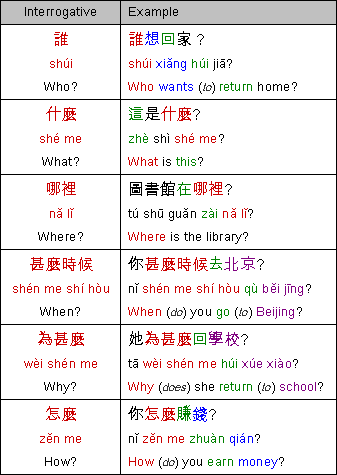
To answer questions in Mandarin, you must first recognize common question structures. Mandarin often uses question particles like 吗 (ma) or 呢 (ne) and interrogative words such as 什么 (shénme) or 谁 (shéi). Here’s how to approach them:
- Yes/No questions: These end with 吗 (ma)—answer with 是 (shì) for yes or 不是 (bù shì) for no.
- Alternative questions: Use 还是 (háishì) to choose between options—respond directly with your choice.
- Interrogative word questions: Replace the question word (e.g., 哪里 (nǎlǐ)) with your answer.
Using Polite Phrases When Answering
Politeness is key in Mandarin conversations. Incorporate courtesy phrases to sound respectful:
See AlsoThe three roads to mastering Chinese- Begin with 请问 (qǐngwèn) if clarifying or asking follow-up questions.
- Add 谢谢 (xièxie) when the question involves assistance or advice.
- Use 不好意思 (bù hǎoyìsi) to apologize if you don’t know the answer.
Mastering Tones for Clear Communication
Tones drastically change meanings in Mandarin. Ensure your answers are accurate by:
- Practicing the four tones (flat, rising, falling-rising, falling) to avoid misunderstandings.
- Mimicking native speakers to grasp tonal nuances in responses.
- Using pinyin as a guide for correct pronunciation.
Common Mistakes to Avoid
Learners often make these errors when answering in Mandarin:
- Ignoring context: Tailor answers based on formality (e.g., casual vs. professional).
- Literal translations: Avoid direct word-for-word conversions from English.
- Overlooking measure words: Use classifiers like 个 (gè) or 只 (zhī) where needed.
Expanding Vocabulary for Better Responses
Enhance your answers by learning high-frequency words and phrases:
See AlsoHow to become a Chinese-English translator and what it’s like to be one- Memorize verbs like 去 (qù) for go or 吃 (chī) for eat to form complete sentences.
- Study adjectives such as 好 (hǎo) for good to describe things accurately.
- Practice connectors like 因为 (yīnwèi) for because to justify answers logically.
Frequently Asked Questions (FAQ)
What are the best websites to find answers about Chinese language and culture?
Several reliable websites can help answer your questions about Chinese language and culture. Some of the top options include Chinese-Forums, a community-driven platform for learners, and Quora, where experts and enthusiasts share insights. Reddit’s r/ChineseLanguage subreddit is another great resource for discussions and tips. Additionally, Stack Exchange’s Chinese Language section offers detailed answers to specific questions. Lastly, Yabla Chinese provides video-based learning with subtitles and translations.
How can I use these websites to improve my Chinese language skills?
To enhance your Chinese skills, leverage these websites effectively. On Chinese-Forums, engage in discussions and ask native speakers for feedback. Quora and Reddit allow you to follow threads on grammar, vocabulary, and pronunciation. Stack Exchange is ideal for resolving technical language questions. For immersive learning, Yabla Chinese offers interactive videos with slow playback and dictionaries. Consistency and active participation are key to progress.
Are these websites suitable for beginners in Chinese?
Yes, these websites cater to all proficiency levels, including beginners. Chinese-Forums has dedicated sections for new learners, while Quora and Reddit feature beginner-friendly advice. Stack Exchange allows filtering questions by difficulty. Yabla Chinese is particularly helpful for beginners due to its visual and auditory learning tools. However, beginners should focus on structured resources alongside these platforms to build a strong foundation.
See AlsoWuxia, a key to Chinese language and cultureDo these websites provide accurate and reliable information about Chinese?
Most of these platforms offer accurate information, but reliability varies. Chinese-Forums and Stack Exchange often feature contributions from experienced learners and native speakers. Quora and Reddit rely on community input, so cross-checking answers is advisable. Yabla Chinese uses professionally curated content, making it highly reliable. For critical questions, consulting multiple sources or verified experts is recommended to ensure accuracy.
Leave a Reply
Related Posts