
12 ways chatting online will improve your Chinese

Learning Chinese can be challenging, but chatting online offers a dynamic and engaging way to accelerate your progress. By interacting with native speakers and fellow learners, you’ll practice real-life conversations, expand your vocabulary, and refine your grammar naturally. Online chats provide instant feedback, cultural insights, and the flexibility to learn at your own pace—whether through text, voice, or video. From mastering tones to picking up slang, digital communication bridges the gap between textbook study and fluency. In this article, we’ll explore 12 key ways chatting online can enhance your Chinese skills, making learning more effective, enjoyable, and tailored to your goals.
12 Effective Ways Online Chatting Can Enhance Your Chinese Language Skills
1. Real-Time Practice with Native Speakers
Chatting online provides immediate interaction with native Chinese speakers, allowing you to practice authentic conversations. Unlike textbooks, real-time chats expose you to colloquial phrases, slang, and cultural nuances. Platforms like WeChat, HelloTalk, or language exchange forums facilitate these interactions, helping you refine pronunciation and fluency naturally.
| Benefit | Example |
|---|---|
| Instant feedback | Corrections on tone mistakes |
| Cultural context | Learning idioms like 马马虎虎 (mǎmǎhūhū) |
2. Exposure to Diverse Vocabulary
Online chats introduce contextual vocabulary across topics—from daily life to hobbies. Unlike rigid curricula, conversations adapt to your interests, reinforcing retention. For instance, discussing sports? You’ll pick up terms like 比赛 (bǐsài, match) organically.
See AlsoBeginner Chinese listening practice: What to listen to and how| Vocabulary Type | Chat Example |
|---|---|
| Informal words | 靠谱 (kàopǔ, reliable) |
| Topic-specific terms | 编程 (biānchéng, programming) |
3. Improved Listening and Reading Speed
Fast-paced chats train your brain to process Chinese quicker. Reading pinyin or characters in real-time boosts character recognition, while voice messages hone listening comprehension.
| Skill | Chat Tool |
|---|---|
| Reading | Text-based group chats |
| Listening | Voice notes on WhatsApp |
4. Learning Through Corrections
Native speakers often correct errors mid-conversation, offering personalized learning. For example, typing 我很忙 (wǒ hěn máng, I’m busy) might prompt a reply with the more natural 我有点忙 (wǒ yǒudiǎn máng).
| Mistake | Common Correction |
|---|---|
| Literal translations | 开门 (kāimén) vs. 营业 (yíngyè) for open (store) |
5. Building Confidence in Communication
Regular chatting reduces language anxiety. The informal setting encourages experimentation without fear of mistakes, gradually improving speaking confidence for real-world scenarios.
See AlsoHow To Get A Taxi in China - Keywords and Things To Know| Confidence Booster | Outcome |
|---|---|
| Quick replies | Faster sentence formation |
How to get better at conversational Chinese?

Immerse Yourself in Chinese Daily
To improve your conversational Chinese, surround yourself with the language as much as possible. Exposure helps you internalize tones, vocabulary, and natural speech patterns.
- Listen to Chinese podcasts, music, or radio stations daily.
- Watch Chinese TV shows or movies with subtitles to match spoken words with text.
- Change your phone or social media settings to Chinese for passive learning.
Practice Speaking Regularly
Consistent speaking practice is key to fluency. Even short daily conversations can significantly boost your confidence and skills.
See AlsoHow good is voice recognition for learning Chinese pronunciation?- Find a language partner or tutor for regular exchanges.
- Repeat phrases aloud from videos or audio lessons to mimic pronunciation.
- Record yourself speaking and compare it to native speakers.
Expand Your Vocabulary Strategically
Focus on learning high-frequency words and phrases used in everyday conversations rather than obscure terms.
- Prioritize words related to hobbies, work, or daily routines.
- Use flashcards or apps like Anki for spaced repetition.
- Learn common slang and idioms to sound more natural.
Master Chinese Tones and Pronunciation
Tones are crucial in Chinese. Mispronouncing them can change meanings entirely, so dedicate time to perfecting them.
- Practice tone pairs (two-syllable combinations) to improve flow.
- Shadow native speakers by repeating sentences immediately after hearing them.
- Use apps like Pinyin Trainer to drill tone accuracy.
Engage in Real-Life Conversations
Applying your skills in real-world settings accelerates learning and builds confidence.
See AlsoHow to Learn to Write Chinese- Join language exchange meetups or online communities like Tandem.
- Visit Chinese-speaking neighborhoods or restaurants to practice ordering.
- Don’t fear mistakes—native speakers often appreciate the effort and will correct you kindly.
How to chat with Chinese people online?

Choosing the Right Platform for Chatting with Chinese People
To effectively chat with Chinese people online, selecting the right platform is crucial. Popular apps in China include WeChat, QQ, and DingTalk, while international platforms like WhatsApp or Facebook Messenger are less common due to restrictions. Here’s what to consider:
- WeChat: The most widely used app in China, offering text, voice, and video calls.
- QQ: A versatile platform with group chats and file-sharing features.
- DingTalk: More business-oriented but still useful for casual conversations.
Understanding Chinese Communication Etiquette
When chatting with Chinese people, cultural nuances matter. Politeness and indirectness are often valued, so avoid being overly blunt. Key points to remember:
- Use honorifics like 您 (nín) for respect, especially with elders.
- Avoid sensitive topics like politics or religion unless the other person brings them up.
- Emojis and stickers are widely used to convey tone and emotions.
Overcoming the Language Barrier
If you don’t speak Mandarin, tools like Google Translate or Pleco can help. However, keep these tips in mind:
- Use simple sentences to avoid translation errors.
- Learn basic greetings (e.g., 你好 - nǐ hǎo) to show effort.
- Ask for clarification politely if you don’t understand something.
Building Trust and Rapport
Chinese culture emphasizes guanxi (relationships), so building trust takes time. Here’s how to foster connections:
- Start with small talk about hobbies or food to break the ice.
- Be consistent and responsive to show you value the conversation.
- Share personal stories gradually to deepen the bond.
China operates on CST (UTC+8), so timing matters for smooth chats. Consider these factors:
- Most Chinese people are active online during evenings (7–10 PM local time).
- Avoid messaging too early or late to respect their schedule.
- Use asynchronous messaging if real-time chats aren’t possible.
How to be good at chatting online?

Master the Basics of Online Communication
To excel in online chatting, start by understanding the fundamentals. Focus on clarity, brevity, and tone to ensure your messages are well-received.
- Be concise: Avoid long paragraphs; break your thoughts into digestible chunks.
- Use proper grammar: Sloppy writing can lead to misunderstandings.
- Adapt your tone: Match the formality or casualness of the conversation.
Engage Actively in Conversations
Active engagement keeps chats lively and meaningful. Show interest by asking questions and responding thoughtfully.
- Ask open-ended questions: Encourage deeper discussions.
- Listen (or read) carefully: Respond to what the other person actually says.
- Avoid one-word replies: Expand on your thoughts to keep the flow going.
Use Emojis and GIFs Effectively
Visual elements like emojis and GIFs can enhance online chats when used appropriately.
- Don’t overdo it: Use them to complement, not replace, words.
- Match the context: A laughing emoji fits a joke, not a serious topic.
- Know your audience: Some prefer text-only communication.
Develop Quick Thinking and Wit
Quick responses and a bit of humor make chats more enjoyable.
- Practice spontaneity: Train yourself to think on your feet.
- Keep it light: Humor can ease tension but avoid offensive jokes.
- Stay relevant: Tie your wit to the ongoing discussion.
Respect Online Etiquette
Good manners are crucial in online chats to maintain positive interactions.
- Avoid spamming: Don’t flood the chat with messages.
- Respect privacy: Don’t share others’ info without consent.
- Be patient: Not everyone responds immediately.
How to start a convo in Chinese?
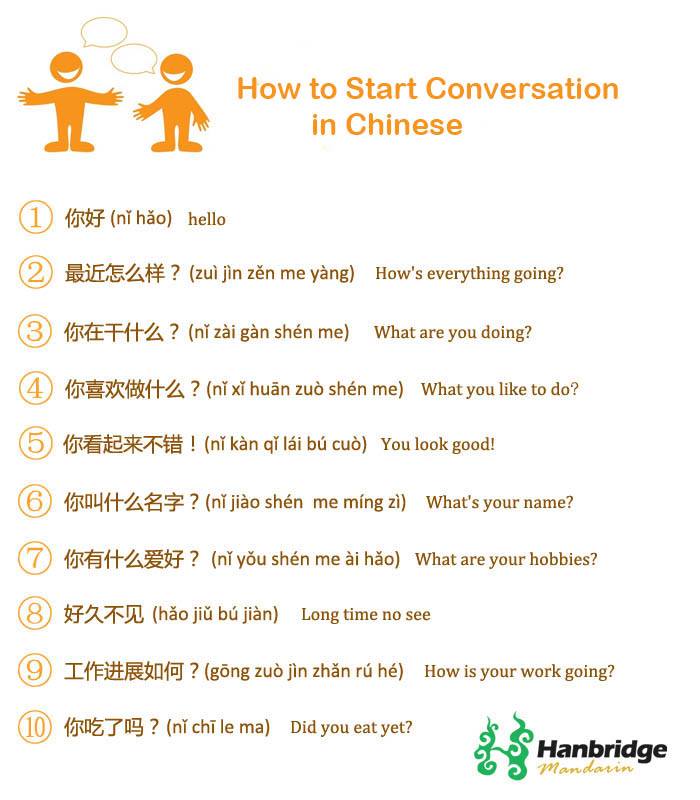
Basic Greetings to Start a Conversation in Chinese
Starting a conversation in Chinese often begins with simple greetings. These phrases are easy to remember and help break the ice. Here are some essential greetings:
- Nǐ hǎo (你好) - The most common way to say Hello.
- Zǎo shang hǎo (早上好) - Means Good morning.
- Wǎn shàng hǎo (晚上好) - Translates to Good evening.
Asking Simple Questions in Chinese
After greeting someone, you can keep the conversation going by asking simple questions. These show interest and encourage a response:
- Nǐ jiào shénme míngzì? (你叫什么名字?) - What is your name?
- Nǐ shì nǎ lǐ rén? (你是哪里人?) - Where are you from?
- Nǐ zuìjìn hǎo ma? (你最近好吗?) - How have you been lately?
Using Common Phrases for Small Talk
Small talk is a great way to build rapport. Here are some useful phrases for casual conversations:
- Jīntiān tiānqì zěnmeyàng? (今天天气怎么样?) - How is the weather today?
- Nǐ xǐhuān chī shénme? (你喜欢吃什么?) - What do you like to eat?
- Nǐ yǒu kòng ma? (你有空吗?) - Do you have free time?
Complimenting to Break the Ice
Giving a compliment can make the other person feel more comfortable. Try these phrases:
- Nǐ de yīfu hěn piàoliang (你的衣服很漂亮) - Your clothes are very pretty.
- Nǐ de Zhōngwén hěn hǎo (你的中文很好) - Your Chinese is very good.
- Nǐ zhēn yǒu cái (你真有才) - You are very talented.
Discussing Hobbies and Interests
Talking about hobbies helps find common ground. Here are some ways to bring it up:
- Nǐ xǐhuān shénme yùndòng? (你喜欢什么运动?) - What sports do you like?
- Nǐ ài kàn diànyǐng ma? (你爱看电影吗?) - Do you like watching movies?
- Nǐ píngshí zuò shénme? (你平时做什么?) - What do you usually do?
Frequently Asked Questions (FAQ)
How can chatting online improve my Chinese vocabulary?
Chatting online exposes you to a wide range of vocabulary in real-time conversations. Unlike textbooks, which often focus on formal language, online chats include slang, idioms, and everyday phrases. By engaging with native speakers, you’ll learn contextual usage and pick up words that are commonly used but rarely taught in classrooms. Additionally, many platforms allow you to save or look up unfamiliar terms, reinforcing your memory retention through repetition.
Does chatting online help with understanding Chinese pronunciation?
Yes, pronunciation improves significantly when you chat online, especially through voice or video calls. Hearing native speakers in real-time helps you mimic tones and accents accurately. Many apps also provide voice messages, allowing you to replay and practice difficult sounds. Over time, your ear becomes attuned to the nuances of Mandarin tones, reducing misunderstandings and boosting your confidence in speaking.
Can online chatting replace traditional Chinese language classes?
While online chatting is a powerful tool, it shouldn’t entirely replace traditional classes. Chatting excels at improving conversational skills and spontaneity, but structured lessons are better for learning grammar rules, writing characters, and understanding cultural depth. The ideal approach is to combine both methods, using online chats to practice what you’ve learned in class and vice versa.
What are the best platforms for chatting online to learn Chinese?
Popular platforms include language exchange apps like Tandem and HelloTalk, which connect you with native speakers. Social media groups on WeChat or QQ offer immersive environments, while video call tools like Zoom or Skype enable real-time practice. For text-based learning, forums like Reddit’s Chinese language communities or Discord servers can be valuable. Choose platforms that align with your learning goals, whether it’s casual conversation or formal practice.
Leave a Reply
Related Posts