
What important words are missing from TOCFL?

The Test of Chinese as a Foreign Language (TOCFL) is a widely recognized proficiency exam for non-native speakers, yet some learners argue that its vocabulary lists lack certain essential words. While TOCFL covers a broad range of terms, everyday expressions, regional colloquialisms, and industry-specific jargon often go unaddressed. This gap can leave test-takers unprepared for real-world conversations or specialized contexts. Identifying these missing words is crucial for improving language acquisition and practical communication skills. This article explores key vocabulary omissions in TOCFL, examining why they matter and how learners can supplement their studies to bridge the gap between textbook Chinese and authentic language use.
What Important Words Are Missing from TOCFL?
The Test of Chinese as a Foreign Language (TOCFL) is a widely recognized proficiency exam for non-native speakers. However, some essential vocabulary is notably absent from its word lists, particularly terms related to modern technology, slang, and industry-specific jargon. This gap can make it difficult for learners to fully engage in real-life conversations or professional settings. Below, we explore key missing words and their significance.
1. Modern Technology and Internet Slang
The TOCFL lacks many contemporary tech terms and internet slang, which are crucial for digital communication. Words like 直播 (zhíbō – livestream), 网红 (wǎnghóng – internet celebrity), and 区块链 (qūkuàiliàn – blockchain) are rarely included, despite their frequent use in daily life.
See AlsoTake responsibility for your Chinese learning now| Missing Word | Pinyin | Meaning |
|---|---|---|
| 直播 | zhíbō | livestream |
| 网红 | wǎnghóng | internet celebrity |
| 区块链 | qūkuàiliàn | blockchain |
2. Business and Professional Terminology
Many business-related terms are overlooked in TOCFL, such as 融资 (róngzī – financing), 股权 (gǔquán – equity), and 供应链 (gōngyìngliàn – supply chain). These words are vital for professionals working in Chinese-speaking environments.
| Missing Word | Pinyin | Meaning |
|---|---|---|
| 融资 | róngzī | financing |
| 股权 | gǔquán | equity |
| 供应链 | gōngyìngliàn | supply chain |
3. Regional Dialects and Colloquialisms
TOCFL primarily focuses on Standard Mandarin, neglecting regional dialects and colloquial expressions. Words like 靠谱 (kàopǔ – reliable) or 忽悠 (hūyou – to trick) are common in speech but often excluded from formal exams.
| Missing Word | Pinyin | Meaning |
|---|---|---|
| 靠谱 | kàopǔ | reliable |
| 忽悠 | hūyou | to trick |
Certain cultural references and social trends are missing, such as 躺平 (tǎngpíng – 'lying flat' movement) or 内卷 (nèijuǎn – involution), which reflect modern societal attitudes in Chinese-speaking regions.
See AlsoFastest Way to Learn Chinese - 8 Critical Ideas| Missing Word | Pinyin | Meaning |
|---|---|---|
| 躺平 | tǎngpíng | lying flat (movement) |
| 内卷 | nèijuǎn | involution |
5. Medical and Health Vocabulary
Healthcare terms, especially those that became prominent post-pandemic, like 核酸检测 (hésuān jiǎncè – nucleic acid test) or 疫苗 (yìmiáo – vaccine), are underrepresented in TOCFL word lists.
| Missing Word | Pinyin | Meaning |
|---|---|---|
| 核酸检测 | hésuān jiǎncè | nucleic acid test |
| 疫苗 | yìmiáo | vaccine |
How many words are there in Tocfl?
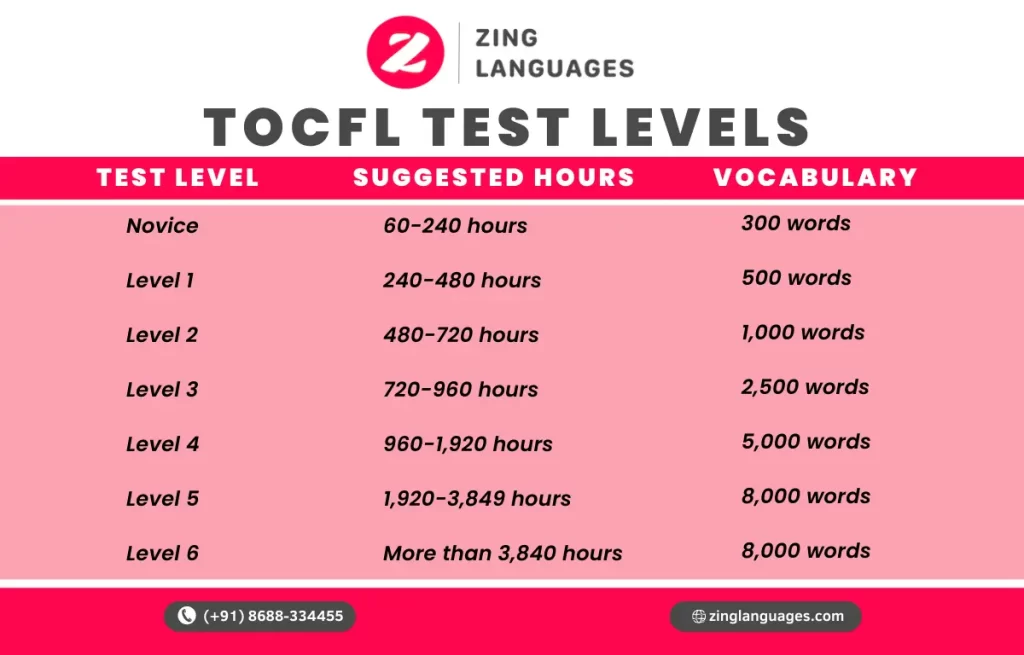
What is the Total Word Count in TOCFL?
The TOCFL (Test of Chinese as a Foreign Language) vocabulary list consists of approximately 8,000 words, categorized into different proficiency levels. These words are essential for learners aiming to master Mandarin Chinese for academic or professional purposes.
See Also10 of the Best Chinese Graded Readers and Where to Find Them- Band A (Beginner): Covers around 500-1,000 basic words.
- Band B (Intermediate): Includes roughly 2,500-3,000 words.
- Band C (Advanced): Encompasses about 5,000-8,000 words.
How Are TOCFL Words Categorized by Level?
The TOCFL vocabulary is divided into six levels, aligned with the CEFR (Common European Framework of Reference for Languages). Each level corresponds to a specific word count and complexity.
- Level 1 (A1): 300-500 words for basic communication.
- Level 2 (A2): 1,000-1,500 words for everyday conversations.
- Level 3 (B1): 2,500 words for intermediate fluency.
Why Does TOCFL Include 8,000 Words?
The 8,000-word benchmark in TOCFL ensures comprehensive coverage of Mandarin vocabulary needed for academic, professional, and daily-life contexts. This range aligns with native speaker proficiency expectations.
- Academic Readiness: Prepares learners for university-level studies.
- Professional Use: Supports workplace communication.
- Cultural Fluency: Enhances understanding of media and literature.
How Does TOCFL Compare to Other Chinese Proficiency Tests?
Unlike HSK (Hanyu Shuiping Kaoshi), which has a 5,000-word limit for its highest level, TOCFL extends to 8,000 words, offering a more rigorous assessment for advanced learners.
- HSK 6: Covers ~5,000 words.
- TOCFL Band C: Tests up to 8,000 words.
- Focus: TOCFL emphasizes real-world usage over standardized testing.
What Resources Help Master TOCFL Vocabulary?
To learn the 8,000 TOCFL words, learners can use textbooks, flashcards, apps, and mock tests. Official TOCFL materials provide structured word lists by level.
- Textbooks: Like A Course in Contemporary Chinese.
- Apps: Such as Pleco or Anki for spaced repetition.
- Mock Tests: Available on TOCFL’s official website.
Frequently Asked Questions (FAQ)
What is TOCFL and why might it have missing important words?
The TOCFL (Test of Chinese as a Foreign Language) is a standardized exam designed to assess the proficiency of non-native speakers in Mandarin Chinese. While it covers a broad range of vocabulary, some important words may be missing due to the test's focus on academic or formal language, omitting regional dialects, slang, or industry-specific terms. Additionally, the test may not always include contemporary or rapidly evolving vocabulary, which could limit its applicability in real-world conversations.
How can I identify gaps in TOCFL vocabulary for my learning needs?
To identify missing words in the TOCFL, compare its vocabulary lists with real-life materials like news articles, movies, or conversations. Pay attention to colloquial expressions, technical jargon, or cultural references that may not appear in the test. Using supplementary resources such as language apps, flashcards, or native speaker interactions can help you uncover these gaps and tailor your study plan accordingly.
Are there alternative resources to supplement TOCFL's vocabulary?
Yes, several resources can complement the TOCFL's vocabulary. Online platforms like Pleco, Anki, or Memrise offer extensive word lists, including informal and specialized terms. Engaging with native content, such as TV shows, podcasts, or social media, exposes learners to authentic language use. Additionally, textbooks focused on business Chinese or regional dialects can fill specific gaps not covered by the TOCFL curriculum.
Does the TOCFL update its vocabulary to reflect modern language trends?
The TOCFL periodically updates its content, but the process may lag behind language evolution. While the test incorporates standardized Mandarin, it might not immediately include new slang, internet lingo, or borrowed words from other languages. Learners should stay informed through official TOCFL announcements and supplement their studies with current materials to ensure they are up-to-date with modern usage.
Leave a Reply
Related Posts