
How to Approach Chinese Grammar

Learning Chinese grammar can seem daunting at first, especially for speakers of Indo-European languages. Unlike English, Chinese relies heavily on word order, particles, and context rather than verb conjugations or complex tenses. However, its logical structure and consistent rules make it more approachable than many expect. By focusing on key patterns, such as sentence order (subject-verb-object), measure words, and the use of particles like 了 (le) and 的 (de), learners can build a strong foundation. Understanding these core principles early on simplifies progress and boosts confidence. This guide breaks down essential concepts to help you navigate Chinese grammar with clarity and ease.
How to Approach Chinese Grammar Effectively
Chinese grammar can seem intimidating at first, but with the right approach, it becomes manageable and even enjoyable. Unlike many Western languages, Chinese relies heavily on word order, particles, and context rather than verb conjugations or complex tenses. Understanding these key differences will help you grasp the language more efficiently. Below, we break down essential aspects of Chinese grammar to guide your learning process.
1. Understanding Basic Sentence Structure
Chinese follows a Subject-Verb-Object (SVO) structure, similar to English. However, modifiers like adjectives and adverbs often come before the noun or verb they describe. For example:
- English: She eats an apple.
- Chinese: 她吃一个苹果 (Tā chī yī gè píngguǒ) – She eats one apple.
| Element | Position |
|---|---|
| Subject | First |
| Verb | Second |
| Object | Last |
2. Mastering Measure Words
Chinese uses measure words (量词 liàngcí) between numbers and nouns. Each noun category has a specific measure word. For example:
- 一本书 (yī běn shū) – one book (本 běn is for books)
- 一只猫 (yī zhī māo) – one cat (只 zhī is for animals)
| Noun Type | Measure Word |
|---|---|
| Books | 本 (běn) |
| Animals | 只 (zhī) |
| Flat Objects | 张 (zhāng) |
3. Grasping Tenses Without Conjugation
Chinese does not conjugate verbs for tense. Instead, it uses time indicators and particles like 了 (le) for past actions or 会 (huì) for future intentions.
- Past: 我吃了 (Wǒ chī le) – I ate.
- Future: 我会吃 (Wǒ huì chī) – I will eat.
| Tense | Indicator |
|---|---|
| Past | 了 (le) |
| Future | 会 (huì), 要 (yào) |
| Present | No marker (context-based) |
4. Using Particles for Nuance
Particles like 吗 (ma) for questions or 的 (de) for possession add meaning without changing word forms.
- Question: 你好吗?(Nǐ hǎo ma?) – How are you?
- Possession: 我的书 (Wǒ de shū) – My book
| Particle | Function |
|---|---|
| 吗 (ma) | Turns statements into yes/no questions |
| 的 (de) | Shows possession or description |
| 了 (le) | Indicates completed actions |
5. Learning Through Context and Practice
Chinese grammar relies heavily on context. Immersing yourself in the language through conversations, reading, and listening will help you internalize patterns naturally.
| Method | Benefit |
|---|---|
| Conversation Practice | Reinforces word order and particles |
| Reading Short Texts | Improves contextual understanding |
| Listening to Native Speakers | Helps recognize grammar in real-time |
How do you approach learning Chinese?

Setting Clear Goals for Learning Chinese
To effectively learn Chinese, start by defining your objectives. Are you learning for travel, business, or personal interest? Clear goals help tailor your study plan. Consider the following steps:
See AlsoGuanxi in China: A Little Understood Concept in the West- Identify priorities: Focus on speaking, reading, or writing first.
- Set milestones: Break learning into manageable stages, like mastering 100 characters.
- Track progress: Use apps or journals to monitor improvements.
Mastering Chinese Pronunciation and Tones
Pronunciation and tones are critical in Chinese due to its tonal nature. Mispronouncing tones can change meanings entirely. Follow these steps:
- Practice daily: Use tools like Pinyin charts or language apps.
- Listen and repeat: Mimic native speakers via videos or audio lessons.
- Record yourself: Compare your pronunciation with native audio.
Building a Strong Vocabulary Foundation
Expanding your vocabulary is essential for fluency. Start with high-frequency words and phrases. Here’s how:
- Learn radicals: Understand character components to memorize faster.
- Use flashcards: Apps like Anki or Pleco reinforce retention.
- Contextual learning: Study words in sentences, not isolation.
Practicing Chinese Characters and Writing
Chinese characters require consistent practice. Begin with basic strokes and radicals before complex characters. Follow these tips:
See AlsoAdd Oil! “Jia You” Makes it Into the Oxford English Dictionary- Write daily: Use grid paper to maintain proportions.
- Break down characters: Analyze radicals and components.
- Use mnemonics: Create stories to remember character meanings.
Immersing Yourself in Chinese Culture and Media
Immersion accelerates learning by exposing you to real-world usage. Engage with Chinese media and culture:
- Watch shows/movies: Use subtitles initially, then gradually remove them.
- Listen to music/podcasts: Improves listening skills and colloquial understanding.
- Join language exchanges: Practice with native speakers online or locally.
What is the basic pattern of Chinese grammar?

Subject-Verb-Object (SVO) Structure
The basic pattern of Chinese grammar follows the Subject-Verb-Object (SVO) order, similar to English. This structure is straightforward and consistent in most sentences.
- Subject (who/what performs the action) comes first.
- Verb (the action) follows the subject.
- Object (the receiver of the action) comes last.
No Verb Conjugation
Chinese grammar does not use verb conjugation based on tense, number, or gender. The verb remains the same, and context or additional words indicate time.
- No changes for past, present, or future—verbs stay in their base form.
- Time indicators (e.g., 昨天 yesterday, 明天 tomorrow) clarify tense.
- Aspect particles like 了 (le) or 过 (guo) show completed actions.
Measure Words (Classifiers)
Chinese uses measure words (量词 liàngcí) between numbers/nouns and demonstratives/nouns, which is a unique feature.
- Required when counting objects (e.g., 一本书 one book uses 本 běn).
- Specific classifiers match noun categories (e.g., 张 zhāng for flat objects).
- General measure word 个 (gè) is often used as a default.
Topic-Comment Structure
Chinese often employs a topic-comment structure, where the topic is introduced first, followed by a comment about it.
- Topic (what the sentence is about) starts the sentence.
- Comment (information about the topic) follows.
- Flexible word order compared to strict SVO in some cases.
No Plural Forms for Nouns
Chinese nouns do not change form to indicate plurality. Context or quantifiers specify number.
- Nouns stay the same whether singular or plural.
- Quantifiers (e.g., 一些 some, 很多 many) clarify amount.
- Pronouns may add 们 (men) for plurals (e.g., 我们 we).
Is Chinese grammar hard or easy?
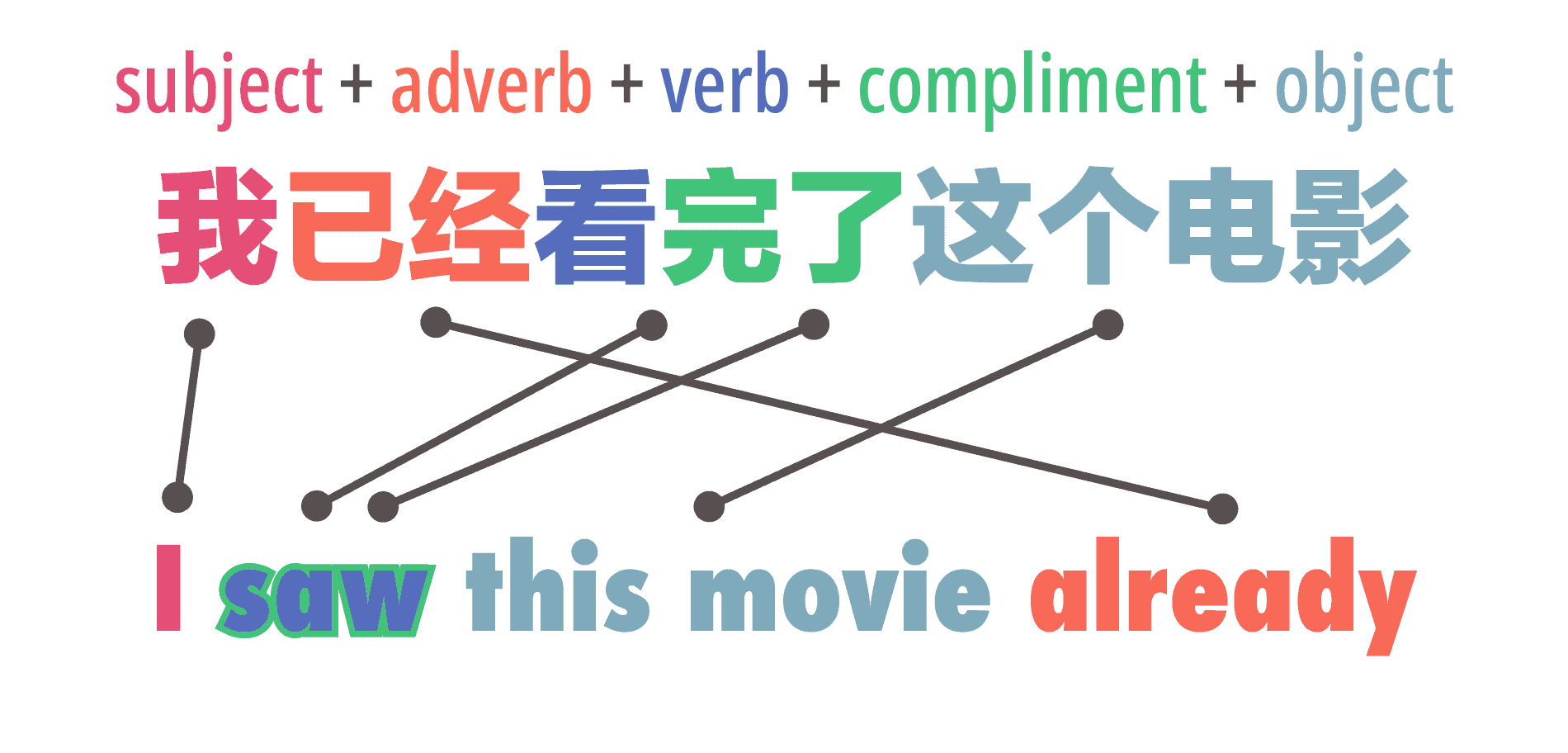
Is Chinese Grammar Simpler Than English?
Chinese grammar is often considered simpler than English in several ways. Unlike English, Chinese does not have:
- Verb conjugations (no changes for tense or person).
- Plural forms (nouns stay the same).
- Articles (no a, an, or the).
What Makes Chinese Grammar Challenging?
Despite its simplicity, Chinese has unique features that can be difficult for learners:
- Tones change word meanings (e.g., ma can mean mother or horse).
- Measure words are required when counting (e.g., one piece of paper).
- Word order is strict (subject-verb-object, but exceptions exist).
How Does Chinese Handle Tenses Without Conjugations?
Chinese uses time indicators and context instead of verb changes:
- Adverbs like yesterday or tomorrow clarify time.
- Aspect particles (e.g., le for completed actions).
- No future tense—rely on context or words like will.
Are Chinese Sentence Structures Flexible?
Chinese sentences follow a rigid order, but some flexibility exists:
- Topic-comment structure can rearrange focus.
- No inversion for questions (use particles like ma).
- Omitting subjects is common if context is clear.
Why Are Measure Words Tricky in Chinese?
Measure words (量词) are mandatory and vary by object type:
- Specificity: 条 for long objects (rivers, pants).
- Memorization: No universal rule—each noun pairs with a measure word.
- Exceptions: Some measure words overlap (e.g., 个 is general but not always correct).
What is ABAB in Chinese grammar?

What Is the ABAB Structure in Chinese Grammar?
The ABAB structure is a reduplication pattern in Chinese grammar where a two-syllable word (AB) is repeated to form a four-syllable phrase (ABAB). This structure is commonly used to emphasize actions, describe states, or create rhythmic expressions. It is frequently seen in verbs, adjectives, and occasionally nouns.
- Function: Used to intensify meaning or soften tone.
- Examples: 学习学习 (xuéxí xuéxí) means to study a bit.
- Context: Often appears in casual or instructional speech.
How Is ABAB Used in Chinese Verbs?
In Chinese verbs, the ABAB pattern indicates a brief or repeated action. It softens the command or suggests a light, temporary activity.
- Example: 休息休息 (xiūxi xiūxi) means take a short rest.
- Purpose: Makes instructions sound less direct.
- Common Verbs: 看看 (kànkan), 试试 (shìshi).
What Role Does ABAB Play in Chinese Adjectives?
When applied to Chinese adjectives, the ABAB structure enhances descriptive qualities, often making them more vivid or expressive.
- Example: 高兴高兴 (gāoxìng gāoxìng) means a little happy.
- Effect: Adds a playful or informal tone.
- Usage: More common in spoken than written Chinese.
Is ABAB Used in Chinese Nouns?
While less frequent, the ABAB pattern can appear in nouns, usually to denote informal or affectionate terms.
- Example: 小朋友小朋友 (xiǎo péngyǒu xiǎo péngyǒu) means little friends.
- Context: Often used in children's language or pet names.
- Limitation: Rare in formal writing.
How Does ABAB Compare to AABB Reduplication?
The ABAB structure differs from AABB reduplication, which repeats each syllable separately (e.g., 高高兴兴 for very happy).
- ABAB: Repeats the whole word for a lighter tone.
- AABB: Emphasizes completeness or intensity.
- Grammatical Focus: ABAB is more action-oriented, while AABB is descriptive.
Frequently Asked Questions (FAQ)
What is the best way to start learning Chinese grammar?
When beginning to learn Chinese grammar, it's essential to focus on sentence structure first. Unlike English, Chinese follows a subject-verb-object (SVO) pattern, which is relatively straightforward. Start by mastering basic word order and common particles like 了 (le) for completed actions or 的 (de) for possession. Building a foundation with simple sentences will help you gradually understand more complex structures.
How important are measure words in Chinese grammar?
Measure words are a crucial aspect of Chinese grammar and cannot be ignored. Every noun requires a specific classifier when paired with a number or demonstrative, such as 个 (gè) for general objects or 本 (běn) for books. While it may seem overwhelming at first, memorizing the most common measure words will significantly improve your fluency and accuracy in speech and writing.
What are the biggest challenges when learning Chinese grammar?
One of the biggest challenges in Chinese grammar is the lack of verb conjugation and tenses as seen in English. Instead, Chinese relies on context and particles to indicate time. Additionally, the use of topic-comment structures and omission of subjects can be confusing for beginners. Understanding these differences early on will help you adapt more quickly to the language's unique logic.
How can I practice Chinese grammar effectively?
To practice Chinese grammar effectively, immerse yourself in the language through reading and listening to native content. Use language apps or textbooks to reinforce rules, and try writing short sentences or dialogues. Engaging in conversations with native speakers will also help you apply grammar naturally. Consistency and exposure are key to internalizing the structures and patterns of Chinese.
Leave a Reply
Related Posts