
Kickstart your Chinese character learning with the 100 most common radicals

Learning Chinese characters can seem daunting, but mastering radicals—the building blocks of characters—can make the process much easier. Radicals often hint at a character’s meaning or pronunciation, providing valuable clues for learners. By focusing on the 100 most common radicals, you’ll unlock the logic behind thousands of characters, accelerating your comprehension and retention. This guide introduces these essential components, explaining their roles and how they combine to form more complex characters. Whether you're a beginner or looking to strengthen your foundation, understanding these radicals will give you a powerful head start in your Chinese language journey. Dive in and discover the key to unlocking Chinese characters.
https://youtube.com/watch?v=Tx_HS3S8Il4
- Kickstart Your Chinese Character Learning with the 100 Most Common Radicals
- What are the 214 radicals in Chinese?
- What is the fastest way to memorize Chinese characters?
- How do you find the radicals in Chinese characters?
-
Frequently Asked Questions (FAQ)
- What are radicals in Chinese characters and why are they important?
- How can learning the 100 most common radicals kickstart my Chinese character learning?
- Are radicals the same as the meaning or pronunciation of a character?
- How should I practice and memorize the 100 most common radicals effectively?
Kickstart Your Chinese Character Learning with the 100 Most Common Radicals
Learning Chinese characters can seem overwhelming, but mastering radicals—the building blocks of characters—can make the process much easier. Radicals often hint at a character’s meaning or pronunciation, making them invaluable for learners. By focusing on the 100 most common radicals, you’ll gain a strong foundation to decode and remember thousands of characters efficiently.
See AlsoShould you learn the pronunciation of radicals?What Are Radicals and Why Are They Important?
Radicals are key components of Chinese characters, often providing clues about meaning (semantic radicals) or sound (phonetic radicals). For example, the radical 氵 (water) appears in characters like 河 (hé, river) and 湖 (hú, lake), linking them to water-related meanings. Learning radicals helps you break down complex characters, recognize patterns, and accelerate vocabulary acquisition.
| Radical | Meaning | Example Character |
|---|---|---|
| ⻊ | Foot | 跑 (pǎo, run) |
| 讠 | Speech | 说 (shuō, speak) |
How to Memorize Radicals Effectively
To memorize radicals efficiently, use mnemonics, spaced repetition, and visual associations. Group radicals by themes (e.g., nature, body parts) and practice writing them alongside example characters. Apps like Anki or Skritter can reinforce retention through interactive exercises.
| Method | Description |
|---|---|
| Mnemonics | Create stories linking radicals to their meanings. |
| Spaced Repetition | Review radicals at increasing intervals. |
The Top 10 Most Frequent Radicals to Learn First
Start with these high-frequency radicals to quickly boost your character recognition:
See AlsoAnswer buttons and how to use SRS to study Chinese1. 人 (rén, person) – Found in 你 (nǐ, you) and 他 (tā, he).
2. 口 (kǒu, mouth) – Appears in 叫 (jiào, call) and 吃 (chī, eat).
| Radical | Frequency |
|---|---|
| 人 | Very High |
| 口 | High |
How Radicals Simplify Character Lookup in Dictionaries
Chinese dictionaries organize characters by their primary radical. Knowing radicals helps you navigate dictionaries faster, even if you don’t know a character’s pronunciation. For instance, the character 妈 (mā, mother) is listed under the 女 (nǚ, woman) radical.
| Radical | Dictionary Section |
|---|---|
| 木 | Tree-related characters |
Common Mistakes to Avoid When Learning Radicals
Avoid these pitfalls to maximize your progress:
- Ignoring stroke order: Proper writing reinforces memory.
- Overloading: Focus on 20-30 radicals at a time to prevent burnout.
| Mistake | Solution |
|---|---|
| Rushing | Practice radicals daily in small batches. |
What are the 214 radicals in Chinese?

What Are the 214 Radicals in Chinese?
The 214 radicals in Chinese are the foundational components used to categorize and organize Chinese characters in dictionaries. These radicals, also known as Kangxi radicals, were systematized during the Qing Dynasty and remain essential for learning and referencing Chinese characters.
- Structure: Each radical serves as a semantic or phonetic indicator, helping to group characters with shared meanings or pronunciations.
- Function: They simplify character lookup in dictionaries by providing a logical classification system.
- Variations: Some radicals have multiple forms, depending on their position within a character (e.g., ⺼ as a left-side variant of 肉).
Why Are the 214 Radicals Important?
The 214 radicals are crucial for understanding and memorizing Chinese characters efficiently. They act as building blocks, enabling learners to break down complex characters into manageable parts.
See AlsoLearning how to learn Chinese through self-experimentation- Memory Aid: Recognizing radicals helps in recalling characters by associating them with familiar components.
- Dictionary Use: Most traditional dictionaries organize entries by radical and stroke count.
- Cultural Significance: Radicals reflect historical and linguistic evolution, offering insights into Chinese writing.
How Are the 214 Radicals Categorized?
The 214 radicals are grouped based on their stroke count, ranging from one stroke (e.g., 一) to 17 strokes (e.g., 龠). This categorization aids in systematic learning and reference.
- Stroke Count: Radicals are ordered from simplest (fewest strokes) to most complex.
- Frequency: Common radicals like 人 (person) appear frequently, while others are rare.
- Position: Radicals may occupy fixed positions in characters (e.g., left, right, top, or bottom).
Common Examples of the 214 Radicals
Some of the most frequently used 214 radicals include:
- 水 (shuǐ): Meaning water, it appears in characters like 河 (river) and 海 (sea).
- 人 (rén): Meaning person, found in 你 (you) and 他 (him).
- 口 (kǒu): Meaning mouth, used in 吃 (eat) and 叫 (shout).
How to Learn the 214 Radicals Effectively
Mastering the 214 radicals requires consistent practice and strategic learning methods.
- Flashcards: Create flashcards for each radical, including its meaning and example characters.
- Writing Practice: Write radicals repeatedly to memorize their forms and stroke order.
- Character Deconstruction: Analyze new characters by identifying their radicals and components.
What is the fastest way to memorize Chinese characters?
Understanding the Structure of Chinese Characters
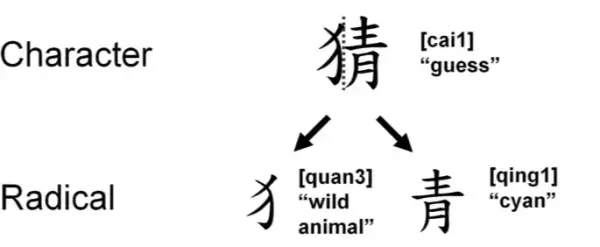
To memorize Chinese characters quickly, it's essential to understand their structure. Most characters are composed of radicals (components with meaning) and phonetic elements (hints to pronunciation). Breaking them down simplifies learning:
- Radicals: Learn common radicals first, as they often indicate a character's general meaning.
- Phonetic components: Identify parts that hint at pronunciation, even if not always accurate.
- Stroke order: Practice writing characters correctly to reinforce muscle memory.
Using Spaced Repetition Systems (SRS)
Spaced repetition is a scientifically proven method to enhance memorization. Tools like Anki or Pleco optimize review timing:
- Flashcards: Create digital or physical cards with characters and their meanings.
- Review intervals: Schedule reviews based on difficulty (e.g., harder characters appear more often).
- Consistency: Daily practice ensures long-term retention.
Linking Characters to Stories or Mnemonics
Creating associations or stories makes abstract characters memorable. Mnemonics tie characters to vivid mental images:
- Visualization: Imagine the character's shape as a real-life object (e.g., 木 tree resembles branches).
- Storytelling: Combine radicals into a narrative (e.g., 好 good = woman 女 + child 子).
- Exaggeration: The sillier or more dramatic the story, the better it sticks.
Practicing Writing and Reading Simultaneously
Combining writing and reading reinforces memory. Writing by hand engages motor skills, while reading builds recognition:
- Copy characters: Write each character multiple times while saying its meaning aloud.
- Contextual reading: Read sentences or short texts to see characters in action.
- Dictation exercises: Listen to words and write them from memory.
Immersing Yourself in Chinese Media
Exposure to native content accelerates learning. Engage with TV shows, books, or music to see characters in context:
- Subtitles: Watch Chinese media with dual-language subtitles.
- Graded readers: Start with beginner-friendly books that include pinyin and translations.
- Labeling: Stick notes with characters on everyday objects at home.
How do you find the radicals in Chinese characters?
Understanding the Concept of Radicals in Chinese Characters
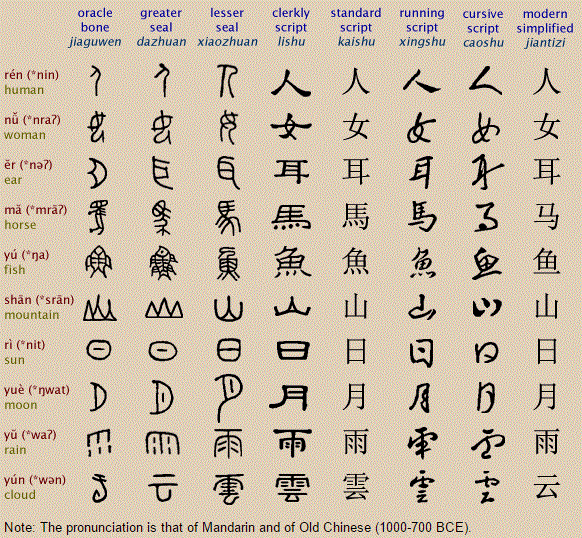
Radicals are key components of Chinese characters that help categorize and organize them in dictionaries. They often provide clues to the character's meaning or pronunciation. To identify radicals:
- Look for recurring components in multiple characters, as radicals often repeat.
- Check the left or top of the character, as radicals commonly appear there.
- Refer to a radical table, which lists all 214 traditional radicals used in dictionaries.
Methods to Identify Radicals in a Character
Finding radicals requires practice, but these methods simplify the process:
- Analyze the structure—many characters are divided into a radical and a phonetic component.
- Use a dictionary—most entries list the radical and stroke count for easy lookup.
- Learn common radicals—memorizing frequently used ones speeds up identification.
Common Positions of Radicals in Characters
Radicals often occupy predictable positions within a character:
- Left side (偏旁)—e.g., 氵in 河 (river).
- Top (部首)—e.g., 艹 in 花 (flower).
- Bottom or enclosure—e.g., 心 in 想 (think).
Tools and Resources for Finding Radicals
Several tools can assist in radical identification:
- Online dictionaries like Pleco or MDBG.
- Radical index books for traditional and simplified characters.
- Mobile apps with handwriting input to detect radicals automatically.
Practical Tips for Memorizing Radicals
Improve retention with these strategies:
- Group characters by radical to see patterns.
- Practice writing radicals separately to recognize them faster.
- Use flashcards for repetitive learning.
Frequently Asked Questions (FAQ)
What are radicals in Chinese characters and why are they important?
Radicals are the building blocks of Chinese characters, often providing clues about a character's meaning or pronunciation. They are essential for learning and memorizing characters efficiently because they help break down complex characters into manageable parts. By mastering the 100 most common radicals, you can significantly improve your ability to recognize, understand, and recall thousands of characters, making them a foundational tool for anyone studying Mandarin.
How can learning the 100 most common radicals kickstart my Chinese character learning?
Focusing on the 100 most common radicals provides a structured approach to learning Chinese characters. Since radicals appear repeatedly across different characters, understanding them allows you to decode new characters more easily. This method accelerates your learning by reducing the need to memorize each character individually. Instead, you'll start recognizing patterns and components, which makes the process more intuitive and less overwhelming, especially for beginners.
Are radicals the same as the meaning or pronunciation of a character?
While radicals often hint at a character's meaning or pronunciation, they are not always definitive. Some radicals indicate the general category or theme of a character (semantic radicals), while others may suggest its sound (phonetic radicals). However, there are exceptions, and not all radicals directly correlate with meaning or pronunciation. Learning radicals is about identifying patterns rather than relying on strict rules, which is why studying the most common ones is so valuable.
How should I practice and memorize the 100 most common radicals effectively?
To memorize radicals effectively, combine visual, written, and contextual practice. Start by writing each radical repeatedly to familiarize yourself with its form. Use flashcards or apps to test your recognition. Then, practice identifying radicals within full characters to see how they function in context. Grouping radicals by theme (e.g., water-related, human-related) can also aid memory. Consistency is key—dedicate a few minutes daily to review, and over time, you'll build a strong foundation for character learning.
Leave a Reply
Related Posts