
Brand Failure in China: What Brands Do Wrong

Entering the Chinese market presents immense opportunities for global brands, but many fail to adapt and ultimately face significant setbacks. From cultural missteps to poor localization strategies, numerous factors contribute to brand failure in China. Whether due to misunderstanding consumer preferences, underestimating local competition, or mishandling sensitive issues, even well-established companies struggle to gain traction. This article explores the common pitfalls that lead to brand failures in China, analyzing real-world examples and offering insights into what companies must do differently. By understanding these mistakes, businesses can refine their strategies and increase their chances of success in one of the world’s most complex and dynamic markets.
Common Mistakes Leading to Brand Failure in China
1. Lack of Cultural Understanding
Many brands fail in China because they do not invest enough time in understanding the cultural nuances and consumer behavior. China has a deeply rooted culture with unique traditions, values, and communication styles. Brands that ignore these aspects often struggle to connect with local audiences. For example, using Western-centric marketing messages without adaptation can lead to misunderstandings or even offend potential customers.
| Mistake | Impact |
|---|---|
| Ignoring local festivals | Missed engagement opportunities |
| Inappropriate symbolism | Brand reputation damage |
2. Poor Localization Strategies
A one-size-fits-all approach rarely works in China. Brands that fail to localize their products, services, or marketing campaigns often face rejection. This includes language translation errors, unsuitable product features, or neglecting regional preferences. For instance, a beauty brand may fail if it does not consider the Chinese preference for lighter skincare textures compared to Western markets.
See AlsoHandwriting Chinese characters: The minimum requirements| Localization Error | Consequence |
|---|---|
| Literal translations | Confusing messaging |
| Ignoring regional tastes | Low product adoption |
3. Overlooking Digital Ecosystem Differences
China’s digital landscape is dominated by platforms like WeChat, Douyin (TikTok China), and Little Red Book, unlike the West’s reliance on Google and Facebook. Brands that do not leverage these platforms effectively miss out on massive engagement opportunities. Additionally, payment systems like Alipay and WeChat Pay are essential for e-commerce success.
| Platform Neglected | Missed Advantage |
|---|---|
| WeChat Mini Programs | Direct customer engagement |
| Douyin Livestreaming | High sales conversion |
4. Ignoring Regulatory Compliance
China has strict regulations on data privacy, advertising, and product standards. Brands that fail to comply risk fines, bans, or loss of consumer trust. For example, incorrect labeling or unapproved claims in advertisements can lead to legal consequences.
| Regulatory Issue | Potential Penalty |
|---|---|
| Non-compliant data storage | Heavy fines |
| Misleading ads | Brand suspension |
5. Underestimating Local Competition
Many international brands underestimate the strength of local competitors in China. Domestic brands often understand consumer needs better and innovate faster. For example, Huawei and Xiaomi have outperformed global tech giants by offering tailored products at competitive prices.
See Also5 ‘Easy’ Chinese Tongue Twisters You Need to Know in Mandarin| Competitive Weakness | Outcome |
|---|---|
| Higher pricing | Lower market share |
| Slower innovation | Loss of relevance |
What brands failed in China?
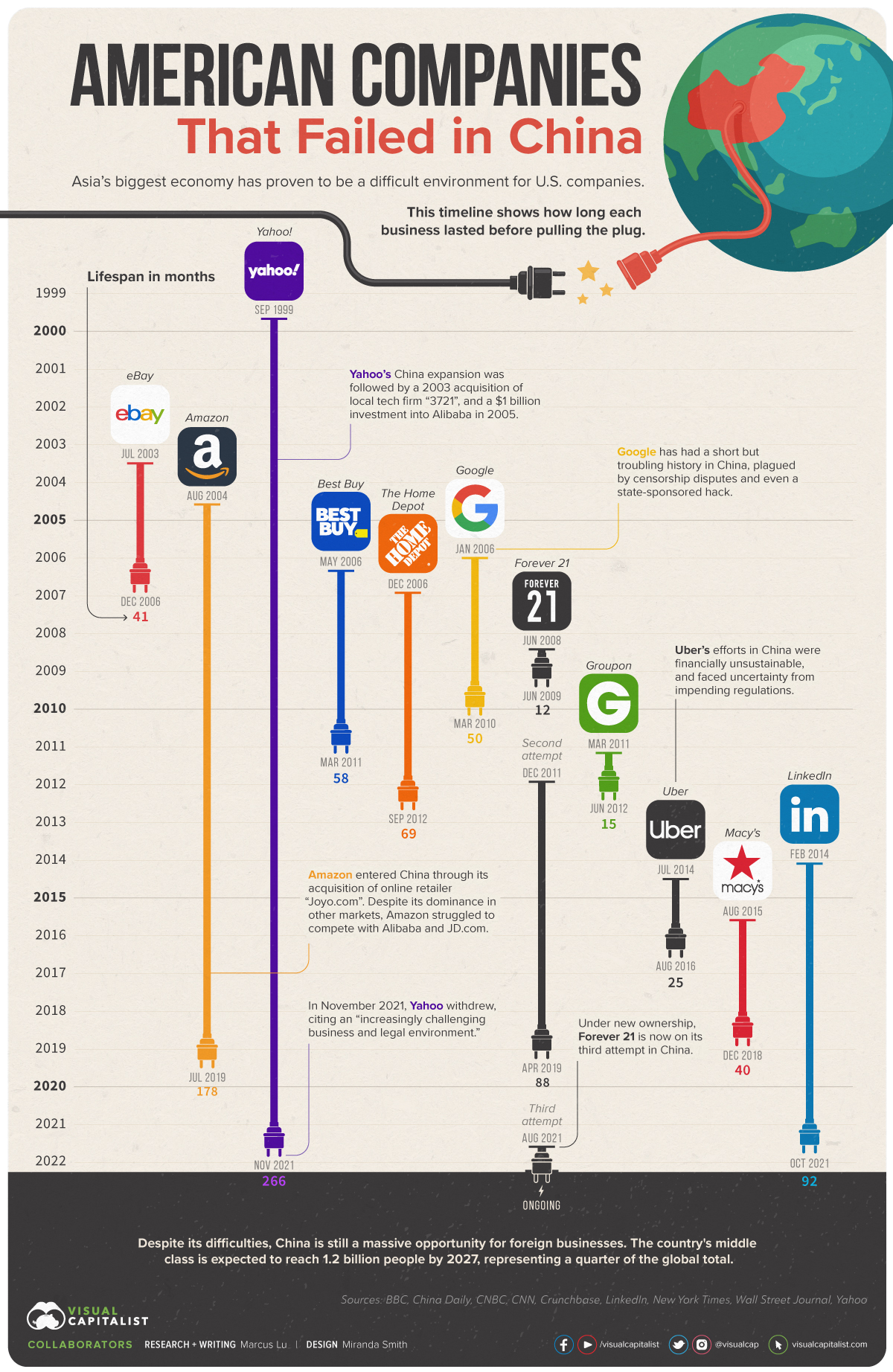
Why Did eBay Fail in China?
eBay entered China in 2002 but struggled due to fierce competition and misaligned strategies. Alibaba's Taobao dominated the market with a free-listings model, while eBay charged fees. Key reasons for eBay's failure include:
- Lack of localization: eBay used a global platform, ignoring Chinese consumer preferences.
- Slow adaptation: Taobao offered better customer service and payment solutions like Alipay.
- Overconfidence: eBay underestimated local competitors and failed to adjust quickly.
How Did Home Depot Struggle in China?
Home Depot, the American home improvement giant, exited China in 2012 after failing to adapt. Unlike Western markets, Chinese consumers preferred custom-built homes over DIY projects. Major challenges included:
See AlsoLearning how to ask for and receive directions in Chinese- Cultural mismatch: Chinese buyers relied on contractors, not self-renovation.
- High operational costs: Rent and labor expenses outweighed profits.
- Strong local competitors: Stores like B&Q and Nitori better understood local needs.
Why Did Best Buy Exit China?
Best Buy closed its branded stores in China in 2011 due to poor performance. The electronics retailer faced intense competition from local rivals like Suning and Gome. Key failures were:
- High prices: Chinese consumers favored cheaper alternatives.
- Limited store presence: Best Buy had fewer locations than competitors.
- Online competition: E-commerce platforms like JD.com offered faster delivery.
What Led to Uber's Defeat in China?
Uber sold its China operations to Didi Chuxing in 2016 after losing billions. Despite aggressive expansion, Uber couldn’t match Didi's dominance. Critical factors included:
- Regulatory hurdles: Didi had stronger government connections.
- Price wars: Uber spent heavily on subsidies but couldn’t sustain them.
- Localized services: Didi offered features like carpooling and taxi-hailing.
Why Did Groupon Fail in China?
Groupon’s joint venture, Gaopeng, shut down in 2012 due to poor performance. The daily-deals platform struggled against local giants like Meituan. Main issues were:
See AlsoJianbing: How to Order Your Favourite Breakfast in China- Lack of trust: Consumers doubted Gaopeng’s merchant quality.
- Management conflicts: Disputes between Groupon and local partners hurt operations.
- Strong competition: Meituan and Dianping had better market penetration.
Which company failed to establish its business in China initially due to misunderstandings of culture?
Why Did eBay Struggle in China Due to Cultural Misunderstandings?
eBay initially failed in China because it underestimated the importance of local consumer behavior and trust-building in e-commerce. The company applied a Western approach, which clashed with Chinese preferences.
- Lack of localized customer service: eBay did not adapt its support to Chinese expectations.
- Over-reliance on auctions: Chinese buyers preferred fixed-price sales, which Taobao offered.
- Failure to integrate social commerce: eBay ignored the role of community-driven platforms like Alibaba's Taobao.
How Did Google Misinterpret Chinese Market Culture?
Google faced challenges in China due to its misunderstanding of censorship policies and user preferences. The company's insistence on a global model led to its decline against Baidu.
See AlsoHorizontal vocabulary learning in Chinese- Ignored government regulations: Google resisted censorship, unlike Baidu, which complied.
- Poor localization: Search results were less tailored to Chinese users compared to Baidu.
- Slow adaptation to mobile: Baidu dominated mobile search early, while Google lagged.
What Cultural Mistakes Did Home Depot Make in China?
Home Depot failed in China because it misjudged DIY culture and consumer habits. Chinese customers preferred hiring laborers over self-service home improvement.
- Wrong product focus: Home Depot stocked large DIY tools, but Chinese buyers wanted smaller, pre-assembled items.
- High prices: Local competitors offered cheaper labor services, making DIY less appealing.
- Lack of local partnerships: Home Depot did not collaborate with Chinese contractors effectively.
Why Did Groupon Fail in China Because of Cultural Missteps?
Groupon struggled in China due to its aggressive expansion and lack of local market understanding. Chinese competitors like Meituan adapted better.
- Overly aggressive marketing: Groupon's tactics alienated local businesses.
- Ignored group-buying nuances: Chinese platforms focused on long-term deals, not one-time discounts.
- Poor merchant relationships: Groupon did not build trust with local vendors.
How Did Best Buy Misunderstand Chinese Retail Culture?
Best Buy exited China because it failed to adapt to local shopping behaviors and pricing expectations. Chinese consumers favored smaller, competitive electronics stores.
- Large-store model: Chinese buyers preferred smaller, specialized shops.
- High pricing strategy: Local competitors like Suning offered better deals.
- Weak online presence: Best Buy did not invest enough in e-commerce, unlike JD.com.
Why did Pepsi fail in China?

Cultural Misalignment and Brand Perception
Pepsi struggled in China due to a cultural misalignment with local preferences. While the brand positioned itself as youthful and rebellious in Western markets, this approach didn’t resonate with Chinese consumers, who valued tradition and conformity. Additionally, Pepsi’s brand perception as a secondary choice to Coca-Cola further hindered its success.
- Youth-centric marketing clashed with conservative Chinese values.
- Lacked emotional connection compared to competitors like Coca-Cola.
- Failed to adapt its global branding to local cultural nuances.
Strong Competition from Coca-Cola
Coca-Cola’s early market entry and deep-rooted presence in China gave it a significant advantage over Pepsi. The company invested heavily in local partnerships and distribution networks, making it the default choice for consumers. Pepsi, meanwhile, couldn’t match this dominance.
- Coca-Cola entered China in 1927, decades before Pepsi.
- Established strong relationships with local bottlers and retailers.
- Pepsi’s limited market share made expansion difficult.
Ineffective Localization Strategies
Pepsi’s localization efforts were insufficient compared to rivals. While Coca-Cola tailored flavors and campaigns to Chinese tastes, Pepsi relied too heavily on its global formula, failing to innovate or differentiate itself meaningfully.
- Didn’t introduce region-specific flavors like Coca-Cola’s tea-infused drinks.
- Marketing campaigns lacked cultural relevance.
- Underestimated the importance of festival-based promotions in China.
Distribution and Supply Chain Challenges
Pepsi faced logistical hurdles in China’s vast and complex market. Its distribution network was weaker than Coca-Cola’s, leading to inconsistent availability and slower expansion into rural areas.
- Limited cold drink infrastructure in smaller cities.
- Relied on third-party distributors, causing inefficiencies.
- Coca-Cola’s direct distribution model outperformed Pepsi’s approach.
Misjudged Pricing and Market Positioning
Pepsi’s pricing strategy didn’t align with Chinese consumer expectations. While it positioned itself as a premium brand, many local consumers preferred affordable alternatives or viewed Coca-Cola as the more authentic choice.
- Failed to compete with local soda brands offering lower prices.
- Premium pricing alienated price-sensitive consumers.
- Lacked perceived value compared to Coca-Cola’s heritage in China.
Why did Marks and Spencer fail in China?
Poor Market Research and Localization
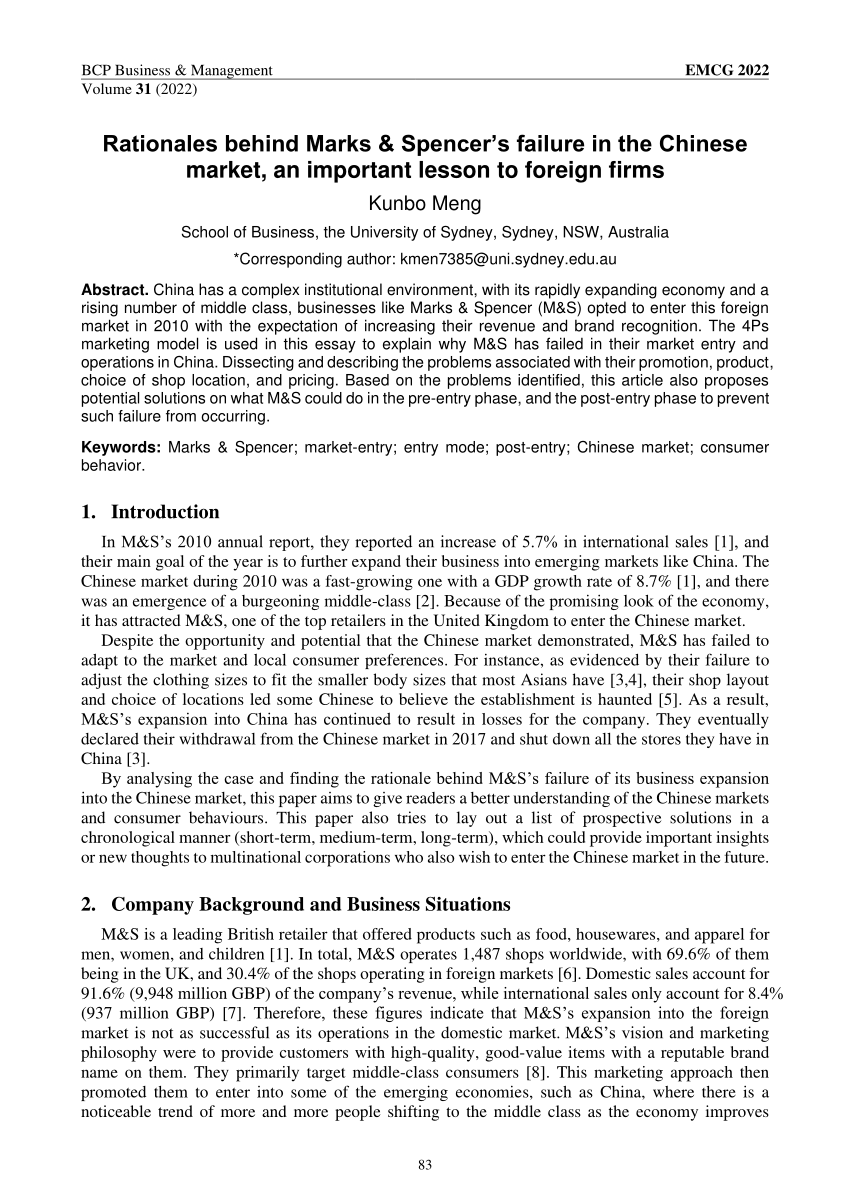
Marks and Spencer (M&S) failed to conduct thorough market research and adapt to Chinese consumer preferences. Their product offerings did not align with local tastes, and they underestimated the importance of localization.
- Clothing sizes were not adjusted for Chinese body types, making their apparel less appealing.
- They overlooked the demand for seasonal and regional variations in fashion and food products.
- Their British-centric branding lacked resonance with Chinese shoppers, who prefer localized or international luxury brands.
Ineffective Pricing Strategy
M&S adopted a premium pricing strategy that did not match the expectations of Chinese consumers, who sought either affordable fast fashion or high-end luxury goods.
- Their mid-range pricing positioned them awkwardly between budget-friendly competitors like Uniqlo and luxury brands like Burberry.
- They failed to offer competitive discounts or loyalty programs to attract price-sensitive shoppers.
- The perceived value for money was low compared to domestic brands offering similar quality at lower prices.
Weak Digital and E-Commerce Presence
M&S lagged behind in digital innovation and failed to leverage China’s booming e-commerce ecosystem.
- They were slow to partner with dominant platforms like Tmall and JD.com.
- Their online shopping experience was not optimized for Chinese users, lacking features like live-streaming or social commerce.
- They underestimated the importance of mobile payments and integrations with WeChat and Alipay.
Strong Local Competition
M&S struggled to compete with established local brands and agile competitors that better understood Chinese consumer behavior.
- Domestic retailers like Peacebird and ICICLE offered trendier and more culturally relevant products.
- Fast-fashion giants like Zara and H&M adapted quickly to local trends, outpacing M&S.
- Chinese consumers favored brands with strong local celebrity endorsements and social media engagement, which M&S lacked.
Operational and Expansion Missteps
M&S made critical errors in store locations and expansion strategy, leading to poor visibility and accessibility.
- They opened stores in high-end malls with low foot traffic instead of bustling commercial districts.
- Their slow expansion allowed competitors to dominate key markets first.
- They failed to adapt their supply chain to local logistics, resulting in inefficiencies and stock issues.
Frequently Asked Questions (FAQ)
Why do international brands often fail in the Chinese market?
Cultural misunderstanding is one of the primary reasons international brands struggle in China. Many companies assume that strategies successful in Western markets will automatically work in China, neglecting the importance of local consumer behavior and preferences. Additionally, lack of adaptation to Chinese digital ecosystems, such as WeChat and Douyin, limits brand visibility. Brands that fail to invest in local market research or collaborate with regional partners often face challenges in resonating with Chinese consumers.
What are the most common marketing mistakes brands make in China?
A frequent mistake is direct translation of campaigns without considering linguistic nuances, leading to awkward or offensive messaging. Another error is underestimating the power of social commerce and influencer marketing (KOLs) in China. Brands that rely solely on traditional advertising often miss engagement opportunities. Additionally, ignoring festivals and holidays like Singles' Day or Lunar New Year can result in lost sales, as these periods drive massive consumer spending.
How does poor localization affect brand success in China?
Poor localization goes beyond language—it includes product design, pricing, and customer service. For example, packaging that doesn’t align with Chinese aesthetics or symbolic meanings can deter buyers. Similarly, pricing strategies that don’t account for regional economic disparities may alienate middle-class consumers. Brands that overlook local customer service expectations, such as responsive after-sales support, risk damaging their reputation in a market where trust is crucial.
Why do some brands struggle with e-commerce in China?
China’s e-commerce landscape is dominated by platforms like Tmall, JD.com, and Pinduoduo, which require tailored strategies for success. Brands that fail to optimize for mobile-first shopping or integrate seamless payment options (e.g., Alipay, WeChat Pay) lose out on conversions. Additionally, logistical inefficiencies, such as slow cross-border shipping, frustrate consumers accustomed to same-day delivery. Without a deep understanding of local platform algorithms and consumer habits, brands struggle to compete with domestic players.
Leave a Reply
Related Posts