
The 10 best free Chinese reading resources for beginner, intermediate and advanced learners

Learning Chinese can be a rewarding yet challenging journey, especially when it comes to reading comprehension. Whether you're a beginner just starting with characters, an intermediate learner expanding your vocabulary, or an advanced student refining fluency, access to high-quality reading materials is essential. Fortunately, numerous free resources cater to all levels, offering engaging content to practice and improve. From graded readers and news articles to short stories and interactive platforms, these tools provide structured learning while keeping the process enjoyable. This article highlights the 10 best free Chinese reading resources, helping learners at every stage enhance their skills efficiently and effectively.
- The 10 Best Free Chinese Reading Resources for Beginner, Intermediate, and Advanced Learners
- What is the most commonly used method for beginning language learners to read Chinese?
- How many hours to learn to read Chinese?
- How to practice Chinese listening comprehension?
- What should I learn first when learning Chinese?
- Frequently Asked Questions (FAQ)
The 10 Best Free Chinese Reading Resources for Beginner, Intermediate, and Advanced Learners
1. Du Chinese – Graded Reading for All Levels
Du Chinese is a fantastic resource for learners at any stage. It offers graded reading materials with pinyin and English translations, making it ideal for beginners and intermediate learners. The app also includes audio recordings to improve pronunciation.
| Feature | Details |
|---|---|
| Levels | Beginner to Advanced |
| Audio | Yes (Native Speaker) |
| Free Content | Limited, but high-quality |
2. The Chairman’s Bao – News-Based Learning
The Chairman’s Bao provides news articles written in simplified Chinese, tailored for different proficiency levels. It’s perfect for intermediate and advanced learners who want to expand their vocabulary with real-world content.
See AlsoDrops vs Duolingo: Complete App Comparison [2025]| Feature | Details |
|---|---|
| Content Type | News Articles |
| HSK Alignment | Yes (HSK 1-6) |
| Free Access | Limited free articles |
3. Chinese Reading Practice – Stories with Translations
This website offers short stories and essays with English translations and vocabulary lists. It’s great for beginners who need extra support while reading.
| Feature | Details |
|---|---|
| Format | Stories & Essays |
| Translation | Full English Translations |
| Level | Beginner to Intermediate |
4. Mandarin Bean – Interactive Reading Exercises
Mandarin Bean provides interactive reading exercises with instant feedback. It’s useful for self-learners who want to test their comprehension as they read.
| Feature | Details |
|---|---|
| Interactive | Yes (Quizzes & Exercises) |
| HSK Focus | HSK 1-6 |
| Cost | Free |
5. Readibu – A Reader-Friendly Chinese App
Readibu is a mobile app designed for reading Chinese texts with built-in dictionary support. It’s excellent for advanced learners who want to read books or articles without switching apps.
See AlsoA minimum-effort approach to writing Chinese characters by hand| Feature | Details |
|---|---|
| Dictionary | In-App Lookup |
| Content | Books, Articles, Web Novels |
| Best For | Advanced Learners |
What is the most commonly used method for beginning language learners to read Chinese?

Introduction to Pinyin for Chinese Reading
The most commonly used method for beginning language learners to read Chinese is through Pinyin, a romanization system that uses the Latin alphabet to represent Mandarin pronunciation. This helps learners associate sounds with characters before mastering the complex writing system.
- Pinyin breaks down characters into phonetic components, making pronunciation accessible.
- It serves as a bridge to recognizing and memorizing Chinese characters (Hanzi).
- Many textbooks and apps use Pinyin alongside characters for gradual learning.
Graded Readers for Beginner Chinese Learners
Graded readers are tailored books that introduce vocabulary and grammar progressively, allowing beginners to practice reading without feeling overwhelmed.
See AlsoWhat Do Duolingo Status Symbol Mean: Complete Guide- They often include Pinyin annotations and English translations.
- Stories are simplified to match the learner's proficiency level.
- They reinforce high-frequency words through repetition.
Flashcards for Character Recognition
Using flashcards is a popular technique to build familiarity with Chinese characters and their meanings.
- Tools like Anki or physical flashcards help with spaced repetition.
- They often pair characters with Pinyin and images for better retention.
- Focuses on radicals (character components) to simplify memorization.
Mobile Apps for Learning Chinese Characters
Apps like Duolingo, HelloChinese, and Pleco provide interactive ways to practice reading Chinese.
- They combine visual, auditory, and kinesthetic learning methods.
- Gamification keeps learners engaged with rewards and progress tracking.
- Many include stroke order animations for writing practice.
Structured Textbook Courses for Reading Practice
Textbooks such as Integrated Chinese or HSK Standard Course offer systematic reading exercises.
See AlsoYou shouldn’t walk the road to Chinese fluency alone- Lessons build from basic sentences to longer passages.
- Include workbook exercises to reinforce reading comprehension.
- Often aligned with proficiency exams like HSK for measurable progress.
How many hours to learn to read Chinese?

How Many Hours Does It Take to Learn to Read Chinese?
The time required to learn to read Chinese varies significantly based on factors like prior language experience, study methods, and consistency. On average, reaching a basic reading level (recognizing ~1,000 characters) may take 300–600 hours of dedicated study. For fluency (3,000+ characters), expect 2,200–4,400 hours or more. Key influences include:
- Character complexity: Chinese has thousands of unique characters, each requiring memorization.
- Learning intensity: Daily practice accelerates progress compared to sporadic study.
- Tools used: Flashcards, apps, or immersion programs impact efficiency.
What Factors Affect the Time to Learn Chinese Characters?
Several variables determine how quickly you can read Chinese characters:
- Prior knowledge: Speakers of Japanese/Korean may recognize some characters.
- Study consistency: Regular practice reinforces retention.
- Character frequency: Focusing on common characters (e.g., 的, 是) speeds up functional reading.
Can You Learn to Read Chinese Faster with Immersion?
Immersion (e.g., living in China or consuming native media) can drastically reduce learning time. Benefits include:
- Contextual learning: Characters are encountered in real-life situations.
- Daily exposure: Reinforces memory through repetition.
- Cultural cues: Helps associate characters with meanings intuitively.
How Many Chinese Characters Are Needed for Basic Reading?
To read basic texts (e.g., menus, signs), aim for:
- 500–1,000 characters: Covers ~80% of everyday written content.
- HSK 4 level: Requires 1,200 characters for intermediate comprehension.
- Frequency lists: Prioritize characters like 我 (I) or 你 (you) early on.
What Are the Best Methods to Learn Chinese Characters Efficiently?
Optimize your study with these effective methods:
- Spaced repetition: Apps like Anki or Pleco reinforce memory.
- Radical recognition: Breaking characters into components (e.g., 氵for water-related words).
- Reading practice: Start with graded readers or children’s books.
How to practice Chinese listening comprehension?

Start with Basic Listening Materials
Begin by using basic listening materials designed for beginners, such as slow-paced dialogues or children's stories. These resources often include clear pronunciation and simple vocabulary, making them ideal for building foundational skills.
- Use textbook audio from beginner-level Chinese courses.
- Listen to slow Chinese podcasts or YouTube channels.
- Practice with HSK 1-2 level listening exercises.
Incorporate Authentic Chinese Media
Expose yourself to authentic Chinese media like TV shows, movies, and news broadcasts. This helps you adapt to natural speech patterns, accents, and colloquial expressions.
- Watch Chinese dramas with subtitles, then rewatch without them.
- Listen to Chinese radio stations or news apps like CCTV.
- Follow Chinese YouTubers or influencers in topics you enjoy.
Use Language Learning Apps
Leverage language learning apps that focus on listening comprehension, such as Duolingo, HelloChinese, or Pleco. These tools often include interactive exercises and quizzes.
- Try dictation exercises where you write what you hear.
- Use flashcards with audio to reinforce vocabulary.
- Engage with AI chatbots to practice conversational listening.
Practice Shadowing Technique
The shadowing technique involves repeating what you hear in real-time, improving both listening and pronunciation. This method trains your ear to recognize sounds more accurately.
- Play a short audio clip and repeat immediately after the speaker.
- Focus on mimicking tone and rhythm to sound natural.
- Gradually increase the speed and complexity of the audio.
Join Language Exchange Groups
Participate in language exchange groups or find a conversation partner to practice listening in real-life scenarios. This exposes you to different accents and speaking styles.
- Use platforms like Tandem or HelloTalk to connect with native speakers.
- Attend local language meetups or online discussion groups.
- Ask your partner to speak at a natural pace and provide feedback.
What should I learn first when learning Chinese?
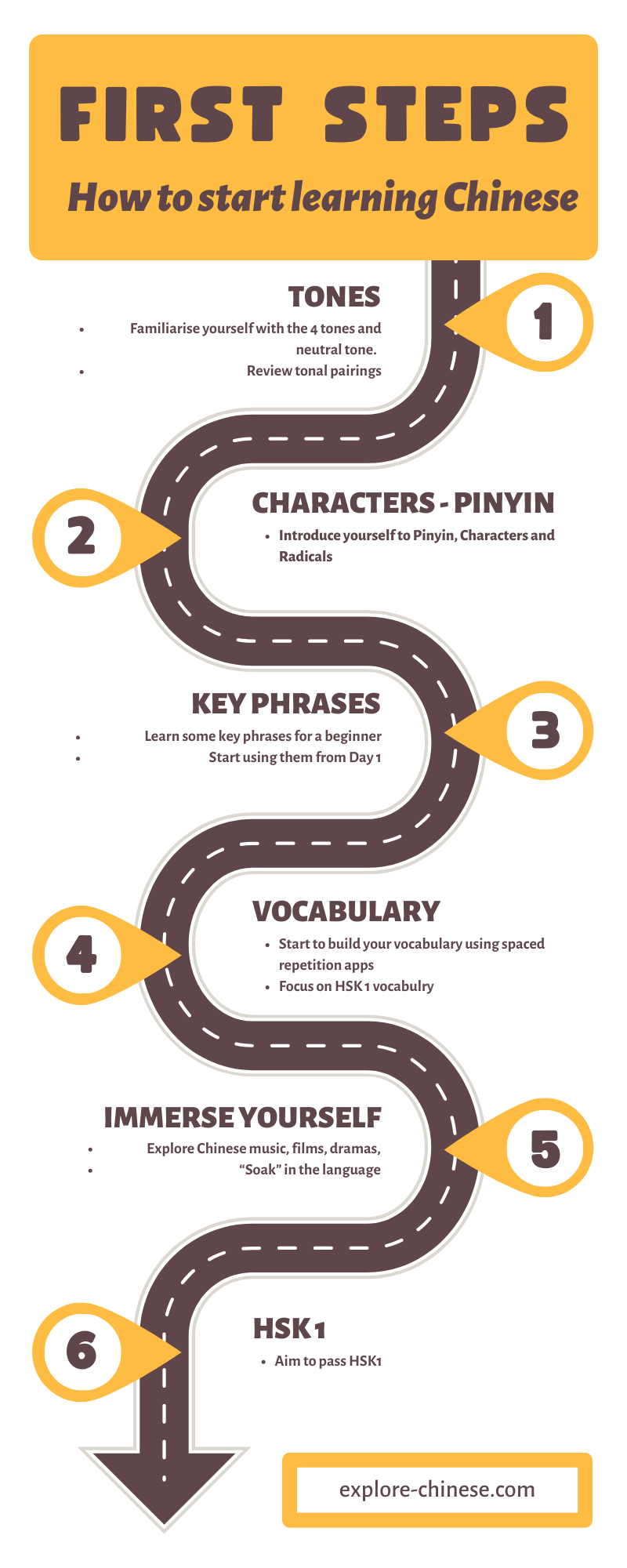
1. Master Pinyin and Pronunciation
Learning Pinyin (the romanization system for Chinese) is crucial because it helps you pronounce words correctly from the start. Chinese is a tonal language, so mispronouncing tones can change the meaning entirely. Focus on:
- Tones: Practice the four main tones (flat, rising, falling-rising, falling) and the neutral tone.
- Initials and Finals: Understand how consonants (initials) and vowels (finals) combine in Pinyin.
- Listening and Repetition: Use audio resources to mimic native speakers.
2. Learn Basic Greetings and Phrases
Starting with common phrases builds confidence and practical communication skills. Essential phrases include greetings, introductions, and polite expressions. Key areas to cover:
- Greetings: 你好 (nǐ hǎo) for hello, 谢谢 (xièxie) for thank you.
- Questions: 你叫什么名字?(nǐ jiào shénme míngzi?) for What’s your name?
- Survival Phrases: 我不会中文 (wǒ bù huì zhōngwén) for I don’t speak Chinese.
3. Understand Chinese Characters (Hanzi)
Hanzi are the building blocks of written Chinese. While challenging, learning basic characters early helps with reading and memorization. Prioritize:
- Radicals: Learn common radicals (components of characters) to decode meanings.
- Stroke Order: Follow correct stroke sequences to write characters properly.
- High-Frequency Characters: Start with numbers (一, 二, 三), days, and simple nouns.
4. Focus on Grammar and Sentence Structure
Chinese grammar is simpler than many languages, but it has unique rules. Key concepts include:
- Subject-Verb-Object (SVO): Similar to English, e.g., 我吃饭 (wǒ chī fàn) – I eat rice.
- No Verb Conjugation: Verbs don’t change based on tense or person.
- Measure Words: Learn classifiers like 个 (gè) for general objects.
5. Build Vocabulary with Thematic Learning
Expand your vocabulary by focusing on themes like family, food, or travel. This contextual approach aids retention. Steps include:
- Daily Objects: Words for household items, clothing, and gadgets.
- Common Verbs: 去 (qù) for go, 买 (mǎi) for buy.
- Adjectives: 好 (hǎo) for good, 大 (dà) for big.
Frequently Asked Questions (FAQ)
What are the best free Chinese reading resources for beginners?
For beginners, free resources like DuChinese (with limited free content) and The Chairman's Bao (offering graded readers) are excellent choices. These platforms provide simplified texts with pinyin and translations, making them ideal for those just starting out. Additionally, websites like Chinese Reading Practice offer short stories with vocabulary lists, helping learners build foundational skills. Another great option is Mandarin Bean, which features beginner-friendly articles with audio support.
Which intermediate-level Chinese reading resources are completely free?
Intermediate learners can benefit from HSK Reading, a site tailored to HSK levels 3-5, offering articles with comprehension questions. Readibu is another fantastic tool, allowing users to import texts and access instant translations. For those interested in news, Slow Chinese provides articles with slower-paced audio, perfect for improving reading and listening simultaneously. Chinese-Tools.com also offers intermediate-level texts with annotations to deepen understanding.
Are there advanced Chinese reading resources available for free?
Yes, advanced learners can explore The World of Chinese, a magazine-style website with in-depth articles on culture and society. Chinese Text Sampler from Yale University offers classical and modern texts for those seeking a challenge. For news enthusiasts, BBC Chinese and Sixth Tone provide high-quality journalism with sophisticated vocabulary. These resources help learners refine their comprehension of nuanced language and complex themes.
How can I make the most of free Chinese reading resources?
To maximize these resources, set clear goals—whether it's vocabulary expansion or fluency improvement. Use tools like Pleco or Anki to save and review new words. Read regularly, starting with shorter texts and gradually increasing difficulty. Engage with audio-supported materials to improve pronunciation and listening. Finally, join online communities like Reddit's r/ChineseLanguage to discuss readings and get recommendations from fellow learners.
Leave a Reply
Related Posts