
Duolingo Vocabulary List Spanish: Essential Words & Phrases

Learning Spanish can be an exciting and rewarding journey, and having a strong foundation in vocabulary is essential for effective communication. Whether you're a beginner or looking to expand your language skills, Duolingo offers a structured and engaging way to build your Spanish vocabulary. This article highlights essential words and phrases from Duolingo's Spanish course, designed to help you navigate everyday conversations with confidence. From common greetings to practical expressions, these carefully selected terms will enhance your understanding and fluency. Dive into this curated list to boost your learning and take your Spanish proficiency to the next level.
Duolingo Vocabulary List Spanish: Essential Words & Phrases
Learning Spanish through Duolingo is an effective way to build your vocabulary and improve your language skills. The platform offers a structured approach to learning essential words and phrases, which are crucial for everyday communication. Below, we explore key aspects of the Duolingo Spanish vocabulary list and provide a detailed breakdown of essential terms and phrases.
1. Basic Greetings and Introductions
Mastering basic greetings and introductions is the first step in any language. Duolingo’s Spanish vocabulary list includes essential phrases like Hola (Hello), Buenos días (Good morning), and ¿Cómo te llamas? (What is your name?). These phrases are fundamental for starting conversations and making a good first impression.
See AlsoBrand Failure in China: What Brands Do Wrong| English | Spanish |
|---|---|
| Hello | Hola |
| Good morning | Buenos días |
| What is your name? | ¿Cómo te llamas? |
2. Common Verbs for Daily Use
Verbs are the backbone of any language. Duolingo emphasizes ser (to be), tener (to have), and hacer (to do/make) as some of the most important verbs in Spanish. These verbs are versatile and appear frequently in everyday conversations.
| English | Spanish |
|---|---|
| To be | Ser |
| To have | Tener |
| To do/make | Hacer |
3. Essential Nouns for Everyday Life
Nouns are critical for describing people, places, and things. Duolingo’s vocabulary list includes casa (house), comida (food), and familia (family). These nouns are commonly used in daily conversations and help you express yourself more clearly.
| English | Spanish |
|---|---|
| House | Casa |
| Food | Comida |
| Family | Familia |
4. Key Adjectives to Describe People and Things
Adjectives add depth to your sentences. Duolingo teaches grande (big), pequeño (small), and interesante (interesting) as essential adjectives. These words help you describe objects, places, and people more effectively.
See AlsoWhy flashcards are terrible for learning Chinese| English | Spanish |
|---|---|
| Big | Grande |
| Small | Pequeño |
| Interesting | Interesante |
5. Useful Phrases for Travel and Directions
When traveling, knowing how to ask for directions or order food is essential. Duolingo includes phrases like ¿Dónde está el baño? (Where is the bathroom?), Quisiera un café (I would like a coffee), and ¿Cuánto cuesta? (How much does it cost?). These phrases are invaluable for navigating Spanish-speaking countries.
| English | Spanish |
|---|---|
| Where is the bathroom? | ¿Dónde está el baño? |
| I would like a coffee | Quisiera un café |
| How much does it cost? | ¿Cuánto cuesta? |
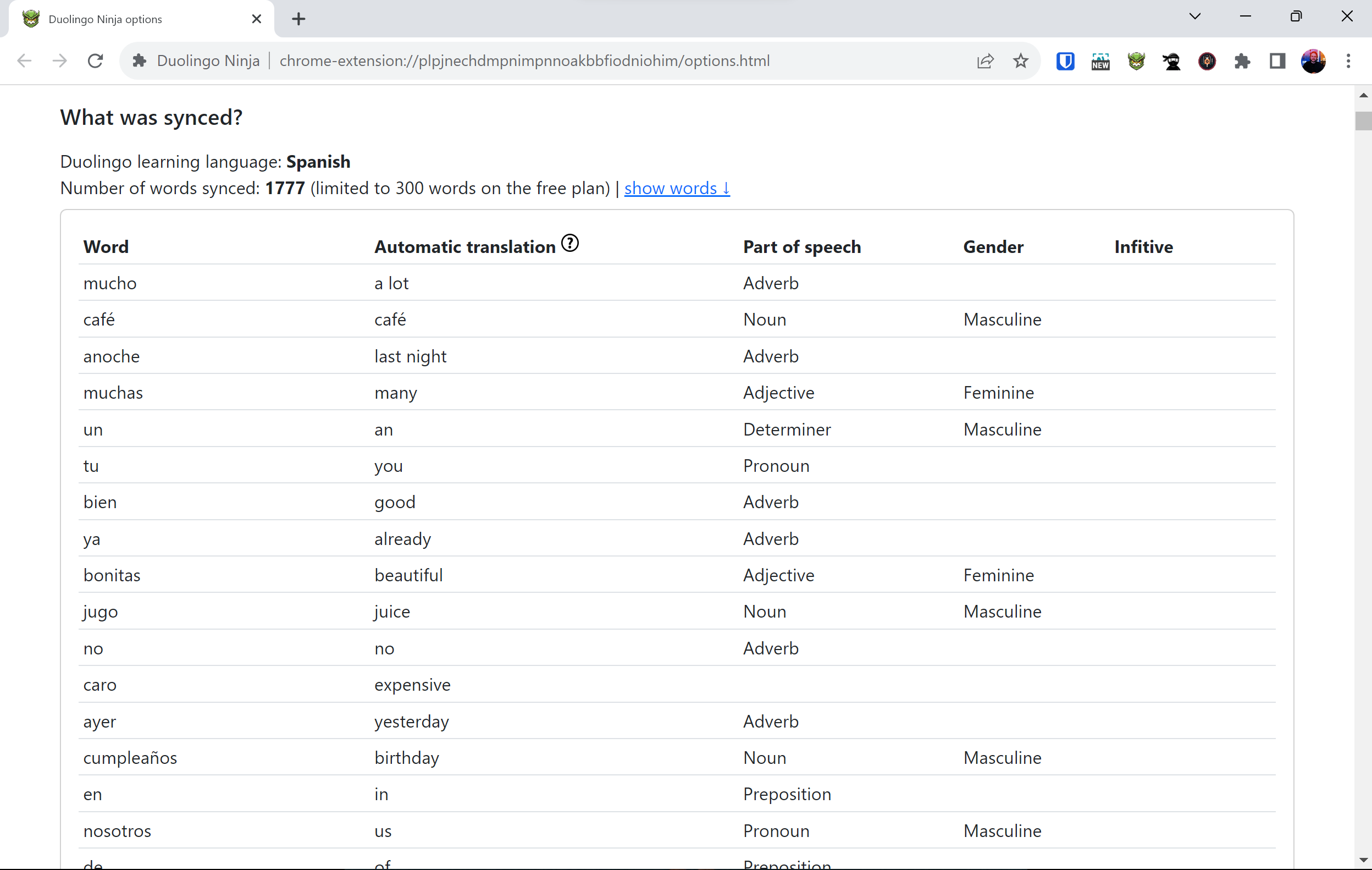
Can I get a vocabulary list from Duolingo?
How to Access Vocabulary Lists on Duolingo
Duolingo does not provide a direct downloadable vocabulary list for users. However, you can access and review words you've learned through the platform's built-in features. Here’s how:
See AlsoThree Easy Jokes in Chinese- Open the Duolingo app or website and log in to your account.
- Navigate to the Practice section, where you can review words and phrases from completed lessons.
- Use the Words tab (available on the web version) to see a list of words you’ve encountered, along with their translations and examples.
Why Doesn’t Duolingo Offer Downloadable Vocabulary Lists?
Duolingo focuses on interactive learning rather than static resources. The platform believes that practicing words in context and through repetition is more effective than memorizing lists. Here are some reasons:
- Encourages active engagement with the language through exercises and quizzes.
- Promotes long-term retention by using spaced repetition algorithms.
- Aligns with Duolingo’s mission to make learning fun and accessible.
Alternatives to Get Vocabulary Lists from Duolingo
If you want to create your own vocabulary list from Duolingo, you can manually compile words as you progress. Here’s how:
- Take notes during lessons, writing down new words and their meanings.
- Use the Words tab on the web version to review and export words to a spreadsheet.
- Consider third-party tools or browser extensions that can extract vocabulary data from Duolingo.
Benefits of Using Duolingo’s Vocabulary Features
Duolingo’s approach to vocabulary learning offers several advantages:
See AlsoTravelling and Getting Scammed in Harbin- Words are presented in context, helping you understand usage and grammar.
- The platform tracks your progress and highlights words you need to practice more.
- Interactive exercises make learning more engaging and effective.
Tips for Maximizing Vocabulary Learning on Duolingo
To get the most out of Duolingo’s vocabulary tools, follow these tips:
- Regularly review the Words tab to reinforce your memory.
- Use the Practice feature to revisit words you’ve learned.
- Combine Duolingo with other resources, such as flashcards or language apps, to expand your vocabulary.
How many Spanish words are there on Duolingo?

How Many Spanish Words Does Duolingo Teach?
Duolingo, a popular language-learning platform, teaches a significant number of Spanish words across its courses. While the exact number is not officially disclosed, it is estimated that learners can encounter thousands of Spanish words throughout the lessons. The platform is designed to help users build a strong vocabulary foundation, covering essential words and phrases for everyday communication.
See AlsoWelcome to The Chairman’s Chow- Duolingo's Spanish course includes a wide range of vocabulary, from beginner to intermediate levels.
- The platform uses spaced repetition to reinforce word retention over time.
- Learners can access additional vocabulary through Duolingo Stories and Podcasts.
What Types of Spanish Words Are Included in Duolingo?
Duolingo's Spanish course covers a diverse range of word categories, ensuring learners gain practical language skills. These include common nouns, verbs, adjectives, and phrases used in daily conversations. The platform also introduces specialized vocabulary related to travel, food, and work.
- Basic vocabulary such as greetings, numbers, and colors.
- Action verbs like comer (to eat) and hablar (to speak).
- Cultural terms that reflect Spanish-speaking traditions and customs.
How Does Duolingo Help Learners Remember Spanish Words?
Duolingo employs several techniques to help learners retain Spanish words effectively. The platform uses gamification, repetition, and contextual learning to reinforce vocabulary. Additionally, it adapts to the user's progress, ensuring they revisit words they struggle with.
- Spaced repetition ensures words are reviewed at optimal intervals.
- Interactive exercises like matching, translation, and speaking tasks.
- Progress tracking allows learners to monitor their vocabulary growth.
Can You Learn Advanced Spanish Vocabulary on Duolingo?
While Duolingo primarily focuses on beginner and intermediate levels, it does introduce some advanced Spanish vocabulary. However, learners seeking more specialized or advanced terms may need to supplement their studies with additional resources.
- Advanced grammar and sentence structures are introduced in later lessons.
- Idiomatic expressions and regional variations are occasionally included.
- For advanced learners, Duolingo Plus offers additional practice opportunities.
How Does Duolingo Compare to Other Resources for Learning Spanish Words?
Duolingo is a user-friendly and accessible tool for learning Spanish vocabulary, but it may not cover as many words as traditional textbooks or immersive methods. However, its interactive approach and gamified structure make it an engaging option for many learners.
- Textbooks often provide more extensive vocabulary lists.
- Language immersion programs offer deeper exposure to native vocabulary.
- Duolingo's mobile app makes learning convenient and flexible.
Is Duolingo an efficient way to learn Spanish?
What Makes Duolingo Effective for Learning Spanish?
Duolingo is considered an effective tool for learning Spanish due to its gamified approach, which keeps users engaged. The app focuses on vocabulary building, basic grammar, and pronunciation through interactive exercises. Here are some key reasons why it works:
- Daily practice: The app encourages consistent learning with reminders and streaks.
- Adaptive learning: It adjusts difficulty based on user performance.
- Accessibility: Available on multiple devices, making it easy to learn anytime, anywhere.
Limitations of Duolingo for Learning Spanish
While Duolingo is useful, it has limitations that may hinder fluency. The app primarily focuses on basic language skills and lacks depth in advanced topics. Here are some drawbacks:
- Limited speaking practice: The speaking exercises are minimal and often repetitive.
- Cultural context: It does not provide enough cultural insights, which are crucial for language mastery.
- Over-reliance on translation: The app heavily relies on translation exercises, which may not reflect real-life conversations.
How Duolingo Compares to Traditional Language Classes
Duolingo offers a flexible and cost-effective alternative to traditional language classes. However, it cannot fully replace the benefits of in-person instruction. Here’s a comparison:
- Cost: Duolingo is free, while classes can be expensive.
- Interaction: Classes provide direct interaction with teachers and peers, which Duolingo lacks.
- Pacing: Duolingo allows self-paced learning, whereas classes follow a fixed schedule.
Can Duolingo Help Achieve Fluency in Spanish?
Duolingo can be a starting point for learning Spanish, but achieving fluency requires additional resources. The app is best suited for beginners and intermediate learners. Here’s why:
- Basic proficiency: It helps build a foundation in vocabulary and grammar.
- Supplementary tools: Fluency requires immersion, conversation practice, and advanced materials.
- Time commitment: Consistent use over a long period is necessary to see significant progress.
Tips for Maximizing Duolingo’s Effectiveness for Spanish
To get the most out of Duolingo, users should adopt strategic learning habits. Combining the app with other resources can enhance results. Here are some tips:
- Set goals: Define clear objectives for what you want to achieve.
- Use additional resources: Supplement Duolingo with podcasts, books, or language exchange partners.
- Practice speaking: Engage in conversations with native speakers to improve fluency.
How do you memorize Spanish vocabulary words?

Use Flashcards for Repetition
Flashcards are a proven method for memorizing Spanish vocabulary. They leverage the principle of spaced repetition, which helps reinforce memory over time. Here’s how to use them effectively:
- Create flashcards with the Spanish word on one side and its English translation on the other.
- Review the flashcards daily, focusing on words you find challenging.
- Use apps like Anki or Quizlet for digital flashcards, which can automate spaced repetition.
Practice with Contextual Sentences
Learning words in isolation can be less effective than using them in context. By creating or reading sentences, you can better understand how the word is used naturally. Follow these steps:
- Write sentences using the new vocabulary words.
- Read Spanish books, articles, or watch shows to see the words in real-life contexts.
- Practice speaking or writing with a language partner to reinforce usage.
Associate Words with Images or Stories
Visual and narrative associations can make vocabulary stick. This technique taps into your brain’s ability to remember images and stories better than abstract words. Here’s how to apply it:
- Pair each word with a vivid image or drawing.
- Create a short story or scenario that includes the new vocabulary.
- Use mnemonic devices to link the word to something familiar.
Group Words by Themes or Categories
Organizing vocabulary into themes or categories can help you remember related words more effectively. This method creates mental connections between similar terms. Try this approach:
- Group words by topics like food, travel, or emotions.
- Create mind maps or charts to visualize the relationships between words.
- Practice using all the words in a category together in conversations or writing.
Incorporate Vocabulary into Daily Life
Using Spanish vocabulary in your daily routine helps reinforce learning naturally. Immersion is key to retaining new words. Here’s how to integrate them:
- Label objects around your home with their Spanish names.
- Set your phone or computer’s language to Spanish.
- Think or speak in Spanish during everyday activities, like cooking or shopping.
Frequently Asked Questions From our Community
What is the Duolingo Vocabulary List for Spanish?
The Duolingo Vocabulary List for Spanish is a curated collection of essential words and phrases designed to help learners build a strong foundation in the Spanish language. It includes commonly used terms, expressions, and grammatical structures that are crucial for everyday communication. This list is particularly useful for beginners who want to expand their vocabulary and improve their language skills efficiently.
How can I access the Duolingo Vocabulary List for Spanish?
To access the Duolingo Vocabulary List for Spanish, you can use the Duolingo app or website. The platform organizes vocabulary into lessons and categories, making it easy to track your progress. Additionally, some users create and share external lists or flashcards based on Duolingo's content, which can be found on platforms like Quizlet or Anki. These resources often complement the official Duolingo materials.
Is the Duolingo Vocabulary List for Spanish suitable for advanced learners?
While the Duolingo Vocabulary List for Spanish is primarily aimed at beginner and intermediate learners, it can still be a helpful resource for advanced learners looking to review foundational vocabulary or fill gaps in their knowledge. However, advanced learners may need to supplement their studies with more specialized materials, such as advanced grammar books, native media, or conversation practice with fluent speakers.
Can I use the Duolingo Vocabulary List for Spanish to prepare for exams?
Yes, the Duolingo Vocabulary List for Spanish can be a valuable tool for exam preparation, especially for tests like the DELE (Diploma de Español como Lengua Extranjera) or school-level Spanish exams. The list covers a wide range of essential words and phrases that are often tested in these exams. However, it's important to combine this resource with other study materials, such as practice tests, grammar exercises, and listening activities, to ensure comprehensive preparation.
Leave a Reply
Related Posts