
Sensible Chinese character learning revisited

Learning Chinese characters has long been a daunting challenge for language learners, often perceived as a complex and time-consuming process. However, recent advancements in pedagogical approaches and digital tools have reshaped the way characters are taught and mastered. Sensible Chinese Character Learning Revisited explores innovative strategies that prioritize understanding over rote memorization, leveraging etymology, component analysis, and contextual learning. By revisiting traditional methods and integrating modern techniques, this article demonstrates how learners can achieve greater efficiency and retention. Whether you're a beginner or an advanced student, these insights offer a fresh perspective on mastering Chinese characters with clarity and confidence.
- Sensible Chinese Character Learning Revisited: A Modern Approach
- How to easily memorize Chinese characters?
- What is the hardest Chinese character to learn?
-
Does learning Chinese characters get easier?
- Does Learning Chinese Characters Become Easier Over Time?
- How Do Radicals Make Learning Chinese Characters Easier?
- Does Writing Practice Speed Up Chinese Character Learning?
- Can Technology Help Make Chinese Characters Easier to Learn?
- How Does Vocabulary Expansion Impact Chinese Character Difficulty?
- How many Chinese characters do you need to know to read fluently?
- Frequently Asked Questions (FAQ)
Sensible Chinese Character Learning Revisited: A Modern Approach
Learning Chinese characters can be a daunting task, but with a sensible and structured approach, it becomes manageable and even enjoyable. This article revisits traditional methods and introduces modern techniques to make character learning more efficient. By combining mnemonics, spaced repetition, and contextual learning, students can achieve better retention and understanding.
1. The Importance of Radicals in Character Recognition
Radicals are the building blocks of Chinese characters and play a crucial role in understanding their meanings and pronunciations. By mastering common radicals, learners can decode unfamiliar characters more easily. For example, the radical 水 (shuǐ, meaning water) appears in characters related to liquids, such as 河 (hé, river) and 海 (hǎi, sea).
See AlsoMemorization Tips for Learning Chinese| Radical | Meaning | Example Characters |
|---|---|---|
| 人 (rén) | person | 你 (nǐ), 他 (tā) |
| 心 (xīn) | heart | 想 (xiǎng), 愛 (ài) |
2. Mnemonics: A Powerful Memory Tool
Using mnemonics helps learners associate characters with vivid stories or images, making them easier to remember. For instance, the character 好 (hǎo, good) can be visualized as a woman (女) holding a child (子), symbolizing something positive.
| Character | Mnemonic Story |
|---|---|
| 明 (míng, bright) | The sun (日) and moon (月) together create brightness. |
3. Spaced Repetition Systems (SRS) for Long-Term Retention
Spaced repetition leverages the psychological spacing effect to improve memory. Tools like Anki or Pleco schedule reviews at optimal intervals, ensuring characters are retained over time.
| Tool | Key Feature |
|---|---|
| Anki | Customizable flashcards with algorithm-based scheduling. |
4. Contextual Learning Through Sentences
Studying characters in contextual sentences rather than in isolation reinforces their usage and meaning. For example, learning 猫 (māo, cat) within the sentence 我的猫很可爱 (My cat is cute) enhances comprehension.
See AlsoStudy Chinese Characters: 6 Easy Points to Start Today| Character | Example Sentence |
|---|---|
| 书 (shū, book) | 我喜欢看书 (I like reading books). |
5. Balancing Writing and Recognition
While typing is convenient, handwriting practice strengthens memory and understanding of stroke order. A balanced approach ensures learners can both recognize and reproduce characters accurately.
| Skill | Benefit |
|---|---|
| Handwriting | Improves muscle memory and stroke order. |
How to easily memorize Chinese characters?
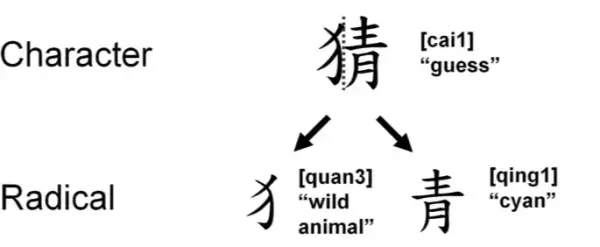
Break Down Characters into Components
Chinese characters are often made up of smaller radicals and components, which can simplify memorization. By learning these building blocks, you can recognize patterns and associate meanings more easily.
See AlsoUltimate Chinese Radicals Quiz What Do They All Mean?- Identify radicals: Many characters share common radicals that hint at their meaning or pronunciation.
- Analyze structure: Break characters into left-right, top-bottom, or inside-outside components.
- Use mnemonics: Create stories linking components to the character's meaning.
Practice Writing Characters Regularly
Repetition and muscle memory play a key role in memorizing Chinese characters. Writing them by hand reinforces recognition and recall.
- Write daily: Dedicate time to practice even a few characters each day.
- Trace first: Use grids or tracing sheets to get familiar with stroke order.
- Test yourself: Cover characters and try rewriting them from memory.
Use Spaced Repetition Systems (SRS)
SRS tools like Anki or Pleco optimize memorization by reviewing characters at increasing intervals.
- Create flashcards: Include characters, pinyin, and meaning.
- Adjust intervals: Review harder characters more frequently.
- Mix old and new: Balance revision with learning new characters.
Associate Characters with Visuals or Stories
Visualization and mnemonics make abstract characters more memorable by linking them to images or narratives.
See AlsoHow to reach a decent level of Chinese in 100 days- Find imagery: Relate character shapes to real-life objects.
- Invent stories: Connect components to a memorable plot.
- Use apps: Tools like Skritter integrate visual learning techniques.
Learn Characters in Context
Studying characters within words or sentences helps reinforce their usage and meaning.
- Read simple texts: Start with children's books or graded readers.
- Watch subtitled media: Exposure to characters in TV shows or movies aids retention.
- Practice with phrases: Learn characters as part of common expressions.
What is the hardest Chinese character to learn?
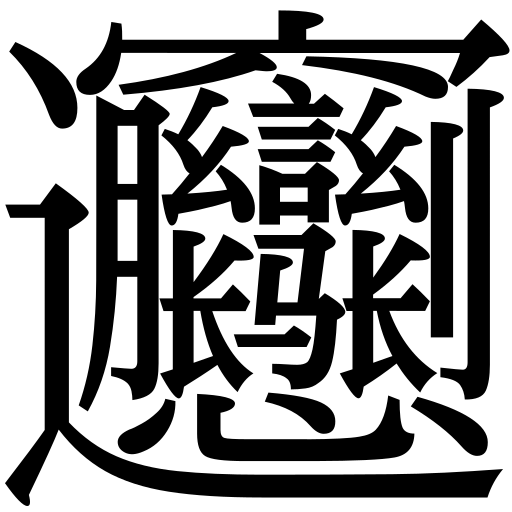
What Makes a Chinese Character Difficult to Learn?
The difficulty of learning a Chinese character depends on several factors, including stroke count, complexity, and lack of phonetic clues. Here are the key reasons:
- Stroke count: Characters with many strokes, like biáng (58 strokes), are harder to write.
- Rare usage: Obscure characters are challenging because they appear infrequently.
- No phonetic hints: Some characters don’t provide pronunciation clues, making memorization tougher.
The Most Complex Chinese Character: Biáng
The character biáng is often considered the hardest due to its extreme complexity. It features:
- 58 strokes, making it one of the most intricate characters.
- Regional usage, primarily in Shaanxi province for a type of noodle.
- No standard keyboard input, as it’s not included in Unicode.
Other Extremely Difficult Chinese Characters
Beyond biáng, several other characters are notoriously hard to learn:
- 齉 (nàng) – Meaning stuffy nose, with 36 strokes.
- 龘 (dá) – Depicting a dragon’s flight, with 48 strokes.
- 靐 (bìng) – Meaning thunder, with 39 strokes.
Why Stroke Order Matters in Difficult Characters
Proper stroke order is crucial for writing complex characters correctly. Key points include:
- Prevents mistakes by following a logical sequence.
- Improves writing speed once memorized.
- Ensures legibility, especially for characters with many strokes.
Tips for Learning Hard Chinese Characters
Mastering difficult characters requires strategy. Effective methods include:
- Break down components into radicals for easier memorization.
- Practice stroke order repeatedly to build muscle memory.
- Use mnemonics to associate shapes with meanings or sounds.
Does learning Chinese characters get easier?

Does Learning Chinese Characters Become Easier Over Time?
Yes, learning Chinese characters does get easier with consistent practice. Initially, memorizing strokes, radicals, and meanings can feel overwhelming, but as you build familiarity, patterns emerge. Key factors that contribute to this progression include:
- Radical recognition: Identifying common components simplifies character breakdown.
- Contextual learning: Exposure through reading or media reinforces retention.
- Repetition: Regular writing drills solidify muscle memory.
How Do Radicals Make Learning Chinese Characters Easier?
Radicals are building blocks of Chinese characters, often hinting at meaning or pronunciation. Mastering them accelerates learning by:
- Grouping characters by shared elements (e.g., 水 [water] in 河 [river]).
- Reducing memorization load through predictable patterns.
- Improving dictionary lookup efficiency via radical indexes.
Does Writing Practice Speed Up Chinese Character Learning?
Writing characters by hand reinforces memory through kinesthetic learning. Benefits include:
- Stroke order mastery, which aids recall and readability.
- Neural reinforcement by engaging multiple senses.
- Error correction, as mistakes become visible during practice.
Can Technology Help Make Chinese Characters Easier to Learn?
Apps and digital tools leverage interactive methods to simplify learning, such as:
- Flashcards (e.g., Anki) for spaced repetition.
- OCR scanners to instantly translate text.
- Games that turn memorization into challenges.
How Does Vocabulary Expansion Impact Chinese Character Difficulty?
As your vocabulary grows, characters become easier due to:
- Compound word recognition (e.g., 电话 [diànhuà] = electric + talk = phone).
- Contextual guessing in sentences or phrases.
- Increased exposure to recurring characters in new contexts.
How many Chinese characters do you need to know to read fluently?

What is the minimum number of Chinese characters needed for basic fluency?
To achieve basic fluency in reading Chinese, you typically need to know around 1,000 to 1,500 characters. This allows you to understand approximately 90% of everyday written content, such as simple news articles, social media posts, and basic literature. Here’s why:
- 1,000 characters cover most common words and phrases used in daily communication.
- 1,500 characters improve comprehension of slightly more complex texts, like short stories or blogs.
- Beyond this range, you’ll encounter fewer new characters but more specialized vocabulary.
How many characters are required to read newspapers fluently?
Reading newspapers fluently requires knowledge of roughly 2,500 to 3,000 characters. This range ensures you can grasp 95-98% of the content in mainstream publications. Key points include:
- 2,500 characters let you understand most headlines and general news articles.
- 3,000 characters help with specialized topics like politics, economics, or culture.
- Newspapers often use repetitive vocabulary, making them easier over time.
How many characters do native Chinese speakers know?
Native speakers typically recognize 3,000 to 5,000 characters, though usage varies. Here’s a breakdown:
- 3,000 characters are enough for everyday literacy and most reading tasks.
- 5,000 characters are common among educated adults, covering literature and technical texts.
- Only scholars or specialists master 8,000+ characters, including rare or archaic forms.
How does character knowledge impact reading speed?
Your reading speed in Chinese depends heavily on character familiarity. Key factors:
- 1,000-2,000 characters: Slow reading with frequent dictionary use.
- 2,500-3,500 characters: Comfortable speed for most materials.
- 4,000+ characters: Near-native fluency with minimal pauses.
What strategies help learn characters efficiently?
To learn characters efficiently, focus on these methods:
- Prioritize high-frequency characters (e.g., HSK lists) for quick practical gains.
- Use mnemonics or radicals to remember complex characters.
- Practice reading in context (books, subtitles) to reinforce retention.
Frequently Asked Questions (FAQ)
What is the main focus of Sensible Chinese character learning revisited?
The main focus of Sensible Chinese character learning revisited is to provide a structured and efficient approach to mastering Chinese characters. It emphasizes understanding the logical patterns and mnemonic techniques that make memorization easier. The method revisits traditional learning strategies and refines them to suit modern learners, focusing on radicals, components, and context to build a strong foundation in character recognition and writing.
How does this method differ from traditional Chinese character learning?
Unlike traditional methods that rely heavily on rote memorization, this approach introduces a systematic breakdown of characters into their fundamental parts. It highlights the importance of etymology and visual associations to create meaningful connections. Additionally, it prioritizes high-frequency characters first, ensuring learners gain practical vocabulary quickly, rather than overwhelming them with less common characters early on.
Can beginners use this method effectively?
Absolutely. The method is designed to be accessible to beginners while also benefiting intermediate learners. It starts with simple radicals and gradually builds complexity, ensuring a smooth learning curve. By focusing on recognizable patterns and practical usage, beginners can quickly gain confidence in reading and writing Chinese characters without feeling discouraged by the perceived difficulty of the language.
What resources are recommended to complement this learning approach?
To maximize the effectiveness of this method, learners should use flashcards (physical or digital) for spaced repetition, mnemonic apps like Anki or Memrise, and workbooks that reinforce writing practice. Additionally, engaging with authentic materials such as children's books or simple articles can help contextualize the characters. Online tools like Pleco or Skritter are also highly recommended for interactive learning and stroke order practice.
Leave a Reply
Related Posts