
10 Things I Wish I Knew When I Started Learning Chinese

Learning Chinese can be both exciting and daunting, especially for beginners. With its unique characters, tones, and grammar, the language presents challenges that many learners aren’t fully prepared for. Looking back, there are countless lessons I wish I had known from the start—tips that would have saved time, reduced frustration, and accelerated progress. Whether it’s mastering tones, building vocabulary efficiently, or understanding cultural nuances, small adjustments in approach can make a big difference. In this article, I’ll share 10 key insights I’ve gathered along the way, hoping to smooth the path for new learners and help them navigate the journey of learning Chinese with greater confidence and clarity.
10 Things I Wish I Knew When I Started Learning Chinese
Detailed Explanation:
When beginning to learn Chinese, many learners face challenges they didn’t anticipate. Reflecting on these early struggles can help new students avoid common pitfalls. Below are five key insights, expanded with detailed explanations and practical advice.
---
See AlsoHow to learn from your mistakes and errors when learning Chinese1. Tones Are Crucial from Day One
Detailed Explanation:
Many beginners underestimate the importance of tones in Mandarin Chinese. Unlike English, where tone changes don’t alter word meanings, in Chinese, a single syllable like ma can mean mother (妈, mā) or horse (马, mǎ) depending on the tone. Mispronouncing tones can lead to confusion or unintended meanings.
Tips for mastering tones:
- Practice with minimal pairs (words that differ only in tone).
- Use apps like Pleco or HelloChinese for tone drills.
- Record yourself and compare with native speakers.
| Tone | Example | Meaning |
|---|---|---|
| 1st (Flat) | mā (妈) | Mother |
| 3rd (Falling-Rising) | mǎ (马) | Horse |
---
See AlsoIs Bilibili a Good Study Platform to Learn Chinese?2. Characters Aren’t Just Pictures
Detailed Explanation:
New learners often assume Chinese characters are purely pictorial, but they follow systematic rules. Characters are built from radicals (components with meaning or sound clues). For example, the radical 女 (nǚ, woman) appears in 妈妈 (māma, mom).
Strategies for learning characters:
- Study radicals first to recognize patterns.
- Break characters into smaller parts (e.g., 好 = 女 + 子).
- Use spaced repetition systems (SRS) like Anki.
| Radical | Meaning | Example Character |
|---|---|---|
| 水 (shuǐ) | Water | 河 (hé, river) |
---
See AlsoWhy Do Chinese People Give Red Envelopes?3. Grammar Is Simpler Than You Think
Detailed Explanation:
Chinese grammar lacks verb conjugations, tenses, or gendered nouns. Instead, it relies on particles (e.g., 了 for past actions) and context. For example, I eat (我吃) and I ate (我吃了) differ by just one character.
Key grammar features:
- No plurals: 猫 (māo) = cat or cats.
- Time words indicate tense (e.g., 昨天, yesterday).
| Feature | Example |
|---|---|
| No verb conjugation | 吃 (chī) = eat/eats |
---
See AlsoConfucius Series: Han Fei ‘韓非’ and his Teachings; an Introduction to “Legalism”4. Listening Takes Time to Develop
Detailed Explanation:
Listening comprehension is challenging due to tonal nuances and fast speech. Beginners often struggle to distinguish words in natural conversation.
How to improve:
- Start with slow podcasts (e.g., ChinesePod Beginner).
- Watch subtitled shows (e.g., Peppa Pig in Chinese).
- Shadowing: Repeat sentences after native speakers.
| Resource | Skill Focus |
|---|---|
| Slow Chinese | Listening + Vocabulary |
---
5. Consistency Beats Intensity
Detailed Explanation:
Short, daily practice is more effective than cramming. Chinese requires gradual character recognition and muscle memory for writing.
Routine tips:
- Dedicate 20 minutes/day to characters.
- Use habit stacking (e.g., review flashcards with coffee).
| Activity | Frequency |
|---|---|
| Flashcards | Daily |
What should I learn first when learning Chinese?
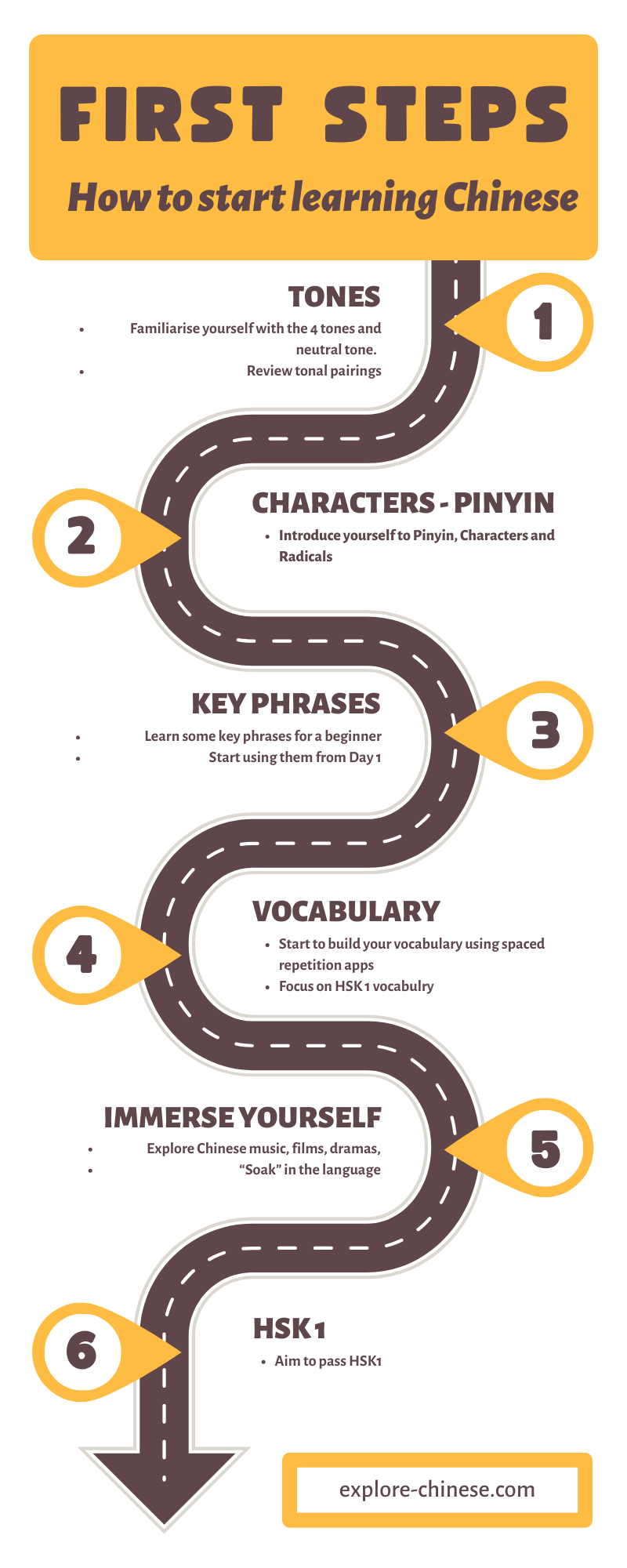
1. Mastering Pinyin and Pronunciation
When starting to learn Chinese, the first step should be mastering Pinyin, the romanization system for Mandarin. Proper pronunciation is crucial because Chinese is a tonal language, and mispronouncing tones can change the meaning of words entirely.
- Learn the four tones and neutral tone to avoid misunderstandings.
- Practice Pinyin with audio resources to improve accuracy.
- Focus on difficult sounds like zh, ch, sh, and x, which don’t exist in English.
2. Building a Foundation with Basic Vocabulary
After pronunciation, focus on basic vocabulary that is practical for daily conversations. Start with words and phrases you’ll use frequently.
- Memorize greetings like 你好 (nǐ hǎo) and 谢谢 (xièxie).
- Learn numbers, days of the week, and common objects.
- Use flashcards or apps like Anki to reinforce retention.
3. Understanding Simple Sentence Structures
Chinese grammar is relatively simple compared to many languages, but it’s essential to grasp basic sentence patterns early.
- Start with Subject-Verb-Object (SVO) structure, similar to English.
- Learn how to form questions using 吗 (ma) and 什么 (shénme).
- Practice simple sentences like 我是学生 (wǒ shì xuéshēng) (I am a student).
4. Learning Essential Chinese Characters
While Pinyin helps with pronunciation, learning characters is vital for reading and writing. Begin with the most common ones.
- Start with radicals, the building blocks of characters.
- Memorize high-frequency characters like 人 (rén) (person) and 日 (rì) (sun/day).
- Use writing practice sheets to improve stroke order.
5. Practicing Listening and Speaking Early
Developing listening and speaking skills early will accelerate fluency. Immersion is key.
- Listen to Chinese podcasts or watch shows with subtitles.
- Repeat phrases aloud to improve intonation and fluency.
- Engage in language exchange with native speakers via apps like Tandem.
What does learning Chinese do to your brain?

How Does Learning Chinese Affect Cognitive Function?
Learning Chinese significantly enhances cognitive function by engaging multiple brain regions simultaneously. Studies show that mastering Chinese characters and tones strengthens neural pathways related to memory, attention, and problem-solving. Here’s how:
- Memory improvement: Memorizing characters activates the hippocampus, boosting long-term retention.
- Attention control: Distinguishing tones sharpens auditory processing and focus.
- Multitasking skills: Switching between characters and pinyin enhances executive function.
Does Learning Chinese Increase Brain Plasticity?
Yes, learning Chinese promotes brain plasticity by creating new neural connections. The complexity of characters and tonal variations forces the brain to adapt, leading to structural changes. Key effects include:
- Gray matter growth: Increased density in areas like the left inferior parietal cortex.
- Enhanced connectivity: Improved communication between brain hemispheres.
- Delayed cognitive decline: Bilingualism in Chinese may slow aging-related brain deterioration.
How Does Chinese Language Learning Impact Memory?
Learning Chinese uniquely challenges memory systems due to its logographic writing and tonal nature. This leads to:
- Visual memory boost: Recalling characters strengthens visual-spatial memory.
- Working memory expansion: Tonal discrimination exercises short-term memory.
- Associative memory development: Linking sounds, meanings, and symbols enhances recall.
What Are the Effects of Chinese Tones on the Brain?
Mastering Chinese tones trains the brain to process subtle auditory differences, resulting in:
- Auditory cortex activation: Heightened sensitivity to pitch variations.
- Right hemisphere engagement: Increased involvement in processing melodic speech.
- Improved musical ability: Tone recognition correlates with better pitch perception.
Can Learning Chinese Improve Problem-Solving Skills?
Yes, the problem-solving demands of Chinese language learning enhance analytical abilities. This occurs through:
- Pattern recognition: Decoding characters trains logical thinking.
- Creative thinking: Combining radicals fosters innovative connections.
- Mental flexibility: Switching between tones and scripts improves adaptability.
What is the hardest thing about learning Chinese?

The Complexity of Chinese Characters
One of the most daunting aspects of learning Chinese is mastering its characters. Unlike alphabetic languages, Chinese relies on thousands of unique symbols, each with its own meaning and pronunciation. Key challenges include:
- Memorization: Learning thousands of characters requires immense time and repetition.
- Stroke order: Writing characters correctly demands adherence to specific stroke sequences.
- Homophones: Many characters sound identical but have entirely different meanings.
Tonal Pronunciation
Chinese is a tonal language, meaning the pitch or intonation of a word can change its meaning entirely. This poses significant difficulties for learners, especially those from non-tonal language backgrounds. Major hurdles include:
- Four tones: Mandarin has four distinct tones (plus a neutral tone), each altering word meaning.
- Listening comprehension: Distinguishing tones in fast-paced conversations can be overwhelming.
- Accurate reproduction: Mimicking tones correctly requires consistent practice and feedback.
Grammar and Sentence Structure
While Chinese grammar is often considered simpler than that of many European languages, its unique structures can still confuse learners. Key obstacles include:
- Lack of verb conjugation: Verbs don’t change form for tense, requiring context clues.
- Measure words: Nouns often require specific classifiers (e.g., 本 for books).
- Word order flexibility: Sentences can shift emphasis in ways unfamiliar to English speakers.
Cultural Context and Idioms
Chinese is deeply tied to its cultural heritage, making idioms and expressions particularly challenging. Learners must navigate:
- Chengyu: Four-character idioms rooted in ancient stories or literature.
- Contextual usage: Phrases often rely on historical or cultural knowledge.
- Regional variations: Idioms may differ between Mandarin and dialects like Cantonese.
Listening and Speaking Fluency
Achieving fluency in spoken Chinese requires overcoming several barriers, including:
- Speed of native speakers: Conversations often feel too fast to follow initially.
- Slang and colloquialisms: Informal speech differs greatly from textbook Chinese.
- Lack of practice opportunities: Finding immersive environments can be difficult outside Chinese-speaking regions.
How long does it realistically take to learn Chinese?
Factors That Influence Learning Chinese
The time it takes to learn Chinese depends on several factors, including your native language, study methods, and exposure. Here are key influences:
- Language background: Speakers of tonal languages (e.g., Vietnamese) may adapt faster to Mandarin’s tones.
- Study intensity: Dedicated learners (20+ hours/week) progress quicker than casual ones.
- Immersion: Living in a Chinese-speaking environment accelerates fluency.
Timeframes for Basic Proficiency
Achieving basic conversational skills (HSK 3) typically requires:
- 6–12 months with consistent daily practice (1–2 hours/day).
- 300–500 vocabulary words to handle everyday interactions.
- Understanding simple grammar like sentence structure and common phrases.
Intermediate Fluency Expectations
Reaching intermediate fluency (HSK 4–5) often takes:
- 2–3 years of structured learning and practice.
- 1,200–2,500 vocabulary words for discussions on diverse topics.
- Mastery of complex grammar, including idioms and formal expressions.
Advanced Mastery and Beyond
Attaining advanced proficiency (HSK 6+) generally demands:
- 4–5+ years of immersion or rigorous study.
- 5,000+ vocabulary words for nuanced communication.
- Cultural familiarity to grasp subtleties like humor and slang.
Accelerating Your Learning Process
To shorten the timeline, consider these strategies:
- Use spaced repetition (e.g., Anki) for character retention.
- Practice speaking daily with native speakers or tutors.
- Consume media (TV, podcasts) to improve listening skills.
Frequently Asked Questions (FAQ)
What are the most important things to know when starting to learn Chinese?
Learning Chinese can be overwhelming at first, but understanding a few key principles can make the journey smoother. First, tones are crucial—mispronouncing them can change the meaning of a word entirely. Second, characters are not just random symbols; they often have logical components that hint at their meaning or pronunciation. Third, consistency is more important than cramming—daily practice, even in small doses, yields better results. Finally, don’t underestimate the importance of listening and speaking from day one, as Chinese is a highly spoken language.
How can I effectively memorize Chinese characters?
Memorizing Chinese characters requires a strategic approach. Start by learning the most common radicals, which are the building blocks of characters. Use mnemonics or stories to associate characters with their meanings. Writing characters by hand reinforces memory, but apps like Anki or Skritter can also help with spaced repetition. Additionally, try to learn characters in context—study them within words or sentences rather than in isolation. Over time, patterns will emerge, making memorization easier.
Why are tones so difficult, and how can I master them?
Tones are challenging because many languages don’t use them to distinguish meaning. In Chinese, the same syllable with different tones can mean entirely different things. To master them, start by listening extensively to native speakers—watch Chinese shows, listen to podcasts, or use language apps. Practice mimicking the tones until they feel natural. Recording yourself and comparing it to native speech can highlight mistakes. Don’t be discouraged—even advanced learners sometimes struggle with tones, but consistent practice will improve your accuracy.
What are common mistakes beginners make when learning Chinese?
Many beginners focus too much on reading and writing while neglecting speaking and listening, which are essential for fluency. Another mistake is relying solely on pinyin without learning characters early, which can create a dependency. Some learners also avoid practicing tones, thinking they’ll “pick them up later,” but this leads to ingrained errors. Finally, expecting rapid progress without consistent effort is unrealistic—Chinese takes time, and patience is key. Avoiding these pitfalls early will set you up for long-term success.
Leave a Reply
Related Posts