
Chinese Measure Words and How to Use Them

Chinese measure words, also known as classifiers, are an essential part of Mandarin grammar, used to quantify nouns and specify their type or category. Unlike English, where a or an often suffices, Chinese requires a measure word between a numeral and a noun. For example, instead of saying three books, you say three [measure word] books. These classifiers can seem daunting to learners, but they follow logical patterns based on shape, function, or material. Mastering them enhances fluency and precision in communication. This article explores common Chinese measure words, their usage rules, and practical examples to help you navigate this unique linguistic feature with confidence.
Understanding Chinese Measure Words and Their Proper Usage
Chinese measure words, also known as classifiers, are an essential part of Mandarin grammar. They are used between a number or demonstrative (like this or that) and a noun to specify the quantity or type of object being referred to. Unlike English, where measure words are optional (e.g., two sheets of paper), Mandarin requires them for almost all nouns. Mastering these classifiers is crucial for sounding natural in Chinese.
1. What Are Chinese Measure Words?
Chinese measure words (量词 liàngcí) categorize nouns based on shape, function, or other attributes. For example, 个 (gè) is a general measure word, while 张 (zhāng) is used for flat objects like paper. Using the wrong measure word can sound awkward or confusing.
See AlsoHow long have you studied Chinese?| Measure Word | Usage | Example |
|---|---|---|
| 个 (gè) | General-purpose | 一个人 (yī gè rén) - one person |
| 张 (zhāng) | Flat objects | 一张纸 (yī zhāng zhǐ) - one sheet of paper |
2. Common Chinese Measure Words for Everyday Objects
Some measure words are used frequently in daily conversations. Here are a few key examples:
| Measure Word | Used For |
|---|---|
| 本 (běn) | Books, notebooks |
| 辆 (liàng) | Vehicles (cars, bikes) |
| 只 (zhī) | Animals, one of a pair |
3. Measure Words for Food and Drinks
Food items often have specific measure words. For example:
| Measure Word | Example |
|---|---|
| 碗 (wǎn) | 一碗饭 (yī wǎn fàn) - one bowl of rice |
| 杯 (bēi) | 一杯水 (yī bēi shuǐ) - one glass of water |
4. Measure Words for People and Animals
People and animals often use different classifiers:
See AlsoAnalyse and balance your Chinese learning with Paul Nation’s four strands| Measure Word | Usage |
|---|---|
| 位 (wèi) | Polite form for people (e.g., 一位老师 - one teacher) |
| 条 (tiáo) | Long, flexible animals (e.g., 一条鱼 - one fish) |
5. How to Practice and Memorize Chinese Measure Words
The best way to learn measure words is through consistent practice:
- Flashcards for repetition.
- Listening to native speakers.
- Writing sentences using correct classifiers.
| Tip | Description |
|---|---|
| Group by category | Learn measure words for similar objects together. |
| Use in context | Practice with full sentences, not just isolated words. |
How to use Chinese measure words?
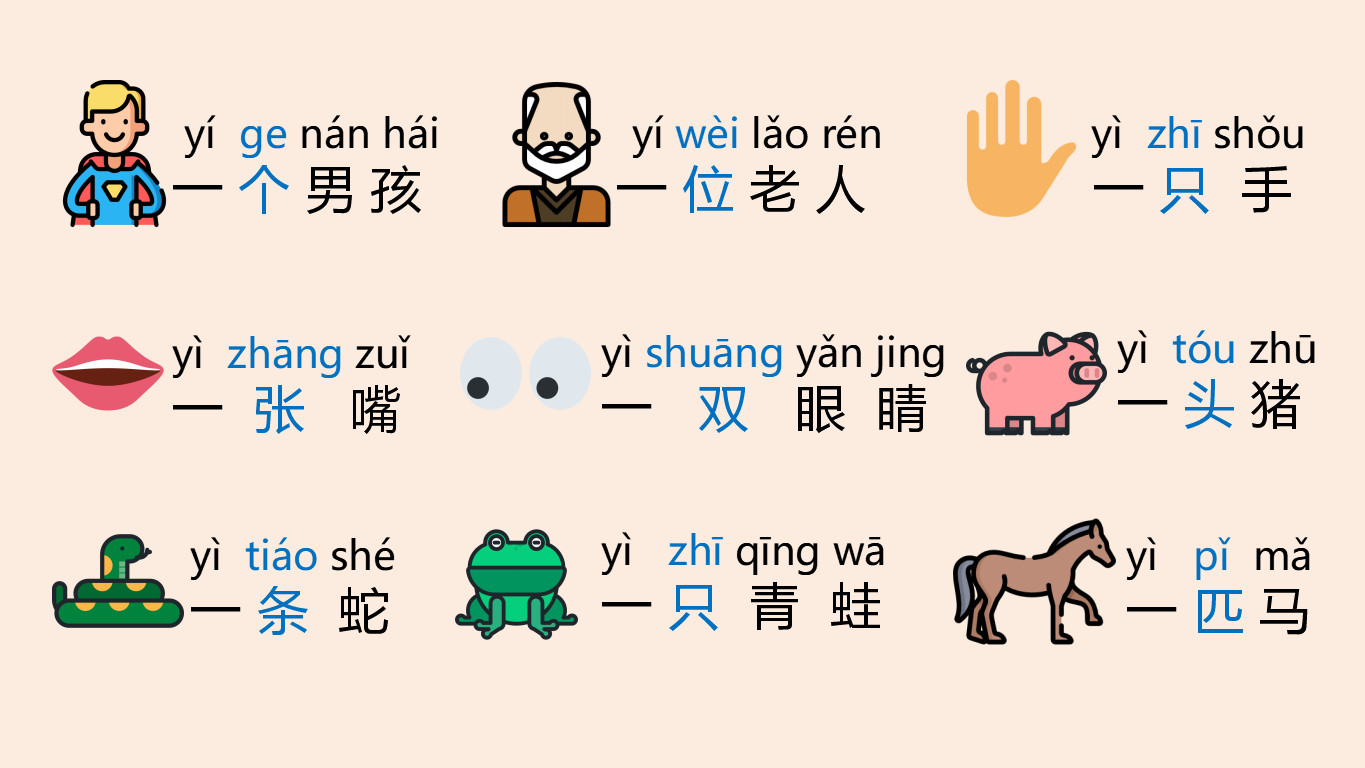
What Are Chinese Measure Words?
Chinese measure words, or classifiers, are used between a numeral and a noun to specify the quantity or type of object being referred to. Unlike English, where measure words are optional (e.g., three cups of coffee), Mandarin requires them for almost all nouns. Here are key points:
See AlsoBeing a Vegetarian in China- Mandatory usage: Every noun paired with a number or demonstrative (e.g., this, that) needs a measure word.
- Noun-specific: Different nouns use different measure words (e.g., 本 (běn) for books, 张 (zhāng) for flat objects).
- General measure word: 个 (gè) is the default but isn’t universally applicable.
Common Chinese Measure Words and Their Uses
Here are some frequently used measure words and the nouns they pair with:
- 个 (gè): Default for people, abstract items (e.g., 一个人 yī gè rén – one person).
- 只 (zhī): Animals, body parts (e.g., 一只猫 yī zhī māo – one cat).
- 辆 (liàng): Vehicles (e.g., 一辆车 yī liàng chē – one car).
How to Choose the Right Measure Word
Selecting the correct measure word depends on the noun’s characteristics:
- Shape/function: Use 条 (tiáo) for long, flexible items (e.g., rivers, pants).
- Material: 块 (kuài) for chunks (e.g., 一块蛋糕 yī kuài dàngāo – one piece of cake).
- Grouping: 双 (shuāng) for pairs (e.g., 一双鞋 yī shuāng xié – one pair of shoes).
Exceptions and Irregularities in Measure Words
Some measure words defy obvious patterns:
See AlsoEscape: A text adventure game for Chinese learners- 头 (tóu): Used for large animals (e.g., cows) but not all (e.g., 一头牛 yī tóu niú – one cow).
- 家 (jiā): For businesses/families (e.g., 一家公司 yī jiā gōngsī – one company).
- No measure word: Nouns like 年 (nián – year) don’t need one (e.g., 三年 sān nián – three years).
Practice Tips for Mastering Measure Words
To internalize measure words, try these methods:
- Memorize noun-measure pairs: Learn them as a unit (e.g., 一本书 yī běn shū – one book).
- Use flashcards: Drill common combinations regularly.
- Listen and imitate: Pay attention to native speakers in conversations/media.
What is 家 a measure word for?
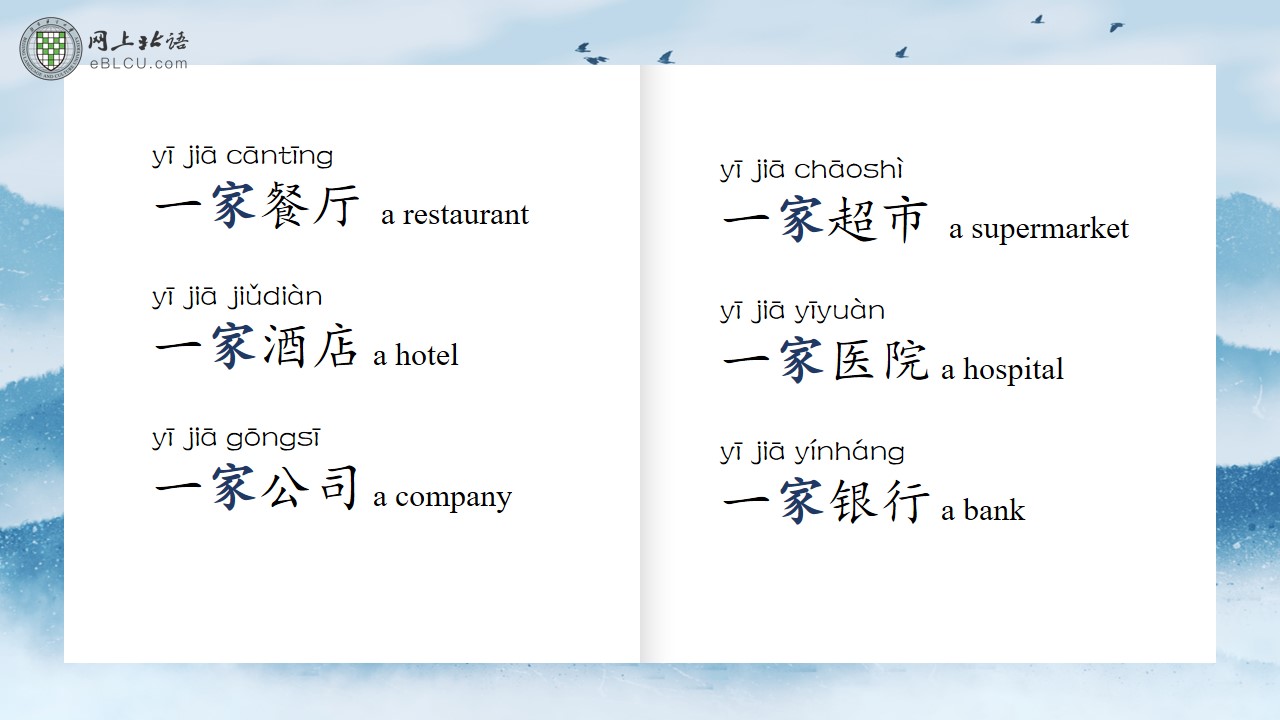
What is the Chinese Measure Word 家 (jiā) Used For?
The Chinese measure word 家 (jiā) is primarily used to count or refer to households, families, businesses, or establishments. It is commonly applied to entities that represent a collective or organized group, particularly those related to living spaces or commercial institutions. Below are some key uses:
- Families or households: E.g., 一家人 (yī jiā rén) – one family.
- Companies or businesses: E.g., 两家公司 (liǎng jiā gōngsī) – two companies.
- Restaurants or shops: E.g., 三家餐厅 (sān jiā cāntīng) – three restaurants.
How is 家 (jiā) Used for Families and Households?
When referring to families or households, 家 (jiā) emphasizes the unit as a whole. It can describe both the physical home and the people living in it. Examples include:
- 一家四口 (yī jiā sì kǒu) – a family of four.
- 邻居家 (línjū jiā) – the neighbor’s household.
- 几家人 (jǐ jiā rén) – several families.
Why is 家 (jiā) Used for Businesses and Companies?
The measure word 家 (jiā) is also applied to businesses, corporations, or institutions, as they function as organized entities. Common examples are:
- 一家银行 (yī jiā yínháng) – one bank.
- 五家工厂 (wǔ jiā gōngchǎng) – five factories.
- 这家公司 (zhè jiā gōngsī) – this company.
Can 家 (jiā) Be Used for Restaurants and Shops?
Yes, 家 (jiā) is frequently used for restaurants, shops, or service-based establishments, treating them as single operational units. Examples include:
- 两家咖啡馆 (liǎng jiā kāfēi guǎn) – two coffee shops.
- 一家超市 (yī jiā chāoshì) – one supermarket.
- 几家书店 (jǐ jiā shūdiàn) – a few bookstores.
Are There Exceptions Where 家 (jiā) Is Not Used?
While 家 (jiā) is versatile, it is not used for individual objects or non-organized entities. For example:
- Not for single items: You wouldn’t say 一家书 (yī jiā shū) for one book.
- Not for abstract concepts: It doesn’t apply to ideas like 一家爱 (yī jiā ài) for one love.
- Not for natural objects: Avoid using it for things like trees or animals.
What are the measure words for money in Chinese?

Common Measure Words for Money in Chinese
In Chinese, measure words (量词, liàngcí) are essential when counting or referring to money. The most common measure word for money is 块 (kuài), which is equivalent to the English word dollar or yuan. Another frequently used measure word is 毛 (máo), meaning 10 cents or jiao. Here’s a breakdown:
- 块 (kuài) – Used for the primary unit of Chinese currency (e.g., 一块钱, yī kuài qián = one yuan).
- 毛 (máo) – Represents smaller denominations (e.g., 三毛钱, sān máo qián = 30 cents).
- 分 (fēn) – Rarely used today, but historically meant cent (e.g., 五分钱, wǔ fēn qián = 5 cents).
Formal and Informal Usage of Money Measure Words
Chinese speakers use measure words differently depending on the context. In formal settings, 元 (yuán) replaces 块 (kuài), while 角 (jiǎo) substitutes 毛 (máo). Here’s how they differ:
- 元 (yuán) – Formal term for yuan (e.g., 十元, shí yuán = 10 yuan).
- 角 (jiǎo) – Formal equivalent of 毛 (máo) (e.g., 两角, liǎng jiǎo = 20 cents).
- 分 (fēn) – Still used in official documents but rarely in daily speech.
Regional Variations in Money Measure Words
Different Chinese-speaking regions may use measure words differently. For example, in Taiwan, 塊 (kuài) is also used, but the currency is New Taiwan Dollar (NTD). Key distinctions include:
- 塊 (kuài) – Used in Taiwan for NTD (e.g., 一百塊, yī bǎi kuài = 100 NTD).
- 毛 (máo) – Less common in Taiwan, where 角 (jiǎo) is preferred.
- 文 (wén) – An archaic term sometimes referenced in historical contexts.
Measure Words for Large Sums of Money
When discussing large amounts of money, Chinese uses specific terms for clarity. These include:
- 万 (wàn) – Represents ten thousand (e.g., 一万块, yī wàn kuài = 10,000 yuan).
- 亿 (yì) – Means hundred million (e.g., 一亿, yī yì = 100,000,000 yuan).
- 兆 (zhào) – Rarely used, but can mean trillion in some contexts.
Slang and Colloquial Terms for Money
Chinese has many slang terms for money, often replacing standard measure words. Some popular examples are:
- 大洋 (dà yáng) – Old-fashioned slang for yuan.
- 银子 (yín zi) – Literally silver, used humorously for money.
- 票子 (piào zi) – Informal term meaning cash or bills.
Frequently Asked Questions (FAQ)
What are Chinese measure words and why are they important?
Chinese measure words, also known as classifiers, are essential components of Mandarin grammar used between a numeral and a noun. They help specify the quantity or type of object being referred to, adding clarity and precision to sentences. Unlike English, where measure words are optional (e.g., three cups of coffee), in Chinese, they are mandatory when counting or describing nouns. For example, instead of saying three books, you would say three 本 (běn) books, where 本 is the measure word for books. Mastering them is crucial for sounding natural and fluent in Chinese.
How do I know which measure word to use in Chinese?
Choosing the correct measure word depends on the noun's characteristics, such as shape, function, or category. For instance, 张 (zhāng) is used for flat objects like paper or tables, while 条 (tiáo) applies to long, flexible items like rivers or pants. Some measure words are more general, like 个 (gè), which is a default for many nouns but may sound less precise. Memorizing common pairings and practicing with native speakers or resources will help you internalize the correct usage over time.
Are there any rules or patterns for learning Chinese measure words?
While there are no strict universal rules, many measure words follow logical patterns based on the noun's attributes. For example, 辆 (liàng) is used for vehicles, 只 (zhī) for animals or one of a pair (like shoes), and 件 (jiàn) for clothing or abstract matters. However, some pairings are arbitrary and must be memorized. Tools like flashcards, apps, or textbooks often group measure words thematically, making them easier to learn. Consistency and exposure are key to mastering these patterns.
Can I use the general measure word 个 (gè) for everything in Chinese?
While 个 (gè) is the most versatile and commonly used measure word in Chinese, overusing it can make your speech sound unnatural or overly simplistic. Native speakers often prefer specific measure words for accuracy and fluency. For example, saying three 个 dogs instead of three 只 (zhī) dogs would be understood but marked as incorrect. Reserve 个 for nouns without a known measure word or in informal contexts, but aim to learn the appropriate classifiers to improve your language proficiency.
Leave a Reply
Related Posts