
Should you learn to speak Chinese before you learn Chinese characters?

Learning Chinese presents a unique challenge for many language learners: should you focus on speaking first or dive straight into characters? While Mandarin’s tonal system and pronunciation require practice, the complexity of Chinese characters can feel overwhelming. Some argue that mastering spoken Chinese builds confidence and practical communication skills before tackling writing. Others believe that learning characters early enhances understanding of the language’s structure and cultural depth. This article explores the pros and cons of each approach, helping you decide whether to prioritize speaking or writing in your Chinese language journey. The right choice depends on your goals, learning style, and commitment level.
- Should You Learn to Speak Chinese Before You Learn Chinese Characters?
- Do I need to learn Chinese characters to speak Chinese?
- What should I learn first when learning Chinese?
-
Should I learn Chinese or Mandarin first?
- What Is the Difference Between Chinese and Mandarin?
- Why Should You Learn Mandarin Before Other Chinese Dialects?
- Are There Benefits to Learning Another Chinese Dialect First?
- How Does Mandarin Compare in Difficulty to Other Chinese Dialects?
- What Resources Are Best for Learning Mandarin as a Beginner?
- Frequently Asked Questions (FAQ)
Should You Learn to Speak Chinese Before You Learn Chinese Characters?
The Importance of Spoken Chinese in Early Learning
Learning to speak Chinese before tackling characters can help build a strong foundation in pronunciation and tones. Since Mandarin is a tonal language, mastering spoken phrases early can prevent common mistakes. Many learners find it easier to engage in conversations first, which boosts confidence and motivation before diving into the complex writing system.
| Advantage | Disadvantage |
|---|---|
| Better pronunciation and tonal accuracy | Delayed reading/writing skills |
| Faster conversational ability | May struggle with character recognition later |
How Characters Enhance Language Comprehension
While speaking first has benefits, Chinese characters provide deeper insight into the language's structure and meaning. Characters often contain phonetic and semantic clues, helping learners understand word origins and connections. Starting early with basic characters can reinforce vocabulary retention and improve overall fluency.
See AlsoWhich Chinese language course should you take?| Advantage | Disadvantage |
|---|---|
| Deeper understanding of vocabulary | Steeper initial learning curve |
| Improved reading comprehension | Slower speaking progress |
Balancing Speaking and Character Learning
A balanced approach is often the most effective. Beginners can focus on basic spoken phrases while gradually introducing simple characters like 一 (one) or 人 (person). This method ensures steady progress in both areas without overwhelming the learner.
| Strategy | Outcome |
|---|---|
| Learn 5-10 characters weekly | Steady character recognition |
| Practice speaking daily | Improved pronunciation |
Common Challenges When Prioritizing Speaking
Learners who ignore characters initially may face difficulties later, such as struggling to read signs or texts. Additionally, homophones in Mandarin (words with the same sound but different meanings) can cause confusion without character knowledge.
| Challenge | Solution |
|---|---|
| Homophone confusion | Learn characters alongside words |
| Limited reading ability | Introduce characters early |
Tools to Learn Both Speaking and Characters Simultaneously
Using interactive tools like apps (e.g., Duolingo, HelloChinese) or flashcards can help integrate speaking and character learning. Many resources include audio for pronunciation and visual aids for characters, making dual learning efficient.
See AlsoThe new HSK 3.0: What you need to know| Tool | Benefit |
|---|---|
| Language apps | Combines audio and visual learning |
| Flashcards | Reinforces character memorization |
Do I need to learn Chinese characters to speak Chinese?

Is Learning Chinese Characters Necessary for Speaking Chinese?
No, learning Chinese characters is not strictly necessary to speak Chinese. Spoken Chinese relies on pronunciation and tones, which can be learned using Pinyin, the romanization system for Mandarin. However, characters are essential for reading and writing.
- Pinyin allows you to pronounce words correctly without knowing characters.
- Tones are more critical for communication than characters in spoken contexts.
- Characters become necessary if you plan to read or write in Chinese.
Can You Communicate in Chinese Without Knowing Characters?
Yes, you can communicate effectively in spoken Chinese without knowing characters. Many learners focus on oral proficiency first, especially if their goal is conversation.
See AlsoHow Many Chinese Characters Do I Need to Learn to be Fluent?- Daily conversations rely on listening and speaking skills.
- Characters are not used in verbal exchanges unless reading is involved.
- Language apps and audio resources can help you learn without characters.
What Are the Advantages of Learning Chinese Characters?
While not mandatory for speaking, learning Chinese characters offers significant benefits, especially for deeper language understanding.
- Characters help you read signs, menus, and documents in Chinese-speaking regions.
- They provide insight into word origins and cultural context.
- Knowing characters improves vocabulary retention and comprehension.
How Does Pinyin Help in Learning Spoken Chinese?
Pinyin is a crucial tool for beginners, as it bridges the gap between pronunciation and characters.
- It uses the Latin alphabet to represent Chinese sounds.
- Pinyin helps learners master tones and syllable pronunciation.
- It is widely used in language apps and beginner textbooks.
When Should You Start Learning Chinese Characters?
The right time to learn Chinese characters depends on your goals and learning pace.
See Also13 more songs to learn Chinese and expand your horizons- If your focus is speaking, delay characters until you’re comfortable with pronunciation.
- For comprehensive fluency, start learning characters early to build reading skills.
- Balance character study with spoken practice to avoid overwhelm.
What should I learn first when learning Chinese?
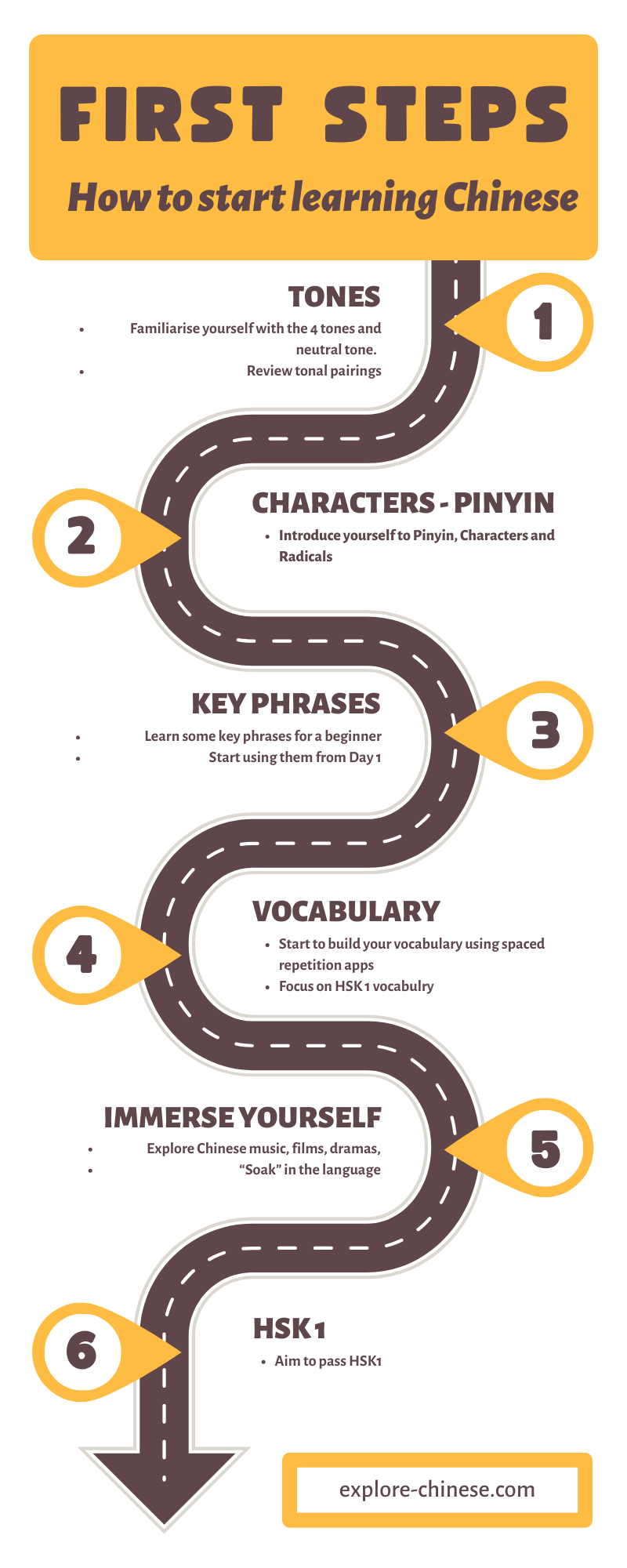
1. Master Pinyin for Pronunciation
Learning Pinyin is the foundation of Chinese pronunciation. It uses the Roman alphabet to represent Mandarin sounds, helping beginners read and speak accurately. Focus on:
- Tones: Mandarin has four tones and a neutral tone—practice them early to avoid miscommunication.
- Initials and Finals: These are the building blocks of syllables; master combinations like zh, ch, and ang.
- Common Mistakes: Watch out for tricky sounds like q (sounds like chee) or x (similar to she).
2. Start with Basic Vocabulary
Begin with high-frequency words to build practical communication skills. Prioritize:
See AlsoAll Duolingo Characters: Names, Stories, and Personalities- Greetings: Learn phrases like 你好 (nǐ hǎo) and 谢谢 (xièxie) for daily interactions.
- Numbers: Essential for shopping, telling time, and basic transactions.
- Pronouns: Words like 我 (wǒ) (I) and 你 (nǐ) (you) form sentence foundations.
3. Understand Simple Sentence Structures
Chinese grammar is relatively straightforward but differs from English. Focus on:
- Subject-Verb-Object (SVO): Similar to English, e.g., 我吃饭 (wǒ chī fàn) (I eat rice).
- No Verb Conjugation: Verbs don’t change for tense—rely on context or time indicators.
- Measure Words: Learn basics like 个 (gè) for general objects or 只 (zhī) for animals.
4. Practice Listening and Speaking Early
Immersion accelerates learning. Key steps:
- Listen to Native Content: Use podcasts, songs, or TV shows to train your ear.
- Shadowing: Repeat after speakers to mimic tones and rhythm.
- Language Partners: Apps like Tandem or HelloTalk connect you with native speakers.
5. Learn to Recognize Basic Characters
While challenging, characters are essential for literacy. Start with:
- Radicals: These components hint at meaning or pronunciation, e.g., 水 (shuǐ) for water-related characters.
- Common Characters: Focus on 100–200 frequent ones like 人 (rén) (person) or 日 (rì) (sun/day).
- Writing Practice: Use grids to learn stroke order—critical for memorization.
Should I learn Chinese or Mandarin first?

What Is the Difference Between Chinese and Mandarin?
Mandarin is a specific dialect of Chinese, while Chinese refers to a group of languages, including Cantonese, Shanghainese, and others. Mandarin is the most widely spoken and is the official language of China and Taiwan. Here’s why this distinction matters:
- Mandarin is the standard form used in education, media, and government.
- Other Chinese dialects like Cantonese are primarily spoken in regions like Guangdong and Hong Kong.
- Learning Mandarin first provides broader utility for communication and business.
Why Should You Learn Mandarin Before Other Chinese Dialects?
Choosing Mandarin as your starting point offers several advantages, especially if your goal is practicality. Here’s why:
- Global relevance: Mandarin has over 1 billion speakers worldwide.
- Simplified writing system: Mandarin uses standardized characters, unlike some dialects with regional variations.
- Easier access to resources: Most textbooks and courses focus on Mandarin.
Are There Benefits to Learning Another Chinese Dialect First?
While Mandarin is the most practical, some may prefer another dialect for specific reasons. Consider these points:
- Cultural or family ties: If you have roots in Cantonese-speaking regions, learning Cantonese may be more meaningful.
- Regional focus: Planning to live in Hong Kong or Macau? Cantonese is dominant there.
- Linguistic interest: Some learners enjoy exploring lesser-studied dialects like Hokkien or Hakka.
How Does Mandarin Compare in Difficulty to Other Chinese Dialects?
Mandarin is often considered easier for beginners due to its structure. Here’s how it compares:
- Tones: Mandarin has four main tones, while Cantonese has six to nine.
- Grammar: Mandarin grammar is relatively straightforward compared to some dialects.
- Pronunciation: Mandarin’s phonetics are more consistent across regions.
What Resources Are Best for Learning Mandarin as a Beginner?
Starting with Mandarin gives you access to abundant learning tools. Here are the top resources:
- Apps: Duolingo, HelloChinese, and Pleco are popular for beginners.
- Textbooks: Integrated Chinese and New Practical Chinese Reader are widely used.
- Online courses: Platforms like Coursera and Yabla offer structured lessons.
Frequently Asked Questions (FAQ)
Is it better to learn spoken Chinese before tackling Chinese characters?
Learning spoken Chinese first can be highly beneficial for beginners, as it helps build a foundation in pronunciation, tones, and basic communication. Since Mandarin relies heavily on tones, mastering speaking early ensures you develop the correct intonation. Once you're comfortable with spoken phrases, transitioning to characters becomes easier because you already understand the sounds and meanings behind them.
How difficult is it to learn Chinese characters without knowing spoken Chinese?
Learning characters without spoken knowledge can be challenging because Chinese is a logographic language, meaning characters represent meaning rather than sound. Without prior exposure to spoken words, memorizing characters may feel abstract. However, some learners succeed by focusing on radicals and character components first, which can provide clues to meaning and pronunciation.
Can you become fluent in Chinese without learning characters?
While it's possible to achieve spoken fluency without mastering characters, doing so limits your ability to read and write. Chinese media, literature, and official documents rely on characters, so skipping them restricts full language comprehension. For casual conversation, spoken Chinese may suffice, but for deeper engagement, learning characters is essential.
What are the advantages of learning Chinese characters early?
Starting with Chinese characters early helps reinforce vocabulary retention and improves reading skills over time. Recognizing characters allows you to decode written materials faster and enhances your understanding of word structure. Additionally, early exposure to characters can make advanced learning smoother, as you’ll already be familiar with common radicals and stroke patterns.
Leave a Reply
Related Posts