
How was your first semester of learning Chinese?

Starting to learn Chinese can be both exciting and challenging, especially during the first semester. For many students, this period is filled with new discoveries—from mastering tones and characters to navigating basic conversations. The initial weeks often feel overwhelming, but gradual progress brings a sense of accomplishment. Whether struggling with pronunciation or celebrating small victories, every learner’s journey is unique. This article explores common experiences, challenges, and tips from those who have just completed their first semester. If you’re curious about what to expect or looking to reflect on your own progress, read on to see how others have navigated their early steps in learning Chinese.
How Was Your First Semester of Learning Chinese?
1. Initial Challenges in Learning Chinese
The first semester of learning Chinese was both exciting and challenging. The tones and characters were the most difficult aspects to grasp. Unlike alphabetic languages, Mandarin requires memorizing thousands of unique characters. Additionally, mastering the four tones was crucial to avoid miscommunication.
| Challenge | Solution |
|---|---|
| Tones | Daily pronunciation drills |
| Characters | Flashcards and writing practice |
2. Progress in Speaking and Listening
By the end of the semester, my speaking and listening skills improved significantly. Regular conversation practice with classmates and listening to Chinese podcasts helped a lot. However, understanding native speakers at full speed remained difficult.
See AlsoTop Tips for Guest Etiquette in China| Skill | Improvement Method |
|---|---|
| Speaking | Language exchange partners |
| Listening | Watching Chinese shows |
3. Writing and Reading Chinese Characters
Learning to write and read Chinese characters was time-consuming but rewarding. I focused on radicals first, which helped in recognizing patterns. Pinyin was useful initially, but relying on it too much slowed my progress in reading characters.
| Aspect | Strategy |
|---|---|
| Writing | Repetitive stroke practice |
| Reading | Graded readers |
4. Cultural Insights Gained
Studying Chinese also introduced me to cultural nuances, such as polite expressions and festivals. Understanding these aspects made the language more meaningful. For example, knowing the significance of Chinese New Year improved my conversational topics.
| Cultural Element | Impact on Learning |
|---|---|
| Festivals | Enhanced vocabulary |
| Etiquette | Better communication |
5. Resources That Helped the Most
Using the right resources was key to progress. Apps like HelloChinese, Anki for flashcards, and YouTube tutorials were invaluable. My textbook provided structured lessons, but real-life practice was irreplaceable.
See AlsoWhat are the Beijing Dialect and Beijing Accent?| Resource | Purpose |
|---|---|
| HelloChinese | Interactive lessons |
| Anki | Character memorization |
What do you learn first when learning Chinese?
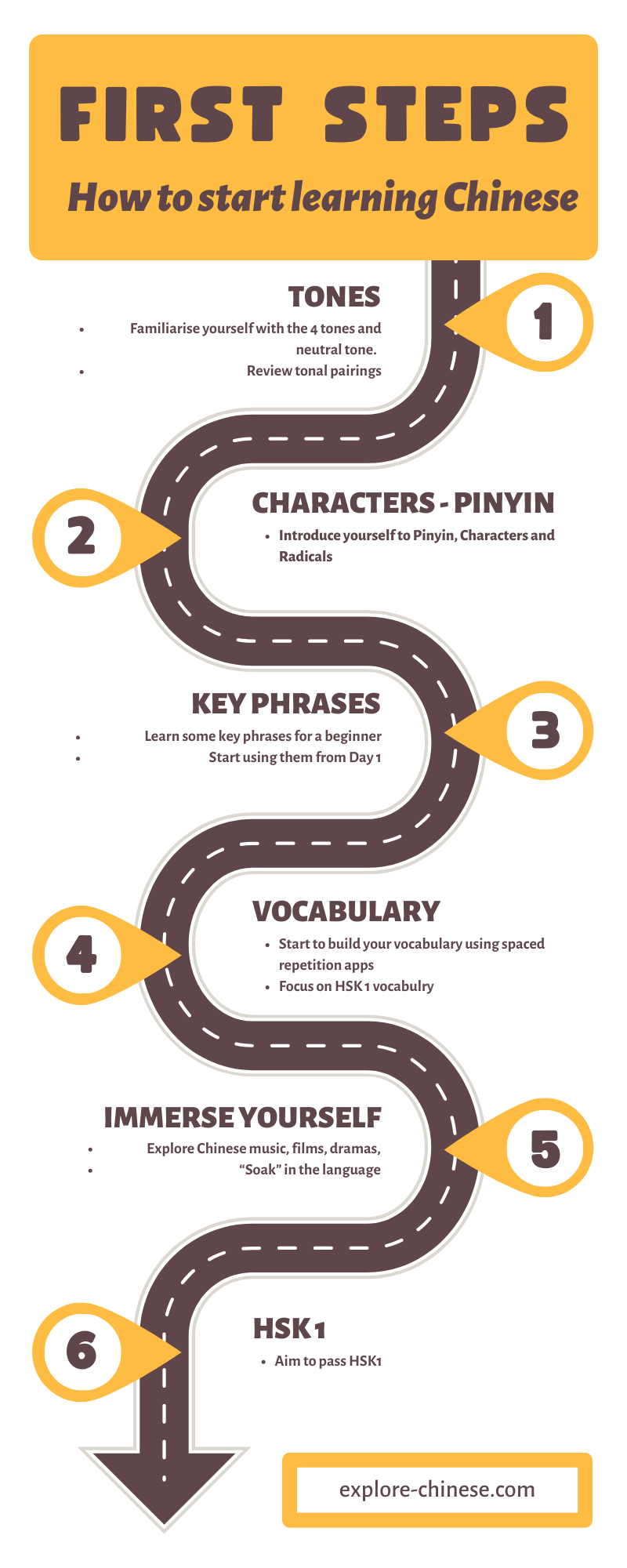
Basic Chinese Pronunciation and Pinyin
When starting to learn Chinese, the first step is mastering pronunciation and Pinyin, the romanization system for Mandarin. This foundation helps learners read and pronounce words correctly before tackling characters.
- Pinyin uses the Latin alphabet to represent Chinese sounds, including initials, finals, and tones.
- Tones are critical—Mandarin has four main tones and a neutral tone, which change word meanings.
- Practice with simple syllables like ma (妈, 麻, 马, 骂) to distinguish tones clearly.
Essential Greetings and Phrases
Early lessons often focus on greetings and basic phrases to build conversational confidence quickly.
See AlsoWhat is the Hungry Ghost Festival in China?- Learn nǐ hǎo (你好) for hello and xiè xie (谢谢) for thank you.
- Master polite phrases like duì bu qǐ (对不起) for sorry and zài jiàn (再见) for goodbye.
- Understand question phrases such as nǐ jiào shén me míng zì? (你叫什么名字?) for What’s your name?
Numbers and Counting
Numbers are fundamental for daily tasks like shopping, telling time, or exchanging phone numbers.
- Start with 1-10 (一, 二, 三, etc.), then expand to larger numbers like 100 (yī bǎi 一百).
- Practice counting money, as prices are often spoken aloud in markets.
- Learn how numbers indicate dates and times, e.g., jǐ diǎn? (几点?) for What time?
Simple Sentence Structure
Understanding basic sentence patterns helps form simple statements and questions.
- Subject-Verb-Object (SVO) order is standard, e.g., wǒ chī píng guǒ (我吃苹果) (I eat apples).
- Use ma (吗) at the end to turn statements into yes/no questions.
- Start with negation like bù (不) for not, e.g., wǒ bù zhī dào (我不知道) (I don’t know).
Common Vocabulary for Daily Life
Early vocabulary focuses on everyday objects, family terms, and survival phrases.
- Memorize words like shuǐ (水) (water), fàn (饭) (rice/meal), and jiā (家) (home).
- Learn family titles: mā ma (妈妈) (mom), bà ba (爸爸) (dad).
- Practice directional terms like zuǒ (左) (left) and yòu (右) (right).
How long does it realistically take to learn Chinese?
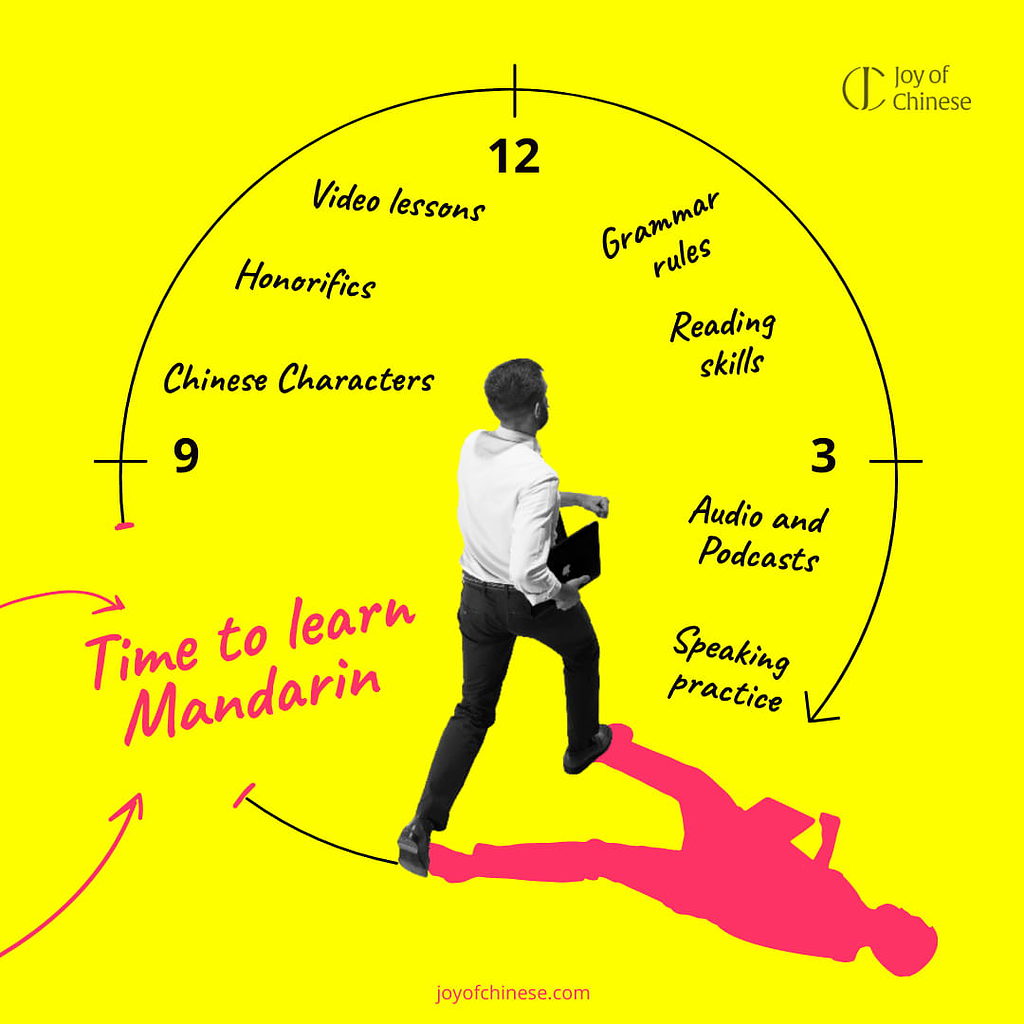
Factors That Influence Learning Chinese
The time it takes to learn Chinese varies based on several factors:
- Prior language experience: Knowing other tonal languages like Vietnamese or Thai can speed up the process.
- Study intensity: Dedication matters—full-time learners progress faster than casual students.
- Learning environment: Immersion in a Chinese-speaking country accelerates fluency.
Basic Proficiency: Survival Chinese
Achieving basic communication (greetings, simple questions) typically takes:
- 3-6 months with consistent daily practice.
- Focus on pinyin and tones to build a foundation.
- Essential vocabulary (200-300 words) for everyday interactions.
Intermediate Level: Conversational Fluency
Reaching intermediate fluency (discussing hobbies, work) usually requires:
- 1-2 years of structured study.
- Mastery of 1,000-2,000 characters.
- Grammar patterns for complex sentences.
Advanced Proficiency: Business or Academic Use
Attaining advanced Chinese for professional contexts demands:
- 3-5 years of intensive study.
- 3,000+ characters and specialized vocabulary.
- Cultural nuance for formal settings.
Native-Like Mastery
Achieving near-native fluency is rare and often takes:
- 5+ years of immersion and daily use.
- Deep cultural understanding beyond language.
- Idiomatic expressions and slang proficiency.
Why did you choose to learn Chinese?

Career Opportunities and Professional Growth
Learning Chinese opens doors to numerous career opportunities, especially in global business, trade, and diplomacy. With China's growing economic influence, proficiency in Mandarin is a valuable asset. Here are key reasons:
- Global business: Many multinational companies seek employees who can communicate with Chinese partners.
- Competitive edge: Bilingual professionals often have higher earning potential and career advancement.
- Diplomatic roles: Governments and NGOs value Mandarin speakers for international relations.
Cultural Appreciation and Travel
Understanding Chinese enhances cultural immersion and makes travel in China more rewarding. It allows deeper connections with locals and access to authentic experiences. Key points include:
- Rich history: Learning the language provides insight into China's 5,000-year-old civilization.
- Local interactions: Speaking Mandarin helps navigate cities, markets, and rural areas with ease.
- Festivals and traditions: Language skills enable participation in events like Lunar New Year.
Academic and Intellectual Challenges
Chinese is considered one of the most challenging languages to learn, making it an exciting intellectual pursuit. Reasons for tackling this challenge include:
- Unique writing system: Mastering characters improves memory and cognitive skills.
- Tonal language: Mandarin's four tones train the ear and enhance linguistic flexibility.
- Brain benefits: Studies show learning Chinese boosts problem-solving and multitasking abilities.
Personal Connections and Relationships
Many learners study Chinese to strengthen personal bonds with family, friends, or partners. Key motivations are:
- Heritage learners: Those with Chinese roots reconnect with their ancestry.
- Cross-cultural relationships: Partners communicate better and share cultural nuances.
- Community engagement: Speaking Mandarin fosters deeper ties in Chinese-speaking communities.
Future-Proofing and Global Trends
As China's influence grows, learning Mandarin is a way to future-proof oneself in an interconnected world. Important factors include:
- Economic power: China is a leading global economy, making Mandarin a strategic language.
- Technological advancements: Many tech innovations originate from Chinese-speaking regions.
- Educational exchanges: Scholarships and study programs in China are increasingly accessible.
What is the hardest thing about learning Chinese?

The Complexity of Chinese Characters
One of the most challenging aspects of learning Chinese is mastering its writing system. Unlike alphabetic languages, Chinese uses logograms, where each character represents a word or a morpheme. This requires memorizing thousands of unique characters, each with its own stroke order and meaning. Key difficulties include:
- Stroke order: Characters must be written in a specific sequence, which can be unintuitive for learners.
- Homophones: Many characters share the same pronunciation but have different meanings.
- Lack of phonetic clues: Unlike拼音 (pinyin), characters often don’t indicate how they’re pronounced.
Tonal Pronunciation
Chinese is a tonal language, meaning the pitch or intonation of a word can change its meaning entirely. Mandarin has four main tones and a neutral tone, which can be difficult for non-native speakers to distinguish and reproduce. Challenges include:
- Tone confusion: Mispronouncing a tone can lead to misunderstandings (e.g., mā (mother) vs. mà (scold)).
- Regional accents: Tones may vary slightly across dialects, adding complexity.
- Listening comprehension: Identifying tones in fast-paced conversations requires extensive practice.
Grammar and Sentence Structure
While Chinese grammar is often considered simpler than that of many European languages, its lack of inflection and reliance on context can be tricky. Key hurdles include:
- Word order: Sentences follow a strict Subject-Verb-Object (SVO) structure, but exceptions exist.
- Measure words: Nouns require specific classifiers (e.g., 一本书 – one 本 book).
- No verb conjugation: Time is indicated through context or particles like 了 (le) for past tense.
Cultural Context and Idioms
Chinese is deeply tied to its culture, and many expressions rely on historical or cultural references. This can make idiomatic phrases hard to grasp. Examples include:
- Chengyu: Four-character idioms often derived from ancient stories (e.g., 画蛇添足 – draw legs on a snake).
- Politeness norms: Indirect speech and honorifics are common in formal settings.
- Regional slang: Colloquialisms vary widely between mainland China, Taiwan, and other regions.
Listening and Speaking Fluency
Achieving fluency in spoken Chinese demands overcoming several barriers, such as:
- Speed of native speech: Conversations often flow quickly, with dropped syllables or contractions.
- Dialectal variations: Mandarin differs from Cantonese, Shanghainese, etc., complicating comprehension.
- Lack of cognates: Few words resemble those in Indo-European languages, limiting guesswork.
Frequently Asked Questions (FAQ)
How challenging was your first semester of learning Chinese?
Learning Chinese in the first semester can be quite challenging, especially for those unfamiliar with tonal languages. The pronunciation and tones require consistent practice, as mispronouncing a word can change its meaning entirely. Additionally, memorizing Chinese characters is demanding due to their complexity and lack of phonetic clues. However, with dedication and regular practice, many students find themselves making steady progress by the end of the semester.
What resources helped you the most during your first semester?
Textbooks like Integrated Chinese and language apps such as Pleco or HelloChinese were incredibly useful for building vocabulary and understanding grammar. Many students also benefited from language exchange partners or tutors who provided real-time feedback. Watching Chinese dramas or listening to podcasts helped improve listening skills, while flashcards (physical or digital) were essential for memorizing characters and tones.
Did you experience any cultural insights while learning Chinese?
Yes, the first semester often introduces learners to cultural nuances embedded in the language. For example, understanding polite phrases and hierarchical terms of address reflects the importance of respect in Chinese culture. Learning about festivals like the Lunar New Year or Mid-Autumn Festival also deepened appreciation for the language. Many students found that these cultural elements made the learning process more engaging and meaningful.
How did you stay motivated throughout the first semester?
Setting small, achievable goals, such as mastering a set number of characters per week, kept motivation high. Celebrating milestones, like holding a basic conversation, provided a sense of accomplishment. Joining a study group or online community also helped, as sharing struggles and successes with peers created accountability. Lastly, reminding oneself of the long-term benefits—whether for travel, career, or personal growth—was key to staying committed.
Leave a Reply
Related Posts