
Direction Complements: How to Use them in Chinese

Chinese direction complements are essential grammatical structures that indicate the direction of an action, adding precision and clarity to sentences. These complements, often formed with words like 来 (lái, come) and 去 (qù, go), follow verbs to show movement toward or away from a reference point. Mastering them enhances fluency and helps learners express actions more naturally. This article explores common direction complements, their correct placement, and practical examples to illustrate their usage. Whether describing simple movements or complex actions, understanding these complements is key to forming accurate and dynamic sentences in Chinese. Let’s dive into their structure and application for more effective communication.
Understanding Direction Complements in Chinese
Direction complements are an essential part of Chinese grammar, used to indicate the direction of an action. They are formed by combining a verb with a directional word, such as 来 (lái) for toward the speaker or 去 (qù) for away from the speaker. Mastering these complements helps convey movement and spatial relationships accurately in sentences. Below, we explore key aspects of direction complements in Chinese.
1. Basic Structure of Direction Complements
Direction complements consist of a main verb followed by a directional word. For example:
- 进来 (jìn lái) – come in
- 出去 (chū qù) – go out
These complements can be simple (using one directional word) or compound (using two). The structure is:
Verb + Directional Word (来/去) or (上/下/进/出/回/过/起 + 来/去).
| Verb | Directional Word | Example |
|---|---|---|
| 走 (zǒu) | 进来 (jìn lái) | 他走进来 (Tā zǒu jìn lái) – He walks in. |
| 跑 (pǎo) | 出去 (chū qù) | 她跑出去 (Tā pǎo chū qù) – She runs out. |
2. Common Directional Words and Their Meanings
Chinese uses several directional words to express movement. Here are the most common ones:
- 来 (lái) – Toward the speaker
- 去 (qù) – Away from the speaker
- 上 (shàng) – Up
- 下 (xià) – Down
- 进 (jìn) – Enter
- 出 (chū) – Exit
These words can combine to form compound direction complements, such as 上来 (shàng lái) – come up or 下去 (xià qù) – go down.
See AlsoMemrise vs Duolingo: Which Language Learning App is Better?| Directional Word | Meaning |
|---|---|
| 上来 (shàng lái) | Come up |
| 下去 (xià qù) | Go down |
3. Using Direction Complements with Objects
When a sentence includes an object, the placement depends on whether the object is a location or a general noun.
- Location objects come before the directional complement:
他上楼来 (Tā shàng lóu lái) – He comes upstairs.
- General objects come after the complement:
他拿书进来 (Tā ná shū jìn lái) – He brings the book in.
| Object Type | Structure |
|---|---|
| Location | Verb + Location + Directional Complement |
| General | Verb + Directional Complement + Object |
4. Negative and Question Forms with Direction Complements
To form negations, use 没 (méi) or 不 (bù) before the verb:
- 他没进来 (Tā méi jìn lái) – He didn’t come in.
- 我不上去 (Wǒ bù shàng qù) – I won’t go up.
For questions, use 吗 (ma) or question words:
- 你进来吗?(Nǐ jìn lái ma?) – Will you come in?
- 谁出去了?(Shéi chū qù le?) – Who went out?
| Form | Example |
|---|---|
| Negative | 他没回来 (Tā méi huí lái) – He didn’t return. |
| Question | 你下去吗?(Nǐ xià qù ma?) – Are you going down? |
5. Advanced Usage: Separable Direction Complements
Some direction complements can be separated by objects or other elements. For example:
- 拿出来 (ná chū lái) → 拿得出来 (ná de chū lái) – can take out
- 走进去 (zǒu jìn qù) → 走不进去 (zǒu bù jìn qù) – cannot walk in
This structure is used for potential complements, indicating whether an action is possible.
| Structure | Example |
|---|---|
| Verb + 得/不 + Directional Complement | 听得懂 (tīng de dǒng) – can understand |
| Verb + 不 + Directional Complement | 看不见 (kàn bù jiàn) – cannot see |
What is a complement in Chinese grammar?
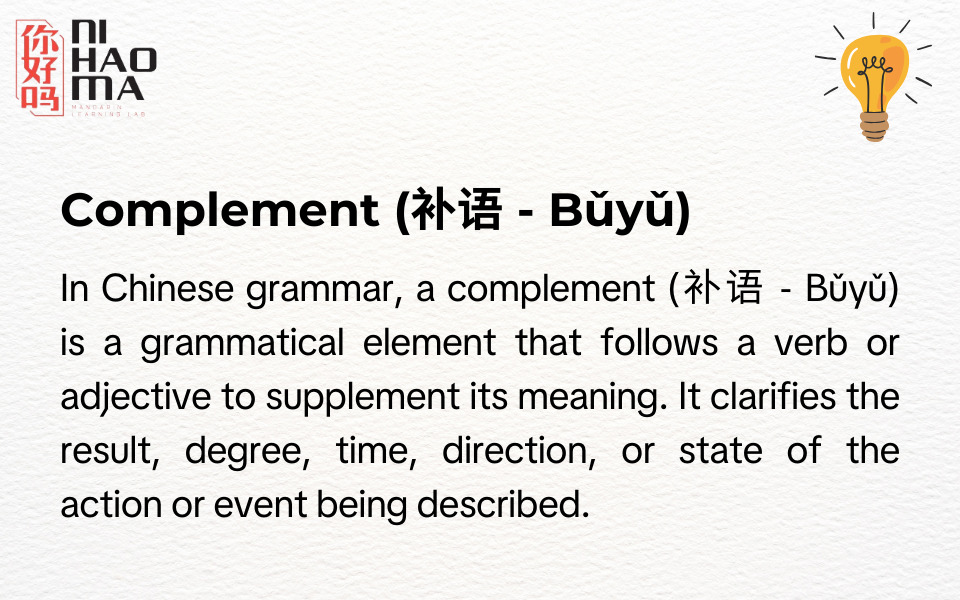
Definition of a Complement in Chinese Grammar
A complement in Chinese grammar is a word or phrase that follows a verb or adjective to provide additional information about the action or state. It often describes the result, degree, direction, or potential of the verb or adjective. Complements are essential for conveying precise meanings in sentences.
- Result complements indicate the outcome of an action (e.g., 听懂 - understand after listening).
- Degree complements describe the intensity of an adjective (e.g., 漂亮极了 - extremely beautiful).
- Directional complements show movement direction (e.g., 走进来 - walk in).
Types of Complements in Chinese
Chinese grammar classifies complements into several types, each serving a distinct function. These include:
- Resultative complements (结果补语): Explain the result of an action (e.g., 写完 - finish writing).
- Potential complements (可能补语): Indicate whether an action is possible (e.g., 看得见 - can see).
- Directional complements (趋向补语): Describe movement toward or away (e.g., 拿起来 - pick up).
How Complements Differ from Adverbs
While both complements and adverbs modify verbs, their roles differ significantly. Complements are mandatory in certain structures and directly affect the verb's meaning, whereas adverbs are optional and describe manner, time, or frequency.
See AlsoBabbel vs Duolingo Spanish: Learning App Comparison (2025)- Complements follow the verb (e.g., 跑得快 - run quickly).
- Adverbs precede the verb (e.g., 很快地跑 - quickly run).
- Complements often change the verb's core meaning, while adverbs only add context.
Common Mistakes with Complements
Learners often confuse complements with other grammatical elements or misuse them. Key errors include:
- Placing the complement incorrectly (e.g., 写得好汉字 → incorrect; 汉字写得好 → correct).
- Overusing adverbs instead of complements (e.g., 很写得好 → incorrect; 写得很好 → correct).
- Mixing complement types (e.g., 看得听懂 → incorrect; 听得懂 → correct).
Practical Examples of Complements
To master complements, examine real-life examples:
- Result complement: 打破 (break open) - 他打破了杯子 (He broke the cup).
- Degree complement: 累死了 (extremely tired) - 我累死了 (I'm exhausted).
- Directional complement: 飞回来 (fly back) - 鸟飞回来了 (The bird flew back).
What is ABAB in Chinese?

What Does ABAB Mean in Chinese?
In Chinese, ABAB refers to a specific repetition pattern often used in poetry, songs, or linguistic structures. It describes a sequence where two elements (A and B) alternate in a repeating fashion. For example, in classical Chinese poetry, this structure creates rhythm and symmetry.
- ABAB is common in four-character idioms (成语) or rhyming schemes.
- It can denote alternating tones or syllables in spoken Chinese.
- This pattern is also used in children's rhymes for memorization.
How Is ABAB Used in Chinese Poetry?
The ABAB structure in Chinese poetry emphasizes balance and harmony. Classical forms like Tang poetry often employ this pattern to create a melodic flow.
- Line alternation: The first and third lines rhyme (A), while the second and fourth rhyme (B).
- Tonal patterns: Used in regulated verse (律诗) to follow strict tonal rules.
- Modern adaptations: Contemporary poets may use ABAB for stylistic effect.
Examples of ABAB in Chinese Language
Here are practical instances where ABAB appears in Chinese:
- Idioms: 七上八下 (qī shàng bā xià) follows an alternating tone structure.
- Nursery rhymes: Simple songs for kids often use ABAB for easy recall.
- Proverbs: Some sayings repeat words in an ABAB sequence for emphasis.
ABAB vs. AABB in Chinese Structures
While ABAB alternates, AABB groups similar elements. Key differences include:
- Rhythm: ABAB creates contrast, while AABB builds repetition.
- Usage: ABAB is more dynamic; AABB feels predictable.
- Cultural context: ABAB is favored in classical works, whereas AABB appears in folk songs.
Why Is ABAB Important in Chinese Linguistics?
The ABAB pattern holds significance in Chinese due to its role in:
- Phonetics: Helps learners grasp tonal variations and pronunciation.
- Literature: Enhances the aesthetic quality of poems and prose.
- Memory aids: Simplifies learning through rhythmic repetition.
What are resultative complements in Chinese?

Definition of Resultative Complements in Chinese
Resultative complements are a grammatical structure in Chinese used to indicate the result or outcome of an action. They typically consist of a verb followed by an adjective or another verb that describes the consequence of the initial action. For example, in the phrase 吃完 (chī wán), the verb 吃 (chī) means to eat, and the complement 完 (wán) means finished, resulting in the meaning to finish eating.
- Resultative complements combine a verb and a complement to show the action's effect.
- They are essential for expressing completed actions or changed states in Chinese.
- Common complements include 完 (wán) (finish), 好 (hǎo) (well), and 到 (dào) (reach).
Structure of Resultative Complements
The basic structure of a resultative complement is Verb + Complement. The complement clarifies the result of the verb's action. For instance, in 看见 (kàn jiàn), the verb 看 (kàn) means to look, and the complement 见 (jiàn) means to see, forming the meaning to see (as a result of looking).
- The verb indicates the action.
- The complement specifies the outcome.
- Some complements can be adjectives (e.g., 干净 (gānjìng) in 洗干净 (xǐ gānjìng)—wash clean).
Common Resultative Complement Words
Certain words frequently appear as resultative complements in Chinese. These include:
- 完 (wán) – Indicates completion (e.g., 做完 (zuò wán) – finish doing).
- 好 (hǎo) – Suggests a satisfactory result (e.g., 做好 (zuò hǎo) – do well).
- 到 (dào) – Implies reaching a goal (e.g., 找到 (zhǎo dào) – find successfully).
Usage in Sentences
Resultative complements are widely used in everyday Chinese to describe completed actions. For example:
- 我听懂了 (Wǒ tīng dǒng le) – I understood (after listening).
- 他写错了 (Tā xiě cuò le) – He wrote it wrong.
- 她哭醒了 (Tā kū xǐng le) – She cried herself awake.
Differences from Directional Complements
While resultative complements focus on the outcome of an action, directional complements describe movement direction (e.g., 上去 (shàng qù) – go up). Key differences include:
- Resultative complements emphasize result (e.g., 打开 (dǎ kāi) – open).
- Directional complements focus on movement path (e.g., 走进来 (zǒu jìn lái) – walk in).
- Some verbs can take both types, altering meaning (e.g., 拿起来 (ná qǐ lái) – pick up vs. 拿好 (ná hǎo) – hold properly).
Frequently Asked Questions (FAQ)
What are direction complements in Chinese?
Direction complements are grammatical structures in Chinese that indicate the direction of an action in relation to the speaker or another reference point. They typically consist of a verb followed by a directional word, such as 来 (lái, toward the speaker) or 去 (qù, away from the speaker). For example, in the phrase 进来 (jìn lái, come in), 进 (jìn) means enter, and 来 (lái) adds the directional meaning of toward the speaker. These complements are essential for expressing movement and spatial relationships clearly in Chinese.
How do you form basic direction complements?
To form basic direction complements, combine a verb of movement with a simple directional word. Common directional words include 上 (shàng, up), 下 (xià, down), 进 (jìn, in), 出 (chū, out), 回 (huí, back), and 过 (guò, over). For example, 上去 (shàng qù) means go up, and 回来 (huí lái) means come back. The choice between 来 (lái) and 去 (qù) depends on whether the movement is toward or away from the speaker. Mastering these combinations is key to using direction complements correctly.
What is the difference between 来 (lái) and 去 (qù) in direction complements?
The difference between 来 (lái) and 去 (qù) lies in the perspective of the speaker. 来 indicates movement toward the speaker or a designated location, while 去 indicates movement away from the speaker. For example, 拿过来 (ná guò lái) means bring it over (to me), whereas 拿过去 (ná guò qù) means take it over (away from me). Understanding this distinction is crucial for conveying the correct direction in conversations and ensuring clarity in communication.
Can direction complements be used with non-movement verbs?
Yes, direction complements can also be used with non-movement verbs to indicate a figurative or abstract direction. For instance, 看起来 (kàn qǐ lái) means seems or appears, where 看 (kàn) is to look and 起来 (qǐ lái) adds the sense of starting or appearing. Similarly, 想起来 (xiǎng qǐ lái) means to remember (literally think up). These extended uses show how direction complements can enrich meaning beyond physical movement, making them a versatile tool in Chinese grammar.
Leave a Reply
Related Posts