
Learning styles: Use with caution!

The concept of learning styles has long been popular in education, suggesting that individuals absorb information best through specific methods, such as visual, auditory, or kinesthetic approaches. While this idea resonates with many educators and learners, recent research urges caution. Critics argue that rigidly categorizing students into learning styles may oversimplify the complexity of cognition and even hinder academic growth. Evidence shows that tailored teaching based solely on preferred styles does not necessarily improve outcomes. Instead, a flexible, multimodal approach often proves more effective. This article explores the debate, examining why learning styles should be used thoughtfully—if at all—in modern educational practices.
Learning Styles: Why You Should Approach Them with Caution
The Myth of Learning Styles
The idea that individuals learn best through specific modalities (e.g., visual, auditory, or kinesthetic) is widely debated. Research suggests there’s little evidence that matching teaching methods to preferred styles improves outcomes. Instead, effective learning depends on the subject matter and context.
| Learning Style | Common Belief | Reality |
|---|---|---|
| Visual | Learns best with images | No proven advantage |
| Auditory | Learns best through listening | Depends on content |
| Kinesthetic | Learns by doing | Useful for certain skills |
The Danger of Labeling
Categorizing learners can create fixed mindsets, limiting their adaptability. Students may avoid challenging material if it doesn’t align with their preferred style, hindering cognitive growth.
See AlsoLearn Chinese faster by leaving your comfort zoneWhat Research Says
Studies show no significant improvement when instruction aligns with learning styles. Instead, multimodal teaching (combining visuals, text, and practice) works best for long-term retention.
Practical Alternatives
Focus on evidence-based strategies like spaced repetition, active recall, and interleaving. These methods are proven to enhance learning efficiency across all subjects.
Educators' Role
Teachers should prioritize flexible instruction over style-based approaches. Encouraging metacognition (awareness of one’s learning process) is more beneficial than adhering to unproven theories.
See AlsoDo Chinese Speakers Suffer from Character Amnesia? And Other Random Questions About Chinese Language| Strategy | Benefit |
|---|---|
| Spaced Repetition | Improves memory retention |
| Active Recall | Strengthens understanding |
| Interleaving | Enhances problem-solving |
What are the 4 types of learning styles?

Visual Learning Style
The visual learning style involves processing information through images, diagrams, and spatial understanding. Learners who prefer this style benefit from seeing information presented in a graphical format. Key characteristics include:
- Preference for charts, graphs, and maps to understand concepts.
- Strong memory for written instructions and visual details.
- Use of color-coding and highlighting to organize notes.
Auditory Learning Style
The auditory learning style focuses on absorbing information through listening and speaking. These learners excel when information is presented verbally. Key traits include:
See AlsoDo you really know how to count in Chinese?- Preference for lectures, discussions, and podcasts over written material.
- Strong ability to remember spoken instructions and verbal explanations.
- Use of mnemonic devices or rhymes to retain information.
Reading/Writing Learning Style
The reading/writing learning style emphasizes text-based input and output. These learners thrive when interacting with written words. Key features include:
- Preference for textbooks, articles, and note-taking as primary learning tools.
- Strong ability to express ideas through writing and summarizing.
- Use of lists and bullet points to organize thoughts.
Kinesthetic Learning Style
The kinesthetic learning style involves learning through physical activity and hands-on experiences. These learners need movement to grasp concepts effectively. Key aspects include:
- Preference for experiments, role-playing, and practical tasks.
- Strong retention when physically engaged, such as through building models.
- Use of gestures or walking while studying to enhance memory.
How to Identify Your Learning Style
Understanding your dominant learning style can improve study efficiency. Consider these steps:
See AlsoHow learning some basic theory can improve your Mandarin pronunciation- Reflect on past learning experiences—what methods worked best?
- Take a learning style assessment or quiz for insights.
- Experiment with different techniques to observe which feels most natural.
What are the 7 main learning styles?
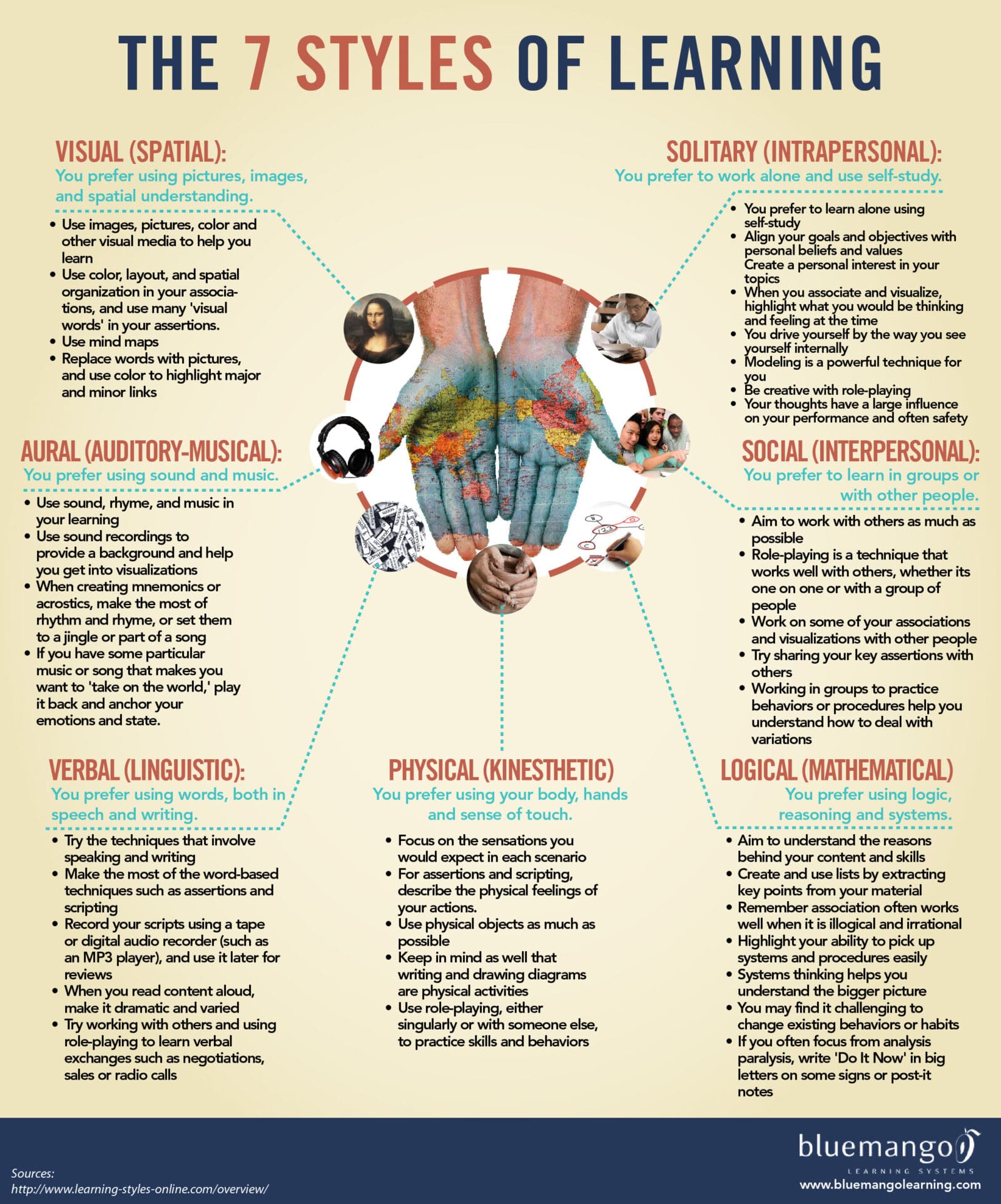
Visual (Spatial) Learning Style
The visual learning style involves processing information through images, diagrams, and spatial understanding. Learners who prefer this style benefit from visual aids such as charts, graphs, and color-coded notes.
- Charts and graphs help visualize complex data.
- Color-coding enhances memory retention.
- Diagrams and mind maps simplify abstract concepts.
Aural (Auditory) Learning Style
The aural learning style focuses on absorbing information through sound and music. Auditory learners excel when listening to lectures, discussions, or audio recordings.
- Lectures and podcasts are effective for retention.
- Mnemonics and rhymes aid in memorization.
- Group discussions reinforce understanding.
Verbal (Linguistic) Learning Style
The verbal learning style relies on words, both written and spoken. These learners thrive through reading, writing, and verbal explanations.
- Reading textbooks solidifies knowledge.
- Writing summaries reinforces learning.
- Debates and storytelling enhance comprehension.
Physical (Kinesthetic) Learning Style
The kinesthetic learning style involves learning through movement and hands-on activities. These learners prefer tactile experiences and physical engagement.
- Role-playing helps internalize concepts.
- Building models provides practical understanding.
- Experiments and lab work solidify theories.
Logical (Mathematical) Learning Style
The logical learning style emphasizes reasoning, systems, and patterns. These learners excel in problem-solving and critical thinking.
- Solving puzzles sharpens analytical skills.
- Classifying information improves organization.
- Working with numbers enhances logical reasoning.
The social learning style thrives on interaction and collaboration. These learners benefit from group work and peer feedback.
- Group projects foster teamwork.
- Peer teaching reinforces knowledge.
- Discussions and debates deepen understanding.
Solitary (Intrapersonal) Learning Style
The solitary learning style involves self-study and introspection. These learners prefer working alone and setting personal goals.
- Journaling aids self-reflection.
- Independent research builds expertise.
- Setting personal milestones enhances motivation.
Frequently Asked Questions (FAQ)
What are learning styles, and why should they be used with caution?
Learning styles refer to the idea that individuals absorb and process information differently, often categorized as visual, auditory, or kinesthetic learners. While this concept is widely popular, research suggests there is limited evidence supporting the idea that tailoring teaching methods to specific styles improves learning outcomes. Over-reliance on learning styles can lead to a narrow approach, ignoring other effective strategies like active recall or spaced repetition. Educators should focus on evidence-based methods rather than assuming a one-size-fits-all model based on preferences.
Do learning styles actually improve educational outcomes?
Despite their popularity, studies have shown that matching teaching methods to students' preferred learning styles does not significantly enhance academic performance. In fact, rigorous research indicates that learners benefit more from varied instructional techniques, regardless of their self-reported preferences. Critical thinking and adaptability are far more important than adhering to a fixed learning style. Educators should prioritize multimodal teaching, which engages multiple senses and cognitive processes, rather than limiting instruction to a single style.
What are the risks of labeling students with specific learning styles?
Labeling students as visual, auditory, or kinesthetic learners can create a fixed mindset, discouraging them from developing skills outside their perceived strengths. This may lead to unnecessary limitations, where students avoid certain subjects or tasks because they believe they can't learn that way. Additionally, such labels can influence teachers to overlook individual needs and focus too narrowly on style-based instruction. A more holistic approach, recognizing diverse cognitive abilities and motivations, is far more effective in fostering long-term learning.
How can educators move beyond learning styles to support students effectively?
Instead of relying on learning style theories, educators should adopt research-backed strategies such as retrieval practice, interleaving, and metacognitive reflection. Encouraging students to engage with material in multiple ways—through discussion, writing, and hands-on activities—can enhance comprehension and retention. Differentiated instruction, which adapts to students' readiness levels and interests, is more impactful than style-based teaching. By fostering a growth mindset, teachers can help students develop resilience and adaptability, key traits for lifelong learning.
Leave a Reply
Related Posts