
How Does Duolingo Work: Features, Methods & Learning System


Duolingo has revolutionized language learning by offering a free, accessible, and engaging platform for millions of users worldwide. At its core, Duolingo combines gamification with scientifically-backed teaching methods to make learning a new language both effective and enjoyable. The app features bite-sized lessons, interactive exercises, and a personalized learning system that adapts to each user’s progress. By incorporating elements like streaks, rewards, and leaderboards, Duolingo keeps learners motivated while ensuring consistent practice. This article explores how Duolingo works, delving into its unique features, teaching methodologies, and the innovative learning system that has made it a global leader in language education.
How Does Duolingo Work: Features, Methods & Learning System
Duolingo is a popular language-learning platform that uses a combination of gamification, adaptive learning, and bite-sized lessons to help users learn new languages effectively. Its intuitive design and scientifically-backed methods make it accessible for beginners and advanced learners alike. Below, we explore the key features, methods, and learning systems that make Duolingo a standout tool for language acquisition.
1. Gamified Learning Experience
Duolingo incorporates gamification to make learning fun and engaging. Users earn XP (experience points), unlock new levels, and collect lingots (in-app currency) as they complete lessons. This approach keeps learners motivated by turning language practice into a game-like experience. The app also includes streaks, which encourage daily practice by tracking how many consecutive days a user has completed a lesson.
See AlsoSpaced repetition software and why you should use it2. Adaptive Learning System
Duolingo uses an adaptive learning algorithm to personalize the learning experience. The app adjusts the difficulty of lessons based on the user's performance, ensuring that they are neither too easy nor too hard. This system helps learners focus on areas where they need improvement while reinforcing concepts they have already mastered.
3. Bite-Sized Lessons
The platform breaks down language learning into short, manageable lessons that typically take 5–10 minutes to complete. These lessons cover various skills, such as vocabulary, grammar, listening, and speaking. The bite-sized format makes it easy for users to fit language practice into their busy schedules.
4. Interactive Exercises
Duolingo offers a variety of interactive exercises to reinforce learning. These include multiple-choice questions, matching exercises, speaking tasks, and listening comprehension activities. The app also uses spaced repetition to ensure that users review material at optimal intervals, improving long-term retention.
See AlsoDoes Duolingo Ban You: Reasons, Prevention & Recovery Tips5. Progress Tracking and Goals
Duolingo provides tools for users to track their progress and set personalized goals. The app displays a progress bar for each skill, showing how close a user is to mastering it. Additionally, users can set daily goals, such as completing a certain number of lessons or earning a specific amount of XP, to stay on track with their learning.
| Feature | Description |
|---|---|
| Gamification | Earn XP, unlock levels, and collect lingots to stay motivated. |
| Adaptive Learning | Personalized lessons based on user performance. |
| Bite-Sized Lessons | Short, 5–10 minute lessons for easy integration into daily routines. |
| Interactive Exercises | Variety of activities, including speaking, listening, and writing tasks. |
| Progress Tracking | Tools to monitor progress and set personalized goals. |
What learning method does Duolingo use?
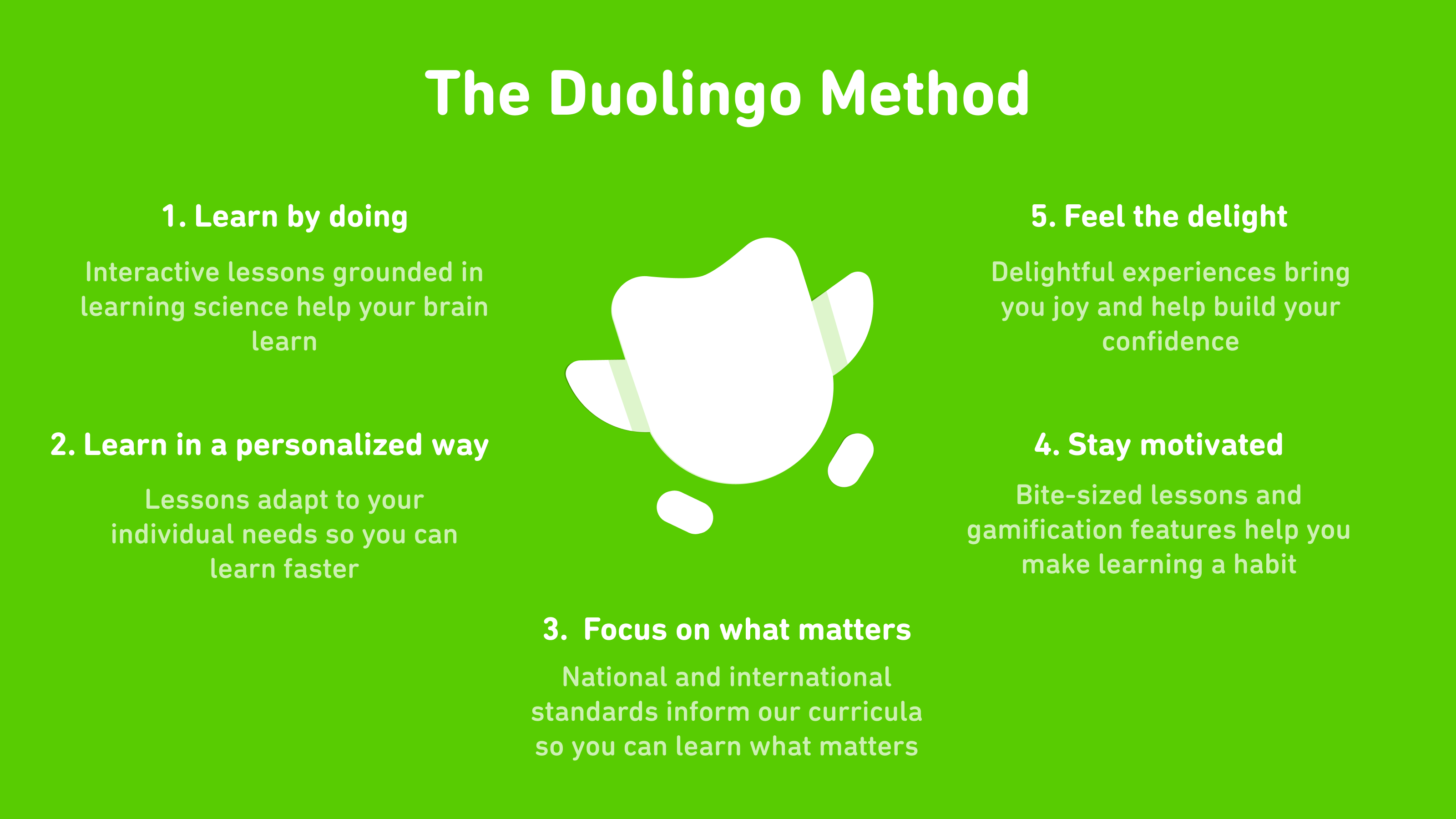
What is Duolingo's Learning Method?
Duolingo uses a gamified learning method that combines spaced repetition, adaptive learning, and interactive exercises to teach languages. The platform is designed to make learning engaging and accessible, focusing on bite-sized lessons that users can complete in just a few minutes. Key features include:
See AlsoDuolingo Quests Guide: Daily, Friend & Monthly Challenges 2025- Spaced Repetition: Duolingo uses algorithms to reinforce vocabulary and concepts at optimal intervals to improve retention.
- Adaptive Learning: The app adjusts difficulty based on user performance, ensuring personalized progress.
- Gamification: Points, streaks, and rewards motivate users to stay consistent and engaged.
How Does Duolingo Incorporate Spaced Repetition?
Duolingo's spaced repetition system ensures that users review material at the right time to maximize memory retention. This method is integrated into the app's design through:
- Review Sessions: Users are prompted to revisit previously learned words and phrases at strategic intervals.
- Adaptive Timing: The app tracks when users are likely to forget information and schedules reviews accordingly.
- Progress Tracking: Duolingo monitors user performance to determine the optimal time for repetition.
What Role Does Gamification Play in Duolingo's Method?
Gamification is a core component of Duolingo's learning method, making the process fun and motivating. Key elements include:
- Streaks: Users are encouraged to maintain daily streaks by completing lessons regularly.
- Lingots and Gems: Virtual currency rewards users for completing tasks, which can be used to unlock bonus content.
- Leaderboards: Competitive features allow users to compare progress with friends or other learners.
How Does Duolingo Use Adaptive Learning?
Duolingo's adaptive learning system tailors lessons to each user's skill level and progress. This is achieved through:
See AlsoLao Gan Ma – The Grandmother of All Chili Oil!- Performance-Based Adjustments: The app analyzes user responses to adjust the difficulty of future exercises.
- Personalized Paths: Lessons are customized based on strengths and weaknesses, ensuring efficient learning.
- Real-Time Feedback: Immediate corrections and explanations help users learn from mistakes.
What Types of Interactive Exercises Does Duolingo Offer?
Duolingo provides a variety of interactive exercises to engage users and reinforce learning. These include:
- Translation Tasks: Users translate sentences between their native language and the target language.
- Listening Exercises: Audio clips help improve comprehension and pronunciation.
- Speaking Practice: Voice recognition technology allows users to practice speaking and receive feedback.
How does the Duolingo system work?
How Does Duolingo Teach Languages?
Duolingo uses a gamified approach to teach languages, making learning interactive and engaging. The platform breaks down lessons into small, manageable units that focus on specific skills, such as vocabulary, grammar, or pronunciation. Each lesson includes a mix of activities, such as:
See AlsoWhat To Do After Duolingo: Your Next Steps in Language Mastery- Translation exercises: Users translate sentences between their native language and the target language.
- Listening exercises: Users listen to audio clips and type or select the correct response.
- Speaking exercises: Users practice pronunciation by speaking into their device's microphone.
What Is the Role of Gamification in Duolingo?
Gamification is a core feature of Duolingo, designed to keep users motivated. The system incorporates elements like:
- Experience points (XP): Users earn XP for completing lessons, which helps track progress.
- Streaks: Users maintain streaks by completing lessons daily, encouraging consistent practice.
- Leaderboards: Users compete with others in leagues, fostering a sense of competition and achievement.
How Does Duolingo Adapt to Different Skill Levels?
Duolingo uses an adaptive learning system to tailor lessons to individual skill levels. When users start, they can take a placement test to skip beginner content. The platform also adjusts difficulty based on performance by:
- Reinforcing weak areas: If a user struggles with a concept, Duolingo provides additional practice.
- Progressing at the user's pace: Users can repeat lessons or move forward as they master skills.
- Personalizing content: The system suggests lessons based on the user's goals and interests.
What Are the Key Features of Duolingo's Lessons?
Duolingo's lessons are designed to be interactive and effective. Key features include:
- Bite-sized lessons: Each lesson takes only a few minutes, making it easy to fit into a busy schedule.
- Immediate feedback: Users receive instant corrections and explanations for mistakes.
- Variety of exercises: Lessons include multiple question types to reinforce learning in different ways.
How Does Duolingo Track Progress?
Duolingo provides detailed progress tracking to help users stay on course. The system includes:
- Skill trees: Users can see which skills they've mastered and which ones need more practice.
- Daily goals: Users set daily XP targets to maintain consistent progress.
- Progress quizzes: Periodic quizzes assess retention and highlight areas for improvement.
What is the learning strategy of Duolingo?
Gamification and Engagement
Duolingo's learning strategy heavily relies on gamification to keep users engaged. The platform incorporates game-like elements such as:
- Points and Levels: Users earn points for completing lessons and can level up, providing a sense of progression.
- Streaks: Maintaining a daily streak encourages consistent practice, rewarding users for daily engagement.
- Leaderboards: Competing with friends or other users fosters motivation and a sense of community.
Personalized Learning Paths
Duolingo tailors the learning experience to individual users through adaptive algorithms. Key features include:
- Skill Assessment: The platform adjusts difficulty based on user performance, ensuring lessons are neither too easy nor too hard.
- Custom Goals: Users can set daily goals, allowing them to learn at their own pace.
- Review Sessions: Duolingo identifies weak areas and prompts users to revisit them, reinforcing retention.
Microlearning Approach
Duolingo employs a microlearning strategy, breaking lessons into small, manageable chunks. This approach includes:
- Short Lessons: Each lesson takes only a few minutes, making it easy to fit into a busy schedule.
- Focused Topics: Lessons concentrate on specific skills, such as vocabulary or grammar, ensuring clarity and focus.
- Frequent Practice: Regular, bite-sized sessions help reinforce learning over time.
Immersive Language Practice
Duolingo emphasizes immersion by simulating real-world language use. This is achieved through:
- Interactive Exercises: Users engage in speaking, listening, reading, and writing activities to develop all language skills.
- Real-Life Scenarios: Lessons often include practical phrases and situations, preparing users for real-world communication.
- Cultural Context: The app incorporates cultural references to enhance understanding and relevance.
Duolingo leverages social interaction to enhance learning. Key elements include:
- Duolingo Clubs: Users can join clubs to compete and collaborate with others, fostering a sense of belonging.
- Discussion Forums: Learners can ask questions and share tips, creating a supportive community.
- Friend Challenges: Competing with friends adds a fun, motivational layer to the learning process.
How does Duolingo algorithm work?
How Does Duolingo's Algorithm Personalize Learning?
Duolingo's algorithm uses adaptive learning technology to tailor lessons to each user's progress and performance. It analyzes data such as:
- Correct and incorrect answers to identify strengths and weaknesses.
- Time spent on exercises to gauge difficulty levels.
- User engagement patterns to optimize lesson frequency and content.
What Role Does Spaced Repetition Play in Duolingo's Algorithm?
Spaced repetition is a core feature of Duolingo's algorithm, designed to improve long-term retention. The system:
- Reintroduces vocabulary and grammar at optimal intervals based on user performance.
- Adjusts repetition frequency for items that are harder to remember.
- Uses historical data to predict when a user is likely to forget a concept.
How Does Duolingo's Algorithm Handle Skill Levels?
Duolingo's algorithm assesses skill levels through a combination of placement tests and ongoing performance tracking. It:
- Starts with a placement test to determine the user's initial level.
- Adjusts difficulty dynamically based on user performance in lessons.
- Offers personalized challenges to bridge gaps in knowledge.
What Data Does Duolingo's Algorithm Collect?
Duolingo's algorithm collects a wide range of data to enhance learning efficiency. This includes:
- User interaction data, such as clicks and time spent on tasks.
- Performance metrics, like accuracy and speed.
- Behavioral patterns, such as when and how often users log in.
How Does Duolingo's Algorithm Encourage Consistency?
Duolingo's algorithm incorporates gamification and reminders to keep users engaged. It:
- Uses streaks and rewards to motivate daily practice.
- Sends personalized notifications based on user activity patterns.
- Adjusts lesson difficulty to maintain a balance between challenge and achievability.
Frequently Asked Questions From our Community
How does Duolingo's learning system work?
Duolingo's learning system is based on gamification and adaptive learning. The platform uses a series of interactive lessons that are designed to feel like a game, making the learning process engaging and fun. Each lesson focuses on specific skills, such as vocabulary, grammar, or pronunciation, and adapts to the user's progress. The system tracks your performance and adjusts the difficulty level accordingly, ensuring that you are always challenged but not overwhelmed. Additionally, Duolingo incorporates spaced repetition, a technique that helps reinforce learning by revisiting material at optimal intervals.
What features does Duolingo offer to enhance language learning?
Duolingo offers a variety of features to enhance language learning, including interactive exercises, speaking practice, and listening comprehension. The platform also includes a streak counter to motivate users to practice daily, and a leaderboard to encourage friendly competition. For those who want to track their progress, Duolingo provides detailed progress reports and skill assessments. Additionally, the app offers a Duolingo Plus subscription, which provides an ad-free experience, offline access, and unlimited hearts, allowing users to practice without interruptions.
What methods does Duolingo use to teach languages effectively?
Duolingo employs several methods to teach languages effectively, including contextual learning, where words and phrases are taught within the context of real-life situations. The platform also uses visual aids, such as images and animations, to help users associate words with their meanings. Another key method is immediate feedback, where users receive instant corrections and explanations for their mistakes, helping them learn from errors in real-time. Furthermore, Duolingo integrates cultural insights into its lessons, providing users with a deeper understanding of the language and its cultural context.
Can Duolingo help achieve fluency in a new language?
While Duolingo is an excellent tool for building a strong foundation in a new language, achieving fluency typically requires additional practice and immersion. Duolingo can help users develop basic conversational skills, vocabulary, and grammar, but it is most effective when used in conjunction with other learning methods, such as speaking with native speakers, consuming media in the target language, and practicing in real-world situations. Duolingo's Duolingo English Test is also available for those looking to certify their English proficiency, which can be a valuable asset for academic or professional purposes.
Leave a Reply
Related Posts