
Focusing on tone pairs to improve your Mandarin pronunciation

Mastering Mandarin pronunciation can be challenging, especially when tackling its tonal nature. One effective way to refine your skills is by focusing on tone pairs—combinations of two syllables with specific tone patterns. Since Mandarin words often consist of two syllables, practicing these pairs helps you mimic natural speech more accurately. By isolating and repeating common tone combinations, you train your ear and voice to distinguish and produce the subtle pitch variations essential for clear communication. This targeted approach not only boosts your confidence but also ensures your pronunciation sounds more native-like. Dive into tone pairs, and watch your Mandarin fluency improve one step at a time.
Mastering Tone Pairs: The Key to Fluent Mandarin Pronunciation
Focusing on tone pairs is one of the most effective ways to improve your Mandarin pronunciation. Mandarin Chinese relies heavily on tones to distinguish meaning, and practicing tone combinations (pairs of tones in sequence) helps learners develop natural-sounding speech. By isolating and drilling tone pairs, you train your ear and mouth to produce the correct pitch patterns, reducing miscommunication. This method is especially useful because Mandarin words are mostly disyllabic (two syllables), making tone pairs highly relevant for real-life conversations.
Why Tone Pairs Are Essential for Mandarin Learners
Mandarin has four main tones and a neutral tone, and their combinations create distinct sound patterns. Mispronouncing a tone pair can change the meaning entirely (e.g., māma (mom) vs. mǎmà (horse scold)). Practicing tone pairs ensures clarity and fluency, as they appear frequently in daily speech.
See AlsoGet to know your Chinese voice to level up your speaking abilityCommon Tone Pair Patterns in Mandarin
The most frequent tone pairs in Mandarin are:
| Tone Pair | Example | Meaning |
|---|---|---|
| 1st + 2nd | mā má (mom hemp) | Common in questions |
| 2nd + 3rd | méi yǒu (not have) | Frequent negation |
| 3rd + 4th | hěn duō (very many) | Descriptive phrases |
| 4th + 1st | shì jiān (time) | Common nouns |
How to Practice Tone Pairs Effectively
Start by listening to native speakers and mimicking tone pairs in isolation. Use shadowing techniques—repeat after recordings while focusing on pitch accuracy. Break down words into tone pairs and drill them repeatedly. Apps like Pinyin Trainer or HelloChinese can help reinforce correct pronunciation.
Common Mistakes When Learning Tone Pairs
Many learners struggle with the third tone, often pronouncing it as a low tone instead of a falling-rising one. Another mistake is neglecting tone sandhi rules (e.g., two third tones change to second + third). Over-relying on Pinyin without listening practice can also hinder progress.
See AlsoAre there any shortcuts for learning Chinese?Tools and Resources for Mastering Tone Pairs
Several tools can accelerate your tone pair mastery:
| Tool | Use |
|---|---|
| Pinyin Chart | Visualize tone contours |
| Tone Pair Drills | Focused repetition exercises |
| Speech Recognition Apps | Get instant feedback |
| Mandarin Podcasts | Hear natural tone pairs |
How can I improve my Mandarin pronunciation?

Master the Four Mandarin Tones
Improving your Mandarin pronunciation starts with mastering the four tones, as they define meaning. Mispronouncing a tone can change the word entirely. Here’s how to practice effectively:
See AlsoLearning Chinese the holistic way: Integrating knowledge- Listen and mimic native speakers using resources like podcasts or tone drills.
- Record yourself and compare your tones to native pronunciation.
- Use tone pairs to practice how tones change in combination (e.g., first + third tone).
Focus on Pinyin Accuracy
Pinyin is the romanization system for Mandarin, and precise pronunciation of its components is crucial. Follow these steps:
- Learn initials and finals thoroughly, paying attention to sounds like zh, ch, and x.
- Practice tongue placement for tricky sounds (e.g., retroflex consonants).
- Use apps like Pleco or HelloChinese for interactive Pinyin drills.
Imitate Native Speakers
Shadowing native speakers helps internalize natural pronunciation. Here’s how to do it:
- Watch Mandarin TV shows or listen to radio and repeat lines immediately after hearing them.
- Focus on rhythm and intonation, not just individual words.
- Join language exchange platforms to converse with natives and get feedback.
Practice with Tongue Twisters
Tongue twisters (绕口令) sharpen articulation and speed. Try these methods:
See AlsoHow learning some basic theory can improve your Mandarin pronunciation- Start slow with simple twisters, then increase speed.
- Target difficult sounds (e.g., sì shì sì for s and sh).
- Repeat daily to build muscle memory.
Use Feedback Tools
Technology can provide instant corrections for pronunciation. Leverage these tools:
- Apps like Speechling or Google Pinyin input for real-time feedback.
- AI tutors (e.g., DuChinese) to identify mispronunciations.
- Work with a teacher for personalized corrections on tricky sounds.
What is the 3-3-3 rule in Mandarin?

What is the 3-3-3 Rule in Mandarin?
The 3-3-3 rule in Mandarin refers to a structured approach for learning the language, focusing on three key components: tones, characters, and vocabulary. It suggests dedicating equal time to mastering these elements to build a strong foundation.
- Tones: Mandarin is a tonal language, meaning the pitch or intonation changes the meaning of a word. Practicing the four main tones (plus the neutral tone) is crucial.
- Characters: Learning Chinese characters involves understanding strokes, radicals, and their meanings. Consistency is key to memorization.
- Vocabulary: Building a daily habit of learning new words ensures steady progress in comprehension and communication.
Why is the 3-3-3 Rule Effective for Learning Mandarin?
The 3-3-3 rule is effective because it balances the most challenging aspects of Mandarin, preventing learners from neglecting any critical area.
- Balanced Focus: By dividing attention equally, learners avoid overemphasizing one skill at the expense of others.
- Consistent Progress: Regular practice of tones, characters, and vocabulary ensures gradual improvement.
- Practical Application: This method aligns with real-world language use, where all three components are interdependent.
How to Apply the 3-3-3 Rule Daily
Applying the 3-3-3 rule requires a structured daily routine to maximize learning efficiency.
- Tone Practice: Spend 10 minutes repeating words with different tones, using apps or audio resources.
- Character Writing: Dedicate 10 minutes to writing and memorizing new characters, focusing on stroke order.
- Vocabulary Building: Learn 3-5 new words daily, using flashcards or spaced repetition tools.
Common Mistakes When Using the 3-3-3 Rule
While the 3-3-3 rule is helpful, learners often make mistakes that hinder progress.
- Ignoring Tones: Neglecting tone practice leads to miscommunication, as tones define word meanings.
- Rushing Characters: Skipping stroke order or radicals makes memorization harder in the long run.
- Inconsistent Vocabulary: Learning words sporadically without review reduces retention.
Tools to Support the 3-3-3 Rule in Mandarin Learning
Several tools can enhance the effectiveness of the 3-3-3 rule by providing structured practice.
- Tone Apps: Apps like Pinyin Trainer or HelloChinese help master pronunciation.
- Character Resources: Websites like Skritter or Anki aid in character memorization.
- Vocabulary Builders: Tools like Pleco or Memrise offer spaced repetition for word retention.
How can I improve my Mandarin tone?
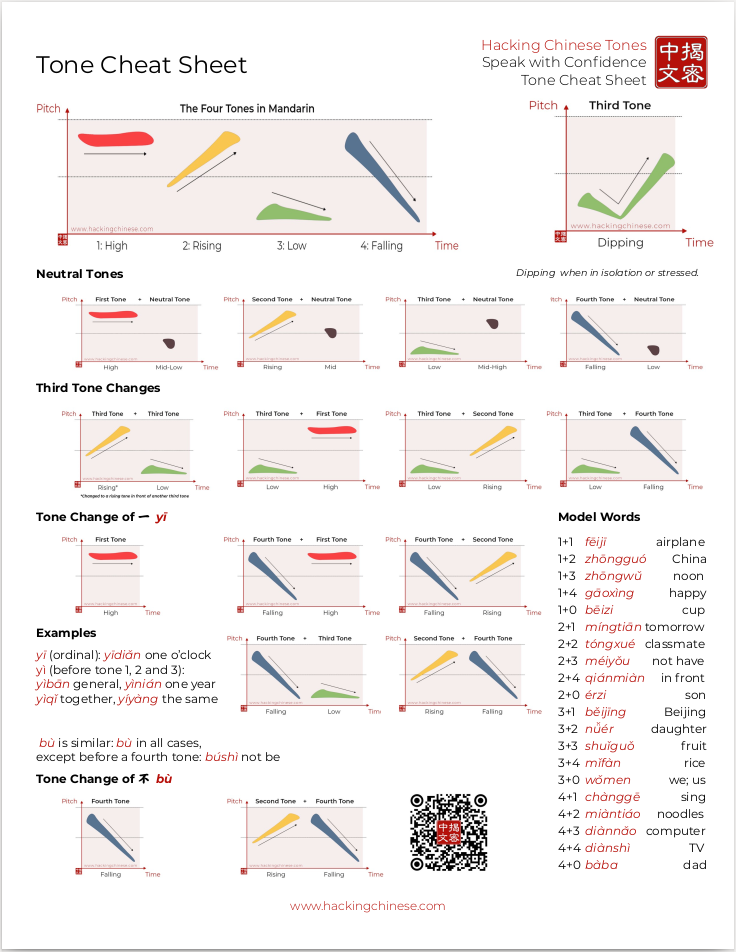
Understand the Four Mandarin Tones
Mastering the four tones of Mandarin is essential for accurate pronunciation. Each tone changes the meaning of a word, so practicing them individually is crucial.
- First tone (high and flat): Hold a steady high pitch, like singing a musical note.
- Second tone (rising): Start mid and rise to a high pitch, similar to asking a question in English.
- Third tone (falling-rising): Begin mid, dip low, then rise slightly—often simplified as a low tone in fast speech.
- Fourth tone (sharp falling): Start high and drop sharply, like a command in English.
Practice with Tone Pairs
Combining tones in pairs helps simulate real speech. Tone pairs train your ear and mouth to transition smoothly between tones.
- 1-1 tone pair: Practice two first tones (e.g., 妈妈 māma) to maintain steady pitch.
- 2-4 tone pair: Try a rising then falling tone (e.g., 学校 xuéxiào) for contrast.
- 3-3 tone pair: The first third tone often becomes second tone (e.g., 你好 nǐhǎo → níhǎo).
Use Technology and Apps
Leverage language apps and tools to refine your tone accuracy with instant feedback.
- Pinyin apps: Apps like HelloChinese or Pinyin Trainer drill tones interactively.
- Voice recording: Record yourself and compare to native speakers.
- Tone visualization: Use apps that display pitch curves to match your tones.
Imitate Native Speakers
Shadowing native speakers helps internalize natural tone patterns.
- Watch Chinese media: Repeat dialogues from shows or podcasts.
- Mimic pronunciation: Focus on tones, not just words, when repeating.
- Work with a tutor: Get real-time corrections from a native speaker.
Engage in Active Listening
Train your ear to distinguish tones through focused listening exercises.
- Minimal pairs: Practice words with same sounds but different tones (e.g., 买 mǎi vs. 卖 mài).
- Slow down audio: Use tools to reduce speed and isolate tones.
- Dictation practice: Write down tones you hear in sentences.
What are the 5 tones in Mandarin pronunciation?
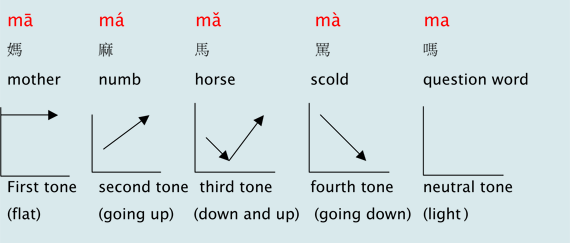
The First Tone: High and Level
The first tone in Mandarin is a high, flat, and steady pitch. It is represented by a straight horizontal line (ˉ) in Pinyin. This tone remains consistently high without any rise or fall.
- Pitch: Maintains a high, level sound (e.g., mā 妈 - mother).
- Symbol: Written as ˉ in Pinyin (e.g., ā).
- Common words: mā (妈), bā (八 - eight).
The Second Tone: Rising
The second tone is a rising pitch, similar to the intonation used in English when asking a question. It is marked by an upward-slanting line (ˊ) in Pinyin.
- Pitch: Starts mid and rises to a high pitch (e.g., má 麻 - hemp).
- Symbol: Written as ˊ in Pinyin (e.g., á).
- Common words: má (麻), né (呢 - question particle).
The Third Tone: Falling-Rising
The third tone has a falling-rising contour, dipping low before rising again. It is represented by a curved line (ˇ) in Pinyin.
- Pitch: Dips low, then rises slightly (e.g., mǎ 马 - horse).
- Symbol: Written as ˇ in Pinyin (e.g., ǎ).
- Common words: mǎ (马), hǎo (好 - good).
The Fourth Tone: Falling
The fourth tone is a sharp, falling pitch, similar to a command in English. It is marked by a downward-slanting line (ˋ) in Pinyin.
- Pitch: Starts high and drops sharply (e.g., mà 骂 - scold).
- Symbol: Written as ˋ in Pinyin (e.g., à).
- Common words: mà (骂), bù (不 - no).
The Neutral Tone: Light and Short
The neutral tone (or fifth tone) is light, short, and unstressed. It has no specific pitch and often appears in weak syllables or grammatical particles.
- Pitch: Quick and soft, with no fixed contour (e.g., ma 吗 - question particle).
- Symbol: No mark in Pinyin (e.g., a).
- Common words: ma (吗), le (了 - completed action marker).
Frequently Asked Questions (FAQ)
Why are tone pairs important for improving Mandarin pronunciation?
Tone pairs are essential because Mandarin is a tonal language where the meaning of a word can change entirely based on its tone contour. Practicing tone combinations (like 1-2, 3-4, etc.) helps learners internalize the natural flow of speech, as words are rarely spoken in isolation. By mastering tone pairs, you train your ear and mouth to produce the correct pitch transitions, which is crucial for being understood and sounding more fluent.
How can I effectively practice Mandarin tone pairs?
To practice tone pairs effectively, start by listening to native speakers and mimicking their intonation patterns. Use resources like audio recordings or language apps that focus on minimal pairs (e.g., mā vs. má). Repeat the pairs aloud, record yourself, and compare your pronunciation to the native speaker. Additionally, practice in context by using two-syllable words or short phrases to reinforce how tones interact in real speech.
What are common mistakes learners make with Mandarin tone pairs?
Many learners struggle with tone sandhi rules, especially the third-tone change (e.g., when two third tones appear together, the first often becomes a second tone). Another mistake is neglecting the neutral tone, which appears in unstressed syllables and can alter the rhythm of speech. Some also mispronounce falling-rising tones (like the fourth tone) by not making the pitch drop sharply enough. Consistent feedback from a teacher or native speaker can help correct these errors.
Can focusing on tone pairs alone make me fluent in Mandarin?
While mastering tone pairs significantly improves your pronunciation, fluency requires a broader skill set, including vocabulary, grammar, and conversational practice. Tone pairs are a foundational tool, but you must also engage with the language through listening, speaking, reading, and writing. Think of tone pairs as a stepping stone—they’ll help you sound more natural, but fluency comes from integrating all aspects of the language.
Leave a Reply
Related Posts