
Why Does China Have Only One Time Zone?

China, despite its vast geographical expanse spanning over 5,000 kilometers from east to west, operates under a single time zone: China Standard Time (CST). This decision, implemented in 1949, unified the country under Beijing Time to promote national cohesion and administrative efficiency. While the system simplifies governance and communication, it also creates significant disparities in daylight hours, particularly in western regions like Xinjiang, where the sun may rise as late as 10 a.m. Critics argue this uniformity disrupts daily life, but proponents highlight its role in fostering unity. Exploring the historical, political, and social reasons behind China's single time zone reveals a unique approach to managing a diverse and sprawling nation.
Why Does China Have Only One Time Zone?
China operates under a single time zone, known as China Standard Time (CST), which is UTC+8. Despite its vast geographical size—spanning five theoretical time zones—the country adheres to one unified time for administrative simplicity and national unity. This decision, implemented by the Communist Party in 1949, ensures consistency across government, media, and transportation systems. However, it also leads to significant discrepancies in daylight hours, particularly in western regions like Xinjiang, where the sun may rise as late as 10 AM.
Historical Reasons for a Single Time Zone
Before 1949, China observed five time zones. After the Communist Party's victory, the government abolished them to strengthen national cohesion and centralized control. The single time zone symbolized political unity and streamlined communication across the country. While practical for governance, it ignored geographical realities, creating challenges for regions far from Beijing.
See AlsoHow to start learning Chinese again after a breakImpact on Daily Life in Western China
In western provinces like Xinjiang and Tibet, the single time zone causes notable lifestyle adjustments. Official business hours follow CST, but locals often use Xinjiang Time (UTC+6) informally. Schools, workplaces, and markets may operate 2-3 hours later than in eastern China to align with natural daylight. This creates a dual-time system, complicating scheduling for businesses and travelers.
Economic and Administrative Benefits
A unified time zone simplifies national operations. Key advantages include:
- Synchronized business hours for stock markets and banks.
- Easier coordination of transportation (flights, trains).
- Uniform media broadcasts, ensuring simultaneous news delivery.
However, these benefits primarily favor eastern urban centers, while western regions adapt through local customs.
Comparison with Other Large Countries
Most large nations, like the USA and Russia, use multiple time zones to align with sunlight. China's approach contrasts sharply:
See AlsoWhich Chinese learning resources are worth paying for?| Country | Time Zones | Geographical Span |
|---|---|---|
| China | 1 (UTC+8) | ~5,000 km (east-west) |
| USA | 6 (UTC-5 to UTC-10) | ~4,500 km (east-west) |
| Russia | 11 (UTC+2 to UTC+12) | ~9,000 km (east-west) |
Criticisms and Challenges
Critics argue the single time zone disadvantages western regions:
- Health impacts from misaligned sleep cycles.
- Reduced productivity due to unnatural work hours.
- Energy inefficiency (e.g., lights used earlier in the west).
Despite these issues, China maintains the system, prioritizing political symbolism over regional practicality.
Unofficial Time Practices in Western China
Some communities unofficially adopt local solar time. For example:
- Xinjiang uses UTC+6 for informal events.
- Tibetan herders base activities on sunrise/sunset.
This flexibility highlights the gap between policy and lived experience, though official records strictly follow CST.
Why did China decide to have one time zone?
Historical Reasons Behind China's Single Time Zone
China adopted a single time zone (China Standard Time, CST) in 1949 under the Communist Party's rule to unify the nation administratively and politically. Before this, China had multiple time zones, but the government sought to:
- Strengthen national unity by eliminating regional differences.
- Simplify governance and reduce bureaucratic complexity.
- Align with centralized control, a key principle of the Communist Party.
Geographical Implications of a Single Time Zone
Despite spanning five geographical time zones, China uses CST nationwide, leading to significant daylight disparities. For example:
- Western regions (like Xinjiang) experience sunrise as late as 10 AM.
- Eastern regions (like Shanghai) follow natural daylight more closely.
- Economic and social activities operate on the same clock, despite natural differences.
Economic and Administrative Benefits
A single time zone streamlines operations across China's vast territory, offering advantages such as:
See AlsoHSK 1 Vocabulary Test - Long & Short Versions- Easier coordination of national projects and infrastructure.
- Simplified scheduling for businesses and government.
- Reduced confusion in transportation and communication networks.
The policy has shaped daily life, particularly in western China, where:
- Unofficial local time (e.g., Xinjiang Time) is sometimes used informally.
- Work and school hours may adjust to daylight conditions.
- Cultural practices adapt to the mismatch between clock time and solar time.
Criticism and Challenges
Critics argue the single time zone creates practical difficulties, including:
- Health and productivity issues due to unnatural daylight cycles.
- Regional dissatisfaction, especially in far-west areas.
- Inefficiency in agriculture and other sun-dependent sectors.
How many time zones could China have?
How Many Time Zones Could China Geographically Have?
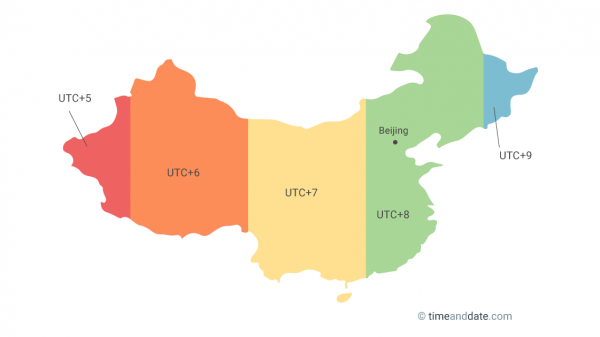
China spans approximately 62 degrees of longitude, which, in theory, could justify five standard time zones (UTC+5 to UTC+9). However, the country officially uses only one time zone (UTC+8), known as Beijing Time. Geographically, the potential time zones could align with these regions:
- Western China (Xinjiang): UTC+5 or UTC+6, aligning with Central Asia.
- Tibet: UTC+6, matching parts of South Asia.
- Central China: UTC+7, covering provinces like Sichuan.
- Eastern China: UTC+8, including Beijing and Shanghai.
- Northeastern China (Heilongjiang): UTC+9, similar to Japan and Korea.
Why Does China Use a Single Time Zone?
China’s single time zone policy was implemented in 1949 for national unity and administrative simplicity. Key reasons include:
- Political cohesion: Avoiding fragmentation across regions.
- Economic coordination: Streamlining business and transport schedules.
- Historical precedent: Aligning with the capital (Beijing) as the central authority.
Challenges of a Single Time Zone in China
The current system creates practical difficulties, especially in western regions like Xinjiang, where:
- Sunrise/sunset mismatches: Daylight hours differ drastically from clock time.
- Work schedules: Locals unofficially use Xinjiang Time (UTC+6) for daily life.
- Energy consumption: Artificial lighting is needed earlier in the day.
Historical Proposals for Multiple Time Zones in China
Before 1949, China experimented with five time zones, including:
- Kunlun Time (UTC+5.5): For far-western regions.
- Sinkiang-Tibet Time (UTC+6): Covering Xinjiang and Tibet.
- Kansu-Szechwan Time (UTC+7): Central provinces.
- Chungyuan Time (UTC+8): Eastern China.
- Changpai Time (UTC+8.5): Northeast (briefly used).
Global Comparisons: How Other Large Countries Handle Time Zones
Unlike China, other vast nations use multiple time zones to align with geography:
- Russia: 11 time zones, spanning UTC+2 to UTC+12.
- USA: 6 time zones (including Alaska and Hawaii).
- Canada: 6 time zones, adjusted for regional daylight.
- Australia: 3 main time zones, with seasonal adjustments.
- Brazil: 4 time zones, accommodating its width.
Why is China all the same time?
Why Does China Use a Single Time Zone?
China operates under a single time zone, known as China Standard Time (CST) or Beijing Time, despite its vast geographical span. This decision was made for administrative unity and political cohesion after the Communist Party came to power in 1949.
- Historical reasons: The single time zone was implemented to strengthen national unity.
- Simplified governance: A single time reduces logistical complexities for the government.
- Economic coordination: Businesses and transportation systems operate more efficiently under one time standard.
How Does China’s Single Time Zone Affect Daily Life?
Despite the convenience for administration, the single time zone creates significant discrepancies in daylight hours across the country.
- Western regions: In Xinjiang, sunrise can be as late as 10 AM, while sunset occurs around midnight.
- Work schedules: Some areas unofficially adjust working hours to match local daylight.
- Cultural adaptations: People in western China often follow a Xinjiang Time schedule for daily activities.
What Are the Geographic Challenges of a Single Time Zone?
China spans five geographical time zones, yet enforces a single official time, leading to natural misalignments.
- East-West divide: The sun rises and sets at vastly different times in Shanghai and Kashgar.
- Agricultural impact: Farmers rely on solar time rather than official time for planting and harvesting.
- Health effects: Disrupted circadian rhythms can affect sleep patterns in western regions.
Why Doesn’t China Adopt Multiple Time Zones?
The Chinese government prioritizes national unity over geographical accuracy, avoiding multiple time zones for political and social stability.
- Centralized control: A single time zone reinforces the authority of Beijing.
- Economic uniformity: Stock markets, media, and transport schedules remain synchronized.
- Historical precedent: Changing the system could create confusion after decades of standardization.
How Do Other Large Countries Handle Time Zones Compared to China?
Unlike China, most large nations use multiple time zones to reflect their geographical breadth.
- Russia: Has 11 time zones, accommodating its vast east-west span.
- USA: Uses six time zones (including Alaska and Hawaii) for regional accuracy.
- Australia: Operates three main time zones, plus additional seasonal adjustments.
When did China get rid of time zones?
When Did China Officially Adopt a Single Time Zone?
China officially adopted a single time zone (China Standard Time, CST) in 1949 after the founding of the People's Republic of China. Before this, the country used multiple time zones, but the Communist Party unified them under one standard to promote national unity.
- The decision was made by the Central People's Government shortly after the revolution.
- Prior to 1949, China had five time zones, including Kunlun, Sinkiang-Tibet, Kansu-Szechwan, Chungyuan, and Changpai.
- The unified time zone is based on UTC+8, aligning with Beijing time.
Why Did China Eliminate Multiple Time Zones?
China eliminated multiple time zones primarily for political and administrative reasons. The government aimed to strengthen central control and foster a sense of national cohesion.
- National unity was a key priority post-revolution, and a single time zone symbolized this.
- Simplified transportation and communication across the vast country.
- Reduced confusion in government operations and military coordination.
How Does China's Single Time Zone Affect Daily Life?
Despite the official use of Beijing time, regions like Xinjiang and Tibet operate on unofficial local schedules due to geographical differences.
- In western China, sunrise can occur as late as 10:00 AM in winter.
- Businesses and schools in these areas often adjust schedules to match local daylight hours.
- The disparity creates challenges for cross-regional coordination.
What Were China's Original Time Zones Before 1949?
Before unification, China followed five time zones established during the Republican era (1912–1949).
- Kunlun Time Zone (UTC+5:30) – Covering parts of western Tibet.
- Sinkiang-Tibet Time Zone (UTC+6) – Used in Xinjiang and central Tibet.
- Kansu-Szechwan Time Zone (UTC+7) – Spanning central China.
How Does China's Time Zone Compare to Other Large Countries?
Unlike large nations such as the USA or Russia, which use multiple time zones, China's single time zone is unique.
- Russia spans 11 time zones, adapting to its vast east-west expanse.
- The USA uses six time zones (including Alaska and Hawaii).
- China's approach prioritizes political unity over geographical accuracy.
Frequently Asked Questions (FAQ)
Why does China use a single time zone despite its vast geographical size?
China operates under a single time zone, China Standard Time (CST), which is UTC+8, despite spanning approximately 5,000 kilometers from east to west. The primary reason for this decision is national unity and administrative simplicity. After the Chinese Civil War in 1949, the government standardized the time zone to streamline governance, communication, and transportation across the country. While this creates significant discrepancies in daylight hours—especially in western regions like Xinjiang—the centralized system prioritizes cohesion over geographical accuracy.
How do people in western China adapt to the single time zone?
In western regions such as Xinjiang and Tibet, where the sun rises and sets much later due to the single time zone, locals often follow unofficial local schedules. For example, businesses and schools may operate on a shifted timetable, starting work or classes two hours later than in eastern cities like Beijing. This adaptation helps align daily activities with natural daylight, though official records and national broadcasts still adhere to China Standard Time.
What are the advantages of having one time zone in China?
The unified time zone simplifies national coordination, reducing confusion in transportation schedules, media broadcasts, and government operations. For instance, trains, flights, and TV programs follow the same time nationwide, avoiding the complexity of multiple time zones. Additionally, it fosters a sense of political and cultural unity, reinforcing the central government's authority. However, critics argue that it disregards the natural circadian rhythms of citizens in western regions.
Has China ever had multiple time zones in its history?
Yes, before 1949, China experimented with five time zones to reflect its vast geography. However, after the founding of the People's Republic of China, the government abolished this system to promote national cohesion during a period of political upheaval. Historical time zones included Kunlun, Sinkiang-Tibet, and Chungyuan, but these were eliminated in favor of a single standard to strengthen centralized control and modernization efforts.
Leave a Reply
Related Posts