
Add Oil! “Jia You” Makes it Into the Oxford English Dictionary

The phrase Add Oil!—derived from the Chinese expression Jia You—has officially entered the Oxford English Dictionary (OED), marking a significant milestone in the global influence of Chinese language and culture. Originally a cheer of encouragement in Chinese-speaking communities, Add Oil! has gained traction worldwide, often used to motivate or show support. Its inclusion in the OED reflects the growing interplay between languages and the dynamic nature of English as it absorbs words from diverse cultures. This recognition not only celebrates linguistic diversity but also highlights how everyday expressions can transcend borders, enriching the global lexicon with new layers of meaning.
The Inclusion of Jia You (Add Oil!) in the Oxford English Dictionary
1. What Does Jia You Mean?
The phrase Jia You (加油) is a common Chinese expression that translates to Add Oil! in English. It is used as a motivational cheer, similar to saying Keep going! or You can do it! The term has gained global recognition, especially in sports and competitive environments, where encouragement is key. Its inclusion in the Oxford English Dictionary (OED) highlights its cultural significance and widespread usage beyond Chinese-speaking communities.
| Term | Meaning | Usage Context |
|---|---|---|
| Jia You (加油) | Add Oil! / Keep going! | Motivational cheer in sports, exams, and daily life |
2. How Did Jia You Enter the Oxford English Dictionary?
The Oxford English Dictionary regularly updates its entries to reflect evolving language trends. Jia You was added due to its increasing use in English-speaking contexts, particularly in multicultural settings and online platforms. The OED noted its appearance in English-language media, social media, and even sports commentary, solidifying its place as a loanword from Chinese.
See AlsoHow to Use ChatGPT to Learn Chinese| Reason for Inclusion | Evidence |
|---|---|
| Global usage | Frequent appearance in English media and social networks |
| Cultural exchange | Adoption by non-Chinese speakers in motivational contexts |
3. The Cultural Significance of Jia You
Jia You is more than just a phrase—it embodies a spirit of perseverance and support. In Chinese culture, it is often shouted during sporting events, academic challenges, and even workplace encouragement. Its adoption into English reflects the growing influence of Chinese culture and language worldwide.
| Cultural Context | Examples |
|---|---|
| Sports | Cheering for athletes in competitions |
| Education | Encouraging students during exams |
4. Other Chinese Loanwords in the Oxford English Dictionary
Jia You is not the first Chinese term to enter the OED. Words like guanxi (关系, relationships) and tuina (推拿, massage therapy) have also been included. These additions demonstrate the OED's recognition of Chinese contributions to global vocabulary.
| Chinese Term | Meaning | OED Inclusion Year |
|---|---|---|
| Guanxi (关系) | Relationships / Connections | 2018 |
| Tuina (推拿) | Chinese massage therapy | 2019 |
5. The Future of Loanwords in English
The inclusion of Jia You in the OED signals a broader trend of language globalization. As cultures interact more closely, loanwords from languages like Chinese, Hindi, and Arabic are becoming commonplace in English. This enriches the language and reflects a more interconnected world.
See AlsoThe Ten Most Common Names in China| Trend | Impact |
|---|---|
| Language globalization | More loanwords entering English dictionaries |
| Cultural exchange | Greater diversity in vocabulary and expressions |
Is add oil proper English?
Is Add Oil Grammatically Correct in English?
The phrase add oil is not grammatically correct in standard English when used as a standalone imperative. In English, the correct phrasing would be add some oil or pour oil depending on the context. However, add oil is a direct translation from the Chinese phrase 加油 (jiāyóu), which is an expression of encouragement meaning keep going or you can do it. While it is not proper English, it has gained some recognition in multicultural contexts due to its cultural significance.
- Grammatical Structure: English requires articles or quantifiers like some for clarity.
- Literal vs. Figurative Meaning: Add oil literally refers to adding oil, but figuratively means encouragement in Chinese.
- Cultural Adaptation: Non-native speakers may use it in English-speaking communities familiar with Chinese culture.
Where Did the Phrase Add Oil Originate?
The phrase add oil originates from the Chinese expression 加油 (jiāyóu), which combines the characters for add (加) and oil (油). Historically, it referred to fueling machinery or vehicles, but over time, it evolved into a motivational cheer. While it is not an English idiom, its usage has spread through globalization, particularly in sports or academic settings among Chinese speakers.
See Also5 levels of understanding Chinese characters: Superficial forms to deep structure- Etymology: Derived from Chinese, not English.
- Historical Context: Originally related to fueling engines.
- Modern Usage: Now a common cheer in Chinese-speaking communities.
Is Add Oil Accepted in English-Speaking Countries?
In English-speaking countries, the phrase add oil is not widely accepted as proper English. However, in multicultural or bilingual environments, especially those with significant Chinese populations, it may be understood due to cultural exposure. Most native English speakers would interpret it literally unless familiar with its Chinese meaning.
- Recognition: Limited to communities with Chinese cultural influence.
- Misinterpretation Risk: Often taken literally by those unaware of its figurative meaning.
- Niche Usage: Occasionally seen in social media or sports events.
How Does Add Oil Compare to English Encouragement Phrases?
Unlike English phrases such as keep it up or you got this, add oil does not follow standard English syntax or idiomatic patterns. While English expressions are direct and grammatically structured, add oil relies on cultural context for meaning. This makes it less intuitive for native English speakers unless explained.
- Syntax Differences: English phrases use complete grammatical structures.
- Idiomatic Nature: English encouragements are self-explanatory.
- Cultural Dependency: Add oil requires prior knowledge of Chinese language.
Can Add Oil Be Used in Formal English Writing?
Using add oil in formal English writing is not recommended, as it is not a recognized English phrase. Formal contexts require standard grammar and widely understood expressions. If referencing the Chinese idiom, it should be italicized or explained to avoid confusion.
- Professional Standards: Formal writing demands proper English.
- Clarity Issues: Unfamiliarity may lead to misunderstandings.
- Alternative Usage: Best reserved for informal or culturally specific contexts.
Why do Chinese people say add oil?

The Origin of Add Oil in Chinese Culture
The phrase add oil (加油, jiāyóu) originates from the literal act of adding fuel to a vehicle or machine to keep it running. Over time, it evolved into a metaphorical expression of encouragement, symbolizing the need to persevere or put in more effort. This term reflects the Chinese cultural emphasis on hard work and resilience.
- Historical context: Initially used in mechanical or industrial settings, it later became a motivational slogan.
- Linguistic shift: The phrase transitioned from a literal meaning to a figurative one, gaining popularity in daily life.
- Cultural significance: Represents collective encouragement, often heard in sports, academics, or personal challenges.
How Add Oil is Used in Modern Chinese Society
In contemporary usage, add oil serves as a versatile phrase to uplift others. It is commonly shouted at sporting events, written in exam halls, or used among friends facing difficulties. The expression embodies support and motivation in various social contexts.
- Sports events: Fans yell add oil to cheer for their favorite teams or athletes.
- Academic settings: Students encourage each other before exams with this phrase.
- Workplace: Colleagues use it to boost morale during challenging projects.
The Linguistic Structure of Add Oil
The phrase add oil is a direct translation of the Chinese characters 加油 (jiāyóu). The term combines the verb add (加) and the noun oil (油), creating a vivid metaphor for sustaining energy. Its simplicity makes it easy to remember and widely applicable.
- Verb-noun pairing: The structure emphasizes action (adding) and sustenance (oil).
- Phonetic appeal: The two-syllable phrase is catchy and rhythmic, ideal for chanting.
- Cultural adaptability: The metaphor resonates across different age groups and professions.
Comparisons Between Add Oil and Western Phrases
While Western cultures might say keep going or you can do it, the Chinese phrase add oil carries a unique cultural nuance. It implies not just encouragement but also the idea of replenishing energy, much like fueling a machine.
- Energy metaphor: Unlike generic encouragement, add oil suggests refueling.
- Collectivist tone: Often used in group settings, reflecting communal support.
- Visual imagery: The phrase conjures a tangible idea of sustaining momentum.
The Global Spread of Add Oil
With the rise of Chinese pop culture and social media, add oil has gained international recognition. Non-Chinese speakers sometimes adopt the phrase, appreciating its succinct and vivid motivational power.
- Social media influence: Viral posts and memes have popularized the term globally.
- Cross-cultural appeal: Its simplicity makes it easy to adopt in different languages.
- Official recognition: The phrase was added to the Oxford English Dictionary in 2018.
What is jia you in English?

The Meaning of Jia You in English
The phrase Jia You (加油) is a Chinese expression commonly translated to English as Add oil or more naturally as Go for it, Keep going, or You can do it. It is used to encourage someone to persevere or put in more effort.
- Literal Translation: Jia means add, and You means oil, but the phrase is idiomatic.
- Cultural Significance: Widely used in sports, academics, and daily life to motivate.
- Popularity: Gained international recognition through events like the Olympics.
Common English Equivalents of Jia You
In English, Jia You can be replaced with various motivational phrases depending on the context.
- Go for it! – Encourages taking action.
- Keep it up! – Motivates continued effort.
- You got this! – Boosts confidence in someone's ability.
Origins and History of Jia You
The term Jia You has roots in Chinese culture, originally linked to fueling machinery or vehicles with oil, symbolizing added energy.
- Early Usage: Associated with manual labor and machinery.
- Modern Adaptation: Evolved into a general motivational phrase.
- Global Spread: Popularized by Chinese diaspora and media.
When to Use Jia You in Conversations
Jia You is versatile and can be used in various scenarios to show support.
- Sports Events: Cheering for athletes.
- Exams or Work: Encouraging someone under pressure.
- Personal Challenges: Motivating friends or family.
How Jia You Differs from Western Encouragement Phrases
While similar to English phrases like Good luck or Hang in there, Jia You carries a unique cultural nuance.
- Action-Oriented: Implies active effort rather than passive hope.
- Energy Metaphor: Uses oil as a symbol of stamina.
- Collective Spirit: Often used in group encouragement.
What is the Chinese chant add oil?
What Does the Chinese Chant Add Oil Mean?
The Chinese chant Add Oil (加油, jiā yóu) is a popular phrase used to encourage or cheer someone on. It literally translates to add fuel but figuratively means keep going or you can do it. The term originates from the idea of adding fuel to a vehicle to keep it moving, symbolizing motivation and support.
- Literal Meaning: Derived from adding fuel (油) to an engine.
- Figurative Meaning: Encouragement to persevere or work harder.
- Cultural Significance: Widely used in sports, exams, and daily life.
Where Did the Phrase Add Oil Originate?
The phrase Add Oil has roots in early 20th-century China, where it was used in mechanical contexts. Over time, it evolved into a motivational slogan, especially during public events and competitions.
- Historical Context: Initially linked to machinery and transportation.
- Modern Adaptation: Adopted in sports and academic settings.
- Global Recognition: Gained international attention during the 2008 Beijing Olympics.
How Is Add Oil Used in Daily Life?
In everyday conversations, Add Oil serves as a versatile phrase to uplift others. It’s commonly heard in schools, workplaces, and even online communities.
- Academic Support: Students use it before exams.
- Workplace Motivation: Colleagues encourage each other during projects.
- Online Cheers: Frequently seen in social media comments.
Why Is Add Oil Popular in Chinese Culture?
The phrase resonates deeply in Chinese culture due to its simplicity, positivity, and collective spirit. It reflects the societal value of perseverance and mutual support.
- Cultural Values: Aligns with Confucian ideals of hard work.
- Emotional Impact: Instills a sense of unity and determination.
- Media Influence: Frequently used in TV shows and advertisements.
How Has Add Oil Spread Internationally?
Thanks to globalization and digital platforms, Add Oil has crossed borders, becoming recognizable even among non-Chinese speakers.
- Sports Events: Cheered by international fans during competitions.
- Internet Memes: Shared widely on platforms like Twitter and TikTok.
- Language Learning: Taught as a cultural phrase in Mandarin courses.
Frequently Asked Questions (FAQ)
What does Add Oil mean in the Oxford English Dictionary?
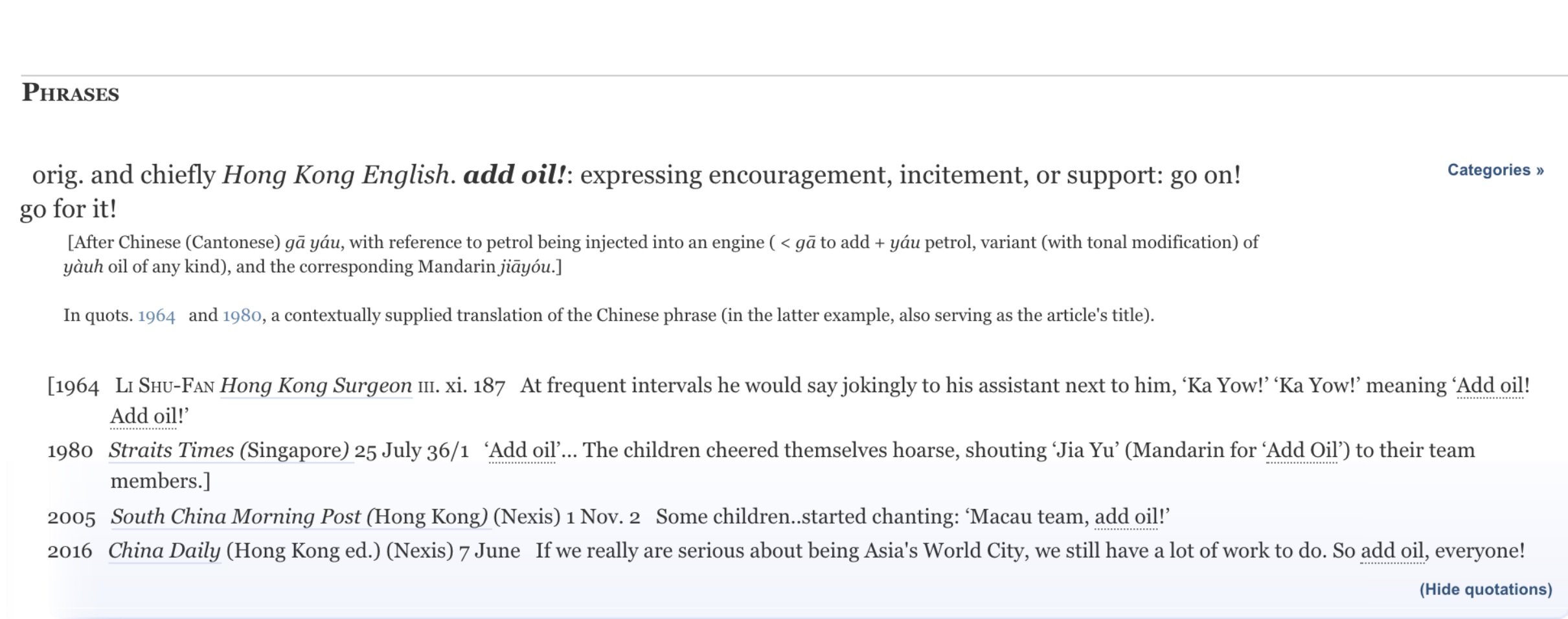
The phrase Add Oil is an English translation of the Chinese expression Jia You (加油), which literally means to add fuel. In the Oxford English Dictionary (OED), it is defined as an exhortation to encourage someone or to express support, similar to saying Go for it! or Keep going! The inclusion of this term reflects the growing influence of Chinese culture and language on global English usage.
Why was Add Oil added to the Oxford English Dictionary?
The term Add Oil was added to the OED as part of its ongoing effort to document the evolution of the English language, including loanwords and phrases from other cultures. Its inclusion acknowledges the widespread use of Jia You in multilingual contexts, particularly in regions like Hong Kong and among Chinese-speaking communities worldwide. The OED recognized its cultural significance and its adoption in English-speaking environments, such as sports events and motivational contexts.
How is Add Oil commonly used in English?
In English, Add Oil is often used in informal settings to cheer someone on or boost their morale. For example, a coach might shout Add Oil! to motivate their team, or a friend might use it to encourage someone during a challenging task. While it originated as a direct translation from Chinese, its usage in English has grown organically, especially in multicultural communities where bilingual expressions are common.
What does the inclusion of Add Oil say about the English language?
The addition of Add Oil to the OED highlights the dynamic and inclusive nature of the English language. It demonstrates how English continuously absorbs words and phrases from other languages, reflecting global cultural exchanges. This recognition also underscores the importance of Chinese linguistic contributions and the blending of languages in an increasingly interconnected world.
Leave a Reply
Related Posts