
Is Chinese difficult to learn?

Learning Chinese is often perceived as one of the most challenging languages for English speakers, but is it truly as difficult as it seems? With its unique writing system, tonal pronunciation, and grammatical structures, Mandarin Chinese presents distinct hurdles. However, the language also offers logical patterns and consistent rules that can simplify the learning process. Factors like motivation, exposure, and effective study methods play a crucial role in mastering it. This article explores the complexities of Chinese, debunks common myths, and provides insights to help learners navigate its challenges. Whether you're a beginner or curious about the journey, understanding the realities of learning Chinese is the first step.
Is Chinese Difficult to Learn?
Chinese is often perceived as one of the most challenging languages for English speakers to learn. This perception stems from several factors, including its tonal nature, complex writing system, and grammatical differences from Indo-European languages. However, with the right approach and consistent practice, mastering Chinese is achievable. Below, we explore key aspects that influence the difficulty of learning Chinese.
1. The Tonal System in Chinese
Chinese is a tonal language, meaning that the pitch or intonation used when pronouncing a word can change its meaning. Mandarin Chinese, for example, has four main tones and a neutral tone. Mispronouncing a tone can lead to misunderstandings, making pronunciation a significant hurdle for beginners. However, with practice, learners can train their ears and vocal cords to distinguish and produce these tones accurately.
See AlsoAnnouncing the Launch of Our New Website – The Chairman’s Bao| Tone | Example (Pinyin) | Meaning |
|---|---|---|
| First Tone (High Flat) | mā (妈) | mother |
| Second Tone (Rising) | má (麻) | hemp |
| Third Tone (Falling-Rising) | mǎ (马) | horse |
| Fourth Tone (Falling) | mà (骂) | scold |
2. The Complexity of Chinese Characters
The Chinese writing system uses logograms (characters) instead of an alphabet. Each character represents a word or a meaningful part of a word, and there are thousands of characters to learn. While this seems daunting, many characters share common components called radicals, which can help in memorization. Additionally, learning Pinyin (the romanization system) first can ease the transition into reading and writing characters.
| Character | Pinyin | Meaning |
|---|---|---|
| 人 | rén | person |
| 好 | hǎo | good |
| 学 | xué | study |
3. Grammar Differences Compared to English
Chinese grammar is often considered simpler than English in some aspects. For example, there are no verb conjugations, no plural forms for nouns, and no gendered articles. However, the sentence structure (Subject-Verb-Object) is similar to English, which can be an advantage. On the other hand, measure words (used when counting nouns) and aspect markers (indicating verb tense) can be tricky for learners.
| Feature | Chinese Example | English Equivalent |
|---|---|---|
| No Verb Conjugation | 我吃 (wǒ chī) - I eat / I ate | Context determines tense |
| Measure Words | 一本书 (yī běn shū) - one [measure] book | one book |
4. Listening and Speaking Challenges
Due to its tonal nature, listening comprehension in Chinese can be difficult at first. Native speakers often speak quickly, and homophones (words that sound the same but have different meanings) are common. However, immersion through movies, music, and conversations can significantly improve listening skills. Speaking fluently requires practice in tone accuracy and natural phrasing.
See AlsoExpressing All Along with 一直 and 一向| Challenge | Example | Tip for Improvement |
|---|---|---|
| Tonal Confusion | mā (mother) vs. mà (scold) | Practice with tone pairs |
| Fast Speech | Native conversational pace | Listen to slow audio first |
5. Resources and Strategies for Learning Chinese
There are numerous resources available for learning Chinese, including language apps, textbooks, tutors, and immersion programs. A structured approach, such as starting with Pinyin, then basic characters, and gradually building vocabulary, is effective. Consistency and daily practice are key, as is engaging with native content (e.g., TV shows, podcasts) to reinforce learning.
| Resource Type | Examples | Benefit |
|---|---|---|
| Language Apps | Duolingo, HelloChinese | Interactive practice |
| Tutoring | iTalki, Preply | Personalized feedback |
| Immersion | Chinese media, travel | Real-world application |
How long does it take to learn Chinese?
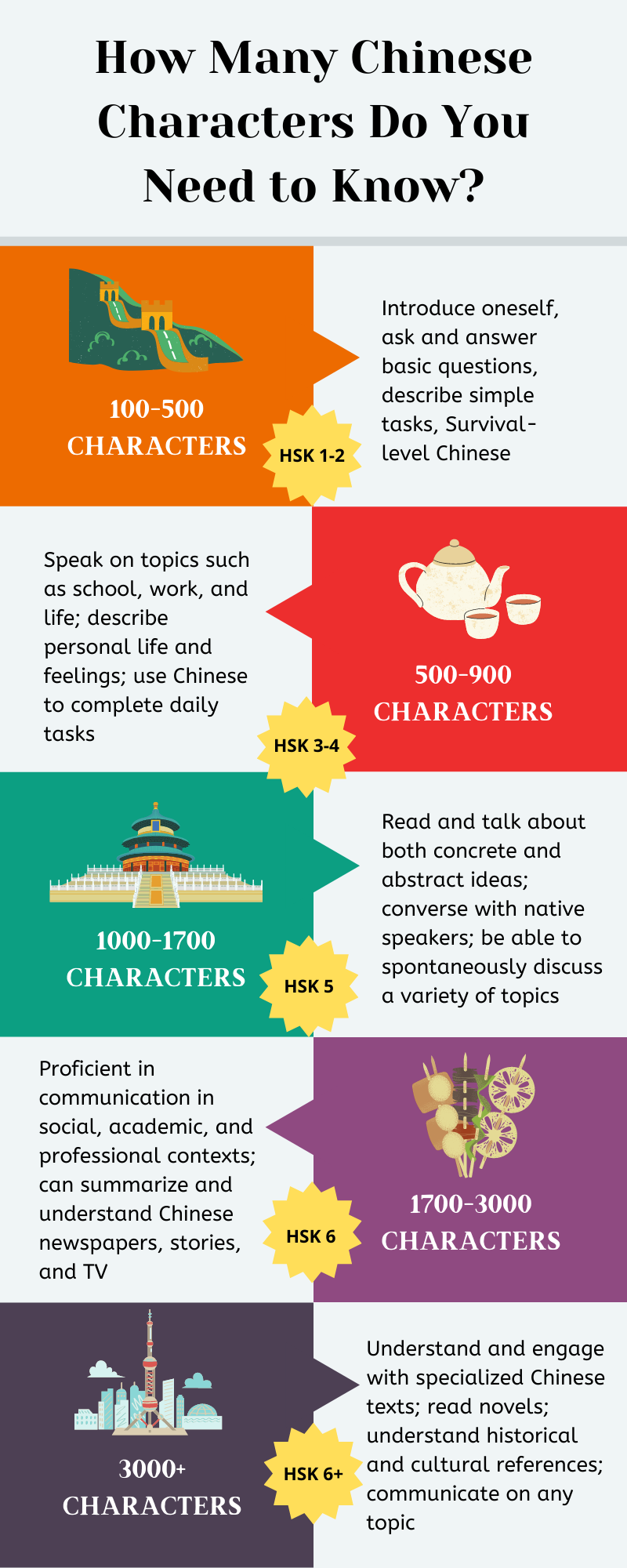
Factors That Influence Learning Chinese
The time it takes to learn Chinese depends on several factors, including:
See AlsoFoodie Map of China- Prior language experience: Knowing other tonal languages like Vietnamese or Thai can speed up the process.
- Study intensity: Dedicated daily practice yields faster results than occasional study.
- Learning methods: Immersion programs or one-on-one tutoring are more effective than self-study alone.
Basic Proficiency in Chinese
Achieving basic conversational skills in Chinese typically requires:
- 6-12 months of consistent study for simple daily interactions.
- 300-500 characters to understand essential phrases.
- Regular practice with native speakers to improve pronunciation.
Intermediate Level of Chinese
Reaching an intermediate level usually involves:
- 2-3 years of structured learning and practice.
- 1,500-2,000 characters to read newspapers or simple books.
- Understanding grammar patterns to form complex sentences.
Advanced Fluency in Chinese
Attaining advanced fluency often demands:
- 4-5 years or more of immersive study.
- 3,000+ characters for academic or professional use.
- Cultural familiarity to grasp idioms and nuances.
Accelerating Chinese Learning
To speed up the learning process, consider:
- Language immersion by living in a Chinese-speaking country.
- Using flashcards (e.g., Anki) for character memorization.
- Watching Chinese media to improve listening and comprehension.
Frequently Asked Questions (FAQ)
Is Chinese one of the hardest languages to learn?
Chinese is often considered one of the most challenging languages for English speakers due to its unique writing system and tonal pronunciation. Unlike alphabetic languages, Chinese uses characters, which require memorization of thousands of symbols. Additionally, the four tones in Mandarin can change the meaning of a word entirely, making pronunciation a significant hurdle. However, with consistent practice and the right resources, many learners achieve fluency.
How long does it take to become fluent in Chinese?
The time required to achieve fluency in Chinese varies based on factors like study intensity, prior language experience, and immersion. According to the Foreign Service Institute (FSI), reaching professional working proficiency typically takes around 2,200 hours of study for English speakers. However, basic conversational skills can be acquired in 6–12 months with dedicated effort. Immersion programs or living in a Chinese-speaking environment can accelerate progress significantly.
What makes Chinese grammar easier than other languages?
Despite its reputation for difficulty, Chinese grammar is surprisingly straightforward in some aspects. Unlike many European languages, Chinese has no verb conjugations, no grammatical gender, and no plural forms for nouns. Sentences often follow a subject-verb-object (SVO) structure, similar to English. Additionally, time expressions are usually indicated by context or simple particles, reducing the need for complex tense systems. This simplicity can make basic communication quicker to grasp.
Can I learn Chinese without mastering the characters?
While it's possible to learn spoken Chinese using Pinyin (the Romanized system), mastering characters is essential for full proficiency. Characters are deeply tied to the language's culture, history, and nuance. Without them, reading, writing, and even understanding homophones in context become difficult. That said, beginners can start with Pinyin to build listening and speaking skills before gradually introducing characters. Tools like flashcards and mnemonics can ease the learning curve.
Leave a Reply
Related Posts