
A Guide to Baidu : the First Chinese Search Engine

Baidu, often referred to as China's Google, is the leading search engine in the world's most populous internet market. Founded in 2000 by Robin Li and Eric Xu, Baidu quickly rose to dominance by tailoring its services to Chinese language users and local preferences. Beyond search, Baidu offers a vast ecosystem, including maps, cloud storage, AI innovations, and autonomous driving technology. As the gateway to China's digital landscape, understanding Baidu is essential for businesses, marketers, and tech enthusiasts navigating this unique online environment. This guide explores Baidu's history, features, and its pivotal role in shaping China's internet culture, offering insights into how it differs from global competitors.
A Comprehensive Guide to Baidu: China's Leading Search Engine
1. What is Baidu and How Does It Work?
Baidu is the dominant search engine in China, often referred to as the Google of China. Launched in 2000, it processes billions of searches daily, offering web, image, video, and news results. Unlike global competitors, Baidu heavily relies on AI-driven algorithms and complies with China's strict internet regulations, filtering content based on government policies. Its search functionality integrates natural language processing (NLP) and localized services like Baidu Maps and Baidu Baike (an encyclopedia).
| Feature | Description |
|---|---|
| AI Integration | Uses deep learning for accurate Chinese-language searches. |
| Localized Services | Includes maps, cloud storage, and an encyclopedia. |
| Censorship Compliance | Filters content as per Chinese regulations. |
2. Key Features of Baidu Search
Baidu offers several unique features tailored to Chinese users. Its Baidu Spider crawler indexes Mandarin content efficiently, while Baidu Zhidao (Baidu Knows) functions as a Q&A platform. The search engine also supports voice and image searches, and its Box Computing feature provides instant answers without clicking external links. Additionally, Baidu prioritizes mobile users with its lightweight Baidu Lite app.
See AlsoWhy you should use more than one Chinese textbook| Feature | Benefit |
|---|---|
| Baidu Zhidao | Crowdsourced answers for niche queries. |
| Box Computing | Direct answers (e.g., weather, calculations). |
| Mobile Optimization | Fast performance on low-end devices. |
3. Baidu vs. Google: Key Differences
While Google dominates globally, Baidu leads in China due to localization and compliance with censorship laws. Baidu's algorithms prioritize Chinese-language content and local businesses, whereas Google emphasizes global sources. Unlike Google, Baidu monetizes heavily through paid placements (e.g., Baidu P4P ads). Technically, Baidu lacks advanced multilingual support but excels in Mandarin voice recognition.
| Aspect | Baidu | |
|---|---|---|
| Market Focus | China-centric | Global |
| Ads Model | Aggressive paid rankings | Contextual ads |
| Language Support | Mandarin-optimized | 100+ languages |
4. How Baidu Handles Censorship and Privacy
Baidu operates under China's Great Firewall, enforcing strict content censorship. It removes results related to sensitive topics (e.g., Tiananmen Square, Tibet) and complies with real-time government directives. Privacy-wise, Baidu collects user data for personalized ads but faces criticism for weak encryption. Users can opt out of ad tracking, though options are limited compared to Western platforms.
| Issue | Baidu's Approach |
|---|---|
| Censorship | Automated + manual filtering |
| Data Collection | Extensive for ad targeting |
| User Control | Basic privacy settings |
5. Baidu’s Ecosystem: Beyond Search
Baidu has expanded into a multifaceted tech giant, offering services like Baidu Cloud, Apollo (self-driving cars), and DuerOS (voice assistant). Its Baidu App aggregates news, payments, and mini-programs, rivaling WeChat. The company also invests heavily in AI research, particularly in NLP and autonomous vehicles, positioning itself as a leader in China's tech innovation.
See AlsoOvercoming the problem of having too many Chinese words to learn| Service | Function |
|---|---|
| Apollo | Open-source autonomous driving platform |
| DuerOS | AI-powered voice assistant |
| Baidu App | Super-app for daily utilities |
Is Baidu better than Google?
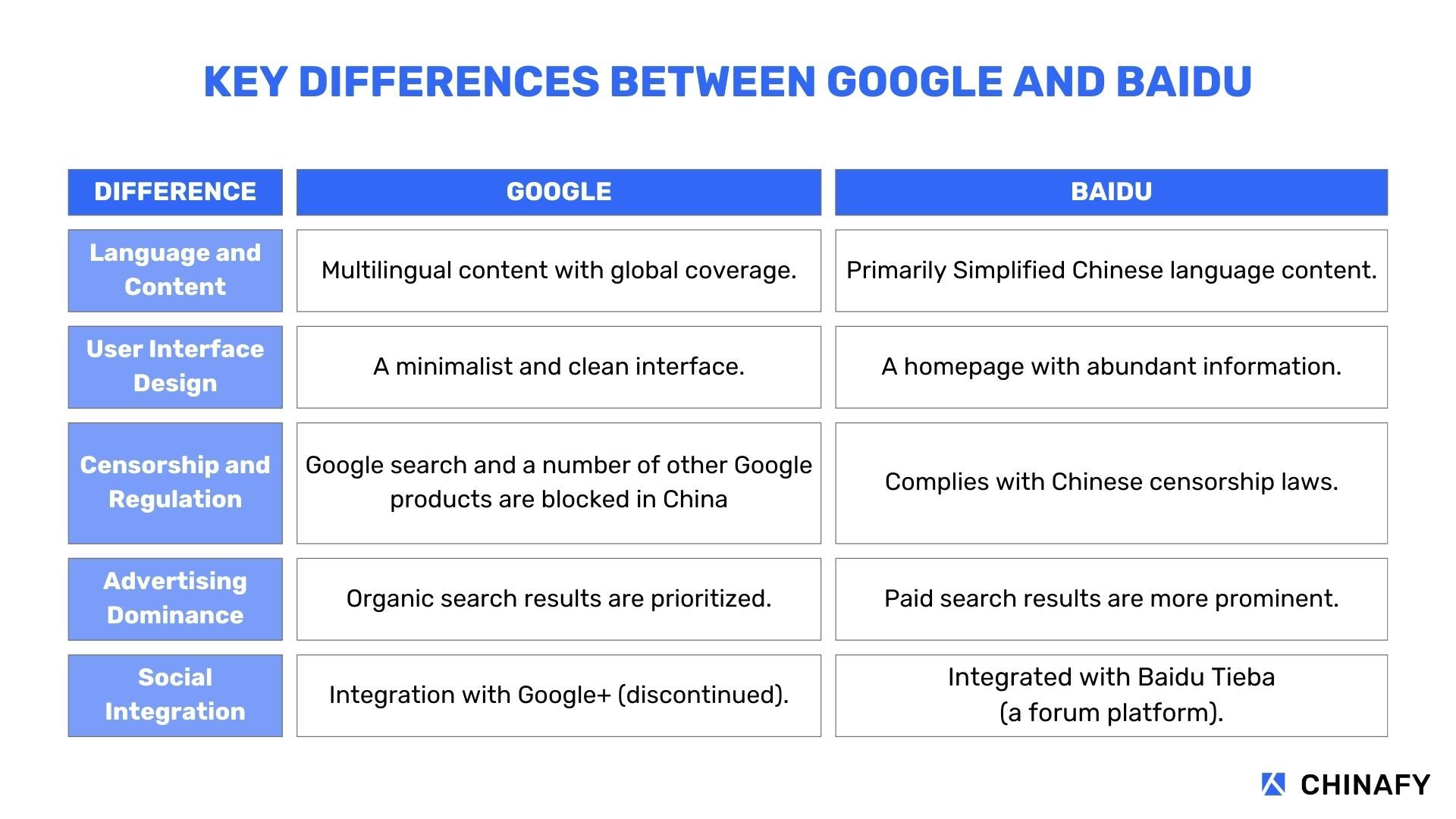
Baidu dominates the Chinese market with over 70% market share, while Google leads globally with approximately 90% market share. The difference arises due to:
- Government restrictions in China blocking Google, giving Baidu a monopoly.
- Baidu’s localized algorithms cater specifically to Chinese users.
- Google’s global infrastructure supports multilingual and multicultural searches.
Language and Localization Capabilities
Baidu excels in Mandarin-based searches, while Google supports a wider range of languages and dialects. Key differences include:
See Also7 Hilarious Chinese Jokes To Make You Laugh (With Explanations!)- Baidu’s Chinese NLP (Natural Language Processing) outperforms Google in regional slang.
- Google’s translation tools are superior for multilingual users.
- Baidu integrates local services like Baidu Maps and Baike (Wikipedia equivalent).
Privacy and Data Policies
Google and Baidu handle user data differently due to regional laws:
- Google follows GDPR in Europe, offering more transparency.
- Baidu complies with China’s data sovereignty laws, storing data locally.
- Both face criticism: Google for data collection, Baidu for government collaboration.
Advertising and Monetization Models
Baidu’s ad revenue relies heavily on local businesses, while Google Ads serves global clients. Key contrasts:
- Baidu prioritizes pay-to-rank schemes, affecting organic results.
- Google uses quality-based ad ranking (e.g., Ad Rank).
- Baidu’s medical ads have faced scandals for promoting unverified clinics.
Innovation and AI Development
Both companies invest heavily in AI, but with different focuses:
See AlsoThe Best Songs to Learn Chinese by HSK Level- Baidu leads in autonomous driving (Apollo) and voice assistants (DuerOS).
- Google advances in generative AI (Gemini) and quantum computing.
- Baidu’s Ernie Bot competes with Google’s Bard in chatbot technology.
What is the first Chinese search engine?
The first Chinese search engine is Yahoo! China, launched in 1999. However, it was a localized version of the American Yahoo! service. The first independently developed Chinese search engine was Baidu, founded in 2000 by Robin Li and Eric Xu. Baidu quickly became the dominant search engine in China due to its focus on Chinese-language content and local user needs.
The Origins of Baidu
Baidu was founded in January 2000 by Robin Li and Eric Xu, with its headquarters in Beijing. It was created to address the unique challenges of searching Chinese-language content, which differs significantly from English.
See AlsoThe nine principles of learning (and the mistakes from failing to follow them)- Baidu's initial focus was on Chinese web indexing, leveraging algorithms tailored for logographic characters.
- By 2001, Baidu launched its independent search portal, competing directly with Yahoo! China.
- The company went public on the NASDAQ in 2005, solidifying its position as China's top search engine.
Key Features of Baidu
Baidu's success stems from its localized features, which cater specifically to Chinese users.
- Baidu Spider: A web crawler optimized for indexing Chinese-language sites efficiently.
- Pinyin Search: Allows users to search using Romanized Chinese, making it accessible for those unfamiliar with Chinese characters.
- Baidu Baike: A Wikipedia-like encyclopedia focused on Chinese topics.
Baidu vs. Early Competitors
Before Baidu, Yahoo! China and Sina were prominent, but Baidu outperformed them by specializing in Chinese search.
- Yahoo! China relied on translated algorithms, which struggled with Chinese nuances.
- Sina's search was portal-based, lacking Baidu's dedicated search infrastructure.
- Baidu's faster indexing and better accuracy made it the preferred choice.
Technological Innovations by Baidu
Baidu introduced several groundbreaking technologies in the early 2000s.
- Hyperlink Analysis: Improved ranking by analyzing Chinese-language link structures.
- Voice Search: Early adoption of Mandarin voice recognition for queries.
- AI Integration: Later incorporated machine learning for personalized results.
Baidu's Market Dominance
By the mid-2000s, Baidu controlled over 70% of China's search market.
- Its advertising platform, Baidu PPC, became a major revenue driver.
- Strategic partnerships with Chinese tech firms expanded its ecosystem.
- Google's exit from China in 2010 further cemented Baidu's dominance.
Is Baidu a safe search engine?

Is Baidu a Secure Search Engine for General Use?
Baidu is generally considered safe for basic searches within China, but users should be aware of certain limitations. The platform adheres to strict Chinese regulations, which can affect the results and privacy policies. Here are key points to consider:
- Government compliance: Baidu follows local laws, meaning some content may be censored or filtered.
- Data collection: Like many search engines, Baidu collects user data, but its policies may differ from Western alternatives.
- Malware risks: While Baidu scans for malicious links, third-party ads or downloads may pose risks.
How Does Baidu Handle User Privacy?
Baidu’s privacy practices are influenced by Chinese laws, which may not align with international standards like GDPR. Users should review the following:
- Data storage: Personal information is stored on servers within China, subject to local jurisdiction.
- Third-party sharing: Baidu may share data with authorities or partners as required by law.
- Limited transparency: Detailed reports on data usage are less accessible compared to global competitors.
Does Baidu Filter or Censor Search Results?
Yes, Baidu actively filters content based on government directives. This impacts the breadth of information available:
- Sensitive topics: Searches related to politics, human rights, or protests are heavily moderated.
- International results: Global perspectives may be omitted or deprioritized.
- Algorithm bias: Results often favor domestic sources over foreign ones.
Are Baidu’s Ads and Third-Party Links Safe?
Baidu’s advertising ecosystem has faced criticism for hosting unverified or harmful content. Key concerns include:
- Misleading ads: Some promoted links may direct users to scams or low-quality services.
- Malware distribution: Ads or downloads from untrusted sources can compromise security.
- Limited vetting: Advertisers may not undergo rigorous checks compared to Western platforms.
How Does Baidu Compare to Google in Terms of Safety?
While both are search giants, their safety profiles differ significantly due to regional and legal frameworks:
- Encryption: Google defaults to HTTPS; Baidu has improved but may lag in consistency.
- Transparency: Google provides clearer privacy controls and data deletion options.
- Content scope: Google offers uncensored global results, whereas Baidu prioritizes local, regulated content.
Frequently Asked Questions (FAQ)
What is Baidu and why is it considered the first Chinese search engine?
Baidu is the leading search engine in China, often referred to as the Google of China due to its dominance in the region. Launched in 2000, it became the first major Chinese search engine to cater specifically to the needs of Chinese-speaking users. Unlike global competitors, Baidu was designed to handle the complexities of the Chinese language, including its characters and dialects, making it more effective for local searches. Its early adoption and deep integration into China's internet ecosystem solidified its position as a pioneer in the industry.
How does Baidu differ from other search engines like Google?
While Google operates globally, Baidu is tailored exclusively for the Chinese market. One key difference is its focus on localized content, including government-approved results due to China's strict internet regulations. Baidu also offers unique services like Baidu Baike (a Wikipedia-like encyclopedia) and Baidu Maps, which are optimized for Chinese users. Additionally, Baidu's search algorithms prioritize Chinese-language websites and understand regional slang, whereas Google may not always deliver the same level of cultural or linguistic relevance.
What are the main features of Baidu that attract users?
Baidu provides a range of features that cater to Chinese internet users. Its search functionality is highly optimized for Mandarin, including voice and image search. Beyond search, Baidu offers cloud storage (Baidu Wangpan), AI-powered tools, and entertainment platforms like iQiyi for streaming. The integration of mobile payments and partnerships with local businesses further enhances its appeal. These features create a comprehensive ecosystem, making Baidu indispensable for daily online activities in China.
Is Baidu available outside of China, and how does it perform globally?
While Baidu primarily serves the Chinese market, it has made limited efforts to expand internationally, such as launching Baidu Japan in the past. However, its global presence remains minimal compared to giants like Google. Outside China, Baidu faces challenges like language barriers, competition, and differing internet regulations. Despite this, Baidu's AI and autonomous driving projects have gained international attention, showcasing its potential beyond search. For most non-Chinese users, though, Baidu remains a niche player.
Leave a Reply
Related Posts