
Daoism: The Complete Guide

Daoism, an ancient Chinese philosophy and spiritual tradition, offers profound insights into living harmoniously with nature and the universe. Rooted in the teachings of Laozi and the Dao De Jing, Daoism emphasizes simplicity, balance, and the flow of qi (life energy). This guide explores its core principles—such as wu wei (effortless action), yin-yang duality, and inner alchemy—while shedding light on its rich history, practices, and modern relevance. Whether you seek philosophical wisdom, meditation techniques, or a deeper connection to the natural world, Daoism provides timeless tools for personal growth and tranquility. Discover the essence of this enduring tradition in Daoism: The Complete Guide.
Daoism: The Complete Guide to Understanding Its Philosophy and Practices
The Origins and History of Daoism
Daoism, also known as Taoism, is an ancient Chinese philosophy and religion that dates back over 2,000 years. It is attributed to the legendary figure Laozi, who wrote the foundational text, the Tao Te Ching. Daoism emphasizes living in harmony with the Dao (Tao), or The Way, which is the natural order of the universe. Over centuries, Daoism evolved into both a philosophical tradition and a religious practice, influencing Chinese culture, medicine, and martial arts.
| Key Figure | Text | Period |
|---|---|---|
| Laozi | Tao Te Ching | 6th-4th century BCE |
| Zhuangzi | Zhuangzi | 4th century BCE |
Core Principles of Daoism
The central idea of Daoism is the Dao, an ineffable force that flows through all things. Key principles include wu wei (effortless action), yin and yang (balance of opposites), and naturalness. Daoists believe in living simply, avoiding excessive desire, and embracing spontaneity to align with the Dao. These principles guide both personal conduct and governance.
See AlsoNew Chinese Buzzword: Dalonga Candy Game/Challenge| Principle | Meaning |
|---|---|
| Wu Wei | Non-action or effortless action |
| Yin-Yang | Harmony of opposites |
Daoist Practices and Rituals
Daoism includes various practices aimed at cultivating longevity and spiritual enlightenment. These include meditation, qigong, tai chi, and alchemy. Religious Daoism also involves rituals, temple worship, and the veneration of deities like the Jade Emperor. Many practices focus on balancing qi (life energy) within the body.
| Practice | Purpose |
|---|---|
| Meditation | Inner peace and clarity |
| Tai Chi | Harmonizing body and mind |
Daoism’s Influence on Chinese Culture
Daoism has deeply shaped Chinese art, literature, medicine, and martial arts. Concepts like feng shui and traditional Chinese medicine (TCM) stem from Daoist ideas of balance and energy flow. Even in modern times, Daoist philosophy inspires environmentalism and minimalism worldwide.
| Area | Influence |
|---|---|
| Medicine | Acupuncture, herbalism |
| Art | Landscape painting |
Modern Interpretations of Daoism
Today, Daoism is practiced globally, adapting to contemporary contexts while retaining its essence. Modern Daoists apply its teachings to stress reduction, leadership, and sustainability. Scholars also explore Daoism’s parallels with quantum physics and ecology, highlighting its timeless relevance.
See AlsoHungry Ghost Festival in China| Application | Example |
|---|---|
| Leadership | Wu Wei in management |
| Ecology | Daoist environmental ethics |
What are the 3 main teachings of Daoism?
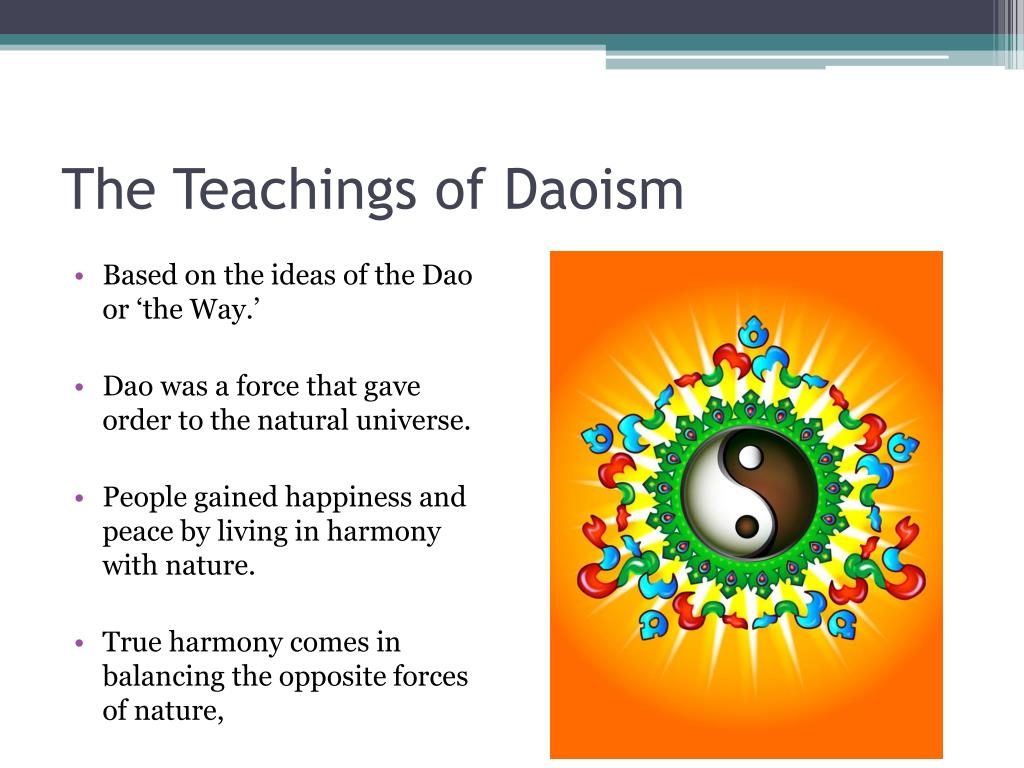
The Principle of Wu Wei (Non-Action)
The concept of Wu Wei is central to Daoism, emphasizing effortless action and harmony with the natural flow of life. It teaches that forcing outcomes often leads to imbalance, while yielding and adapting brings peace. Key aspects include:
- Effortless Action: Acting without struggle, like water flowing downstream.
- Natural Alignment: Aligning with the Dao (the Way) instead of resisting it.
- Spontaneity: Trusting intuition over rigid planning.
The Unity of Opposites (Yin and Yang)
Daoism highlights the interdependence of opposites, symbolized by Yin and Yang. This teaching reveals that duality is an illusion, and harmony arises from balance. Essential points include:
See AlsoText adventure games and how to use them in the Chinese language classroom- Complementary Forces: Light/dark, active/passive coexist and define each other.
- Dynamic Balance: Change is constant, and extremes self-correct.
- Cyclical Nature: Day turns to night, seasons shift—all part of the Dao.
Living in Harmony with Nature
Daoism advocates for a deep connection with the natural world, viewing humans as part of—not masters of—the ecosystem. Core ideas involve:
- Simplicity: Reducing artificial desires to align with nature’s rhythms.
- Respect for All Life: Valuing plants, animals, and landscapes as expressions of the Dao.
- Adaptability: Mimicking nature’s flexibility, like bamboo bending in the wind.
The Concept of Dao (The Way)
The Dao is the ineffable, eternal principle underlying existence. It cannot be named but guides all things. Key teachings include:
- Mystery: The Dao is beyond human comprehension yet ever-present.
- Source of All: It generates and unifies the universe.
- Path to Wisdom: Understanding the Dao requires humility and observation.
The Virtue of De (Inner Power)
De represents the virtuous power cultivated by aligning with the Dao. It manifests as integrity and effortless influence. Important elements are:
- Authenticity: Acting from true nature, not ego.
- Non-Force: Leading without domination, like the Dao’s gentle guidance.
- Magnetic Influence: Virtue attracts harmony naturally.
What does Taoism think of Jesus?

Taoist Perspective on Jesus as a Spiritual Teacher
In Taoism, Jesus is often viewed as a spiritual teacher or sage whose teachings align with certain Taoist principles, such as compassion, humility, and harmony. While not a central figure in Taoist thought, Jesus' message of love and selflessness resonates with the Taoist ideal of wu-wei (effortless action) and living in accordance with the Tao (the Way).
- Jesus' emphasis on inner peace mirrors Taoist meditation practices.
- His teachings on forgiveness align with Taoist values of non-contention.
- The concept of the Kingdom of God parallels the Taoist idea of unity with the universe.
Jesus in the Context of Taoist Syncretism
Syncretism in Taoism allows for the integration of diverse spiritual figures, including Jesus, into its philosophy. Some Taoist scholars see Jesus as a manifestation of the divine sage, akin to Lao Tzu or Confucius, who embodied virtuous living.
- Jesus' miracles are interpreted as demonstrations of alignment with cosmic energy (Qi).
- His resurrection symbolizes the Taoist belief in transformation and immortality.
- The Beatitudes reflect Taoist ideals of simplicity and detachment.
Contrasts Between Taoism and Christian Teachings
Despite overlaps, key differences exist. Taoism lacks a personal God or savior figure, focusing instead on the impersonal Tao. Jesus' role as the Son of God contrasts with Taoism's non-theistic framework.
- Taoism emphasizes natural spontaneity, while Christianity often stresses divine will.
- Jesus' sacrificial love is distinct from Taoist detachment.
- The Trinity concept has no direct parallel in Taoist cosmology.
Historical Interactions Between Taoism and Christianity
Historically, interactions were limited, but Jesuit missionaries in China noted parallels between Taoist and Christian mysticism. Some Taoists viewed Jesus as a Western sage whose teachings complemented their own.
- Matteo Ricci's 16th-century missions sparked dialogues on comparative theology.
- Taoist texts like the Tao Te Ching were compared to biblical wisdom literature.
- Modern Taoist-Christian dialogues explore shared ethical values.
Modern Taoist Interpretations of Jesus
Contemporary Taoists may see Jesus as a universal symbol of enlightenment, transcending religious boundaries. His life exemplifies virtues like compassion and service, which align with Taoist practice.
- Jesus' parables are likened to Taoist koans or paradoxical teachings.
- His emphasis on the poor and marginalized echoes Taoist social ideals.
- Some Taoists incorporate Jesus into eclectic spiritual practices.
What are the 5 elements of Daoism?
:max_bytes(150000):strip_icc()/Wu_Xing-56a92e4d3df78cf772a4804b.jpg)
The Five Elements in Daoism: An Overview
In Daoist philosophy, the Five Elements (五行, Wǔ Xíng) are fundamental components of the natural world, representing cyclical interactions and balance. These elements are:
- Wood (木, Mù) – Symbolizes growth, flexibility, and vitality.
- Fire (火, Huǒ) – Represents transformation, passion, and energy.
- Earth (土, Tǔ) – Embodies stability, nourishment, and grounding.
- Metal (金, Jīn) – Signifies strength, structure, and refinement.
- Water (水, Shuǐ) – Reflects fluidity, adaptability, and wisdom.
The Role of Wood in Daoist Philosophy
Wood is associated with the spring season and the direction east. It embodies:
- Expansion – Like trees reaching upward, it symbolizes new beginnings.
- Compassion – Linked to the liver and the emotion of kindness.
- Creativity – Encourages innovation and artistic expression.
Fire: The Element of Transformation
Fire corresponds to summer and the south. Its key attributes include:
- Dynamic Energy – Drives action and enthusiasm.
- Purification – Burns away impurities, both physical and spiritual.
- Connection – Tied to the heart and joy in Daoist medicine.
Earth: The Foundation of Balance
Earth is central to the Five Elements, representing late summer and neutrality. It emphasizes:
- Harmony – Bridges the other elements, fostering equilibrium.
- Nurturing – Associated with the spleen and the emotion of empathy.
- Manifestation – Turns ideas into tangible results.
Metal and Water: Structure and Flow
Metal (autumn, west) and Water (winter, north) complete the cycle:
- Metal – Governs discipline, precision, and the lungs (grief).
- Water – Rules intuition, resilience, and the kidneys (fear).
- Interdependence – Metal condenses, while Water dissolves, illustrating cyclical change.
What are the 8 principles of Daoism?

The Principle of Wu Wei (Non-Action)
The concept of Wu Wei emphasizes effortless action and natural spontaneity. It teaches that one should align with the natural flow of the universe rather than forcing outcomes. Key aspects include:
- Letting go of excessive control and allowing events to unfold naturally.
- Avoiding unnecessary struggle by trusting in the Dao's wisdom.
- Acting with minimal effort to achieve maximum harmony.
The Principle of Yin and Yang
The Yin and Yang principle represents the balance of opposing yet complementary forces. It illustrates how duality creates harmony in existence. Key points include:
- Recognizing that opposites (light/dark, active/passive) are interconnected.
- Understanding that balance between Yin (receptive) and Yang (active) brings peace.
- Accepting that change is constant, and harmony comes from adaptation.
The Principle of Simplicity (Pu)
Simplicity (Pu) refers to the uncarved block, symbolizing purity and unpretentiousness. It encourages shedding artificial complexity. Core ideas include:
- Valuing naturalness over artificial constructs.
- Embracing humility and avoiding unnecessary desires.
- Returning to a state of childlike innocence for clarity.
The Principle of Naturalness (Ziran)
Ziran means self-so or spontaneity, advocating alignment with one's true nature. It highlights:
- Trusting in the innate wisdom of the universe.
- Rejecting forced behavior in favor of authenticity.
- Living in harmony with natural laws without resistance.
The Principle of Detachment
Detachment in Daoism involves freeing oneself from material cravings and emotional extremes. Essential teachings include:
- Cultivating inner peace by letting go of attachments.
- Recognizing that clinging leads to suffering.
- Focusing on the eternal Dao rather than transient desires.
Frequently Asked Questions (FAQ)
What is Daoism and what does Daoism: The Complete Guide cover?
Daoism, also spelled Taoism, is an ancient Chinese philosophy and spiritual tradition that emphasizes living in harmony with the Dao (or the Way), the fundamental principle underlying the universe. Daoism: The Complete Guide provides a comprehensive exploration of this tradition, covering its philosophical foundations, practices, rituals, and historical development. The book delves into key texts like the Dao De Jing and the Zhuangzi, as well as the role of meditation, martial arts, and nature in Daoist life.
Who would benefit from reading Daoism: The Complete Guide?
This book is ideal for beginners seeking an accessible introduction to Daoism, as well as practitioners looking to deepen their understanding. Scholars of religion or philosophy will appreciate its thorough research, while spiritual seekers can apply its teachings to cultivate balance and mindfulness. Whether you're interested in Chinese culture, meditation, or alternative philosophies, this guide offers valuable insights.
How does Daoism: The Complete Guide explain the concept of Wu Wei?
The book explores Wu Wei, often translated as non-action or effortless action, as a central Daoist principle. It clarifies that Wu Wei doesn’t mean inactivity but rather aligning with the natural flow of events without unnecessary force. Through examples from nature and daily life, the guide illustrates how practicing Wu Wei can reduce stress and improve decision-making by trusting the spontaneous order of the Dao. It also connects Wu Wei to modern concepts like minimalism and mindful living.
Does Daoism: The Complete Guide address the differences between religious and philosophical Daoism?
Yes, the book clearly distinguishes between religious Daoism, which includes rituals, deities, and temple worship, and philosophical Daoism, which focuses on texts and ethical teachings. It explains how both branches share core ideas like the Dao and Yin-Yang but diverge in practices. The guide also traces their historical evolution, showing how religious Daoism incorporated elements like alchemy and immortality cults, while philosophical Daoism remained more abstract and contemplative.
Leave a Reply
Related Posts