
5 Measure Words Explained

Measure words are essential in many languages, particularly in Mandarin Chinese, where they classify nouns based on type, shape, or quantity. For English speakers, these linguistic tools can seem unfamiliar, but understanding them is key to mastering the language. This article breaks down five common measure words, explaining their usage and nuances. Whether you're learning Chinese or simply curious about how measure words function, this guide will clarify their purpose and help you use them correctly. From general classifiers to those for specific objects, each example will enhance your grasp of this unique grammatical feature. Let’s explore these five measure words in detail.
5 Measure Words Explained: A Guide to Common Quantifiers
1. What Are Measure Words?
Measure words, also known as counters or classifiers, are used in many languages to specify the quantity of a noun. Unlike English, where you can say three apples, some languages require a measure word between the number and the noun. For example, in Mandarin, you would say 三个苹果 (sān gè píngguǒ), where 个 (gè) is the measure word for apples.
| Language | Example | Measure Word |
|---|---|---|
| Mandarin | 三个苹果 (three apples) | 个 (gè) |
| Japanese | 三つのりんご (three apples) | つ (tsu) |
2. Common Measure Words in Mandarin
Mandarin Chinese heavily relies on measure words, and each noun typically has a specific one. Here are some of the most common:
See AlsoHow to adjust your Chinese listening to the right level| Measure Word | Pinyin | Usage |
|---|---|---|
| 个 | gè | General counter for people/objects |
| 张 | zhāng | Flat objects (paper, tickets) |
| 本 | běn | Books, notebooks |
3. Measure Words in Japanese
Japanese also uses counters, which vary depending on the object's shape, size, or type. Some examples include:
| Counter | Reading | Usage |
|---|---|---|
| つ | tsu | General counter for small objects |
| 枚 | mai | Flat objects (paper, shirts) |
| 冊 | satsu | Books, magazines |
4. Measure Words in Korean
Korean employs measure words (called 수분류사) similarly to Mandarin and Japanese. Some frequently used ones are:
| Counter | Romanization | Usage |
|---|---|---|
| 개 | gae | General counter for objects |
| 명 | myeong | People (informal) |
| 병 | byeong | Bottles |
5. Why Are Measure Words Important?
Measure words are essential for grammatical correctness in many languages. Without them, sentences may sound unnatural or incomplete. They also help clarify the type or shape of the noun being referenced.
See AlsoAnnouncing the Launch of Our New Website – The Chairman’s Bao| Language | Without Measure Word | With Measure Word |
|---|---|---|
| Mandarin | 三苹果 (incorrect) | 三个苹果 (correct) |
| Japanese | 三りんご (incorrect) | 三つのりんご (correct) |
What is an example of a measure word?

What Are Measure Words in English?
Measure words are used to quantify or specify nouns, especially when dealing with uncountable or collective nouns. For example, in the phrase a cup of coffee, the word cup acts as a measure word. These words help clarify the amount or unit of the noun being referenced.
- Measure words are essential for uncountable nouns like water or rice.
- They provide context, such as a slice of bread or a piece of paper.
- Some measure words are container-based, like a bottle of milk.
Common Examples of Measure Words
Here are some frequently used measure words in English:
See AlsoFoodie Map of China- A loaf of bread – Used for bread baked in a single mass.
- A sheet of paper – Refers to a single piece of paper.
- A bar of soap – Describes a single unit of soap.
Measure Words for Liquids
Liquids often require specific measure words to indicate volume or container type:
- A glass of water – Measures water in a drinking glass.
- A gallon of milk – Specifies a large volume of milk.
- A drop of oil – Refers to a very small quantity.
Measure Words for Food Items
Food-related nouns often pair with measure words to define portions:
- A slice of pizza – Indicates a single portion of pizza.
- A bunch of bananas – Refers to a group of bananas.
- A pinch of salt – Describes a tiny amount of salt.
Measure Words for Abstract Concepts
Even abstract ideas can use measure words for quantification:
- A bit of advice – Means a small amount of advice.
- A piece of information – Refers to a single fact or detail.
- A burst of laughter – Describes a sudden, short laugh.
What is 家 a measure word for?
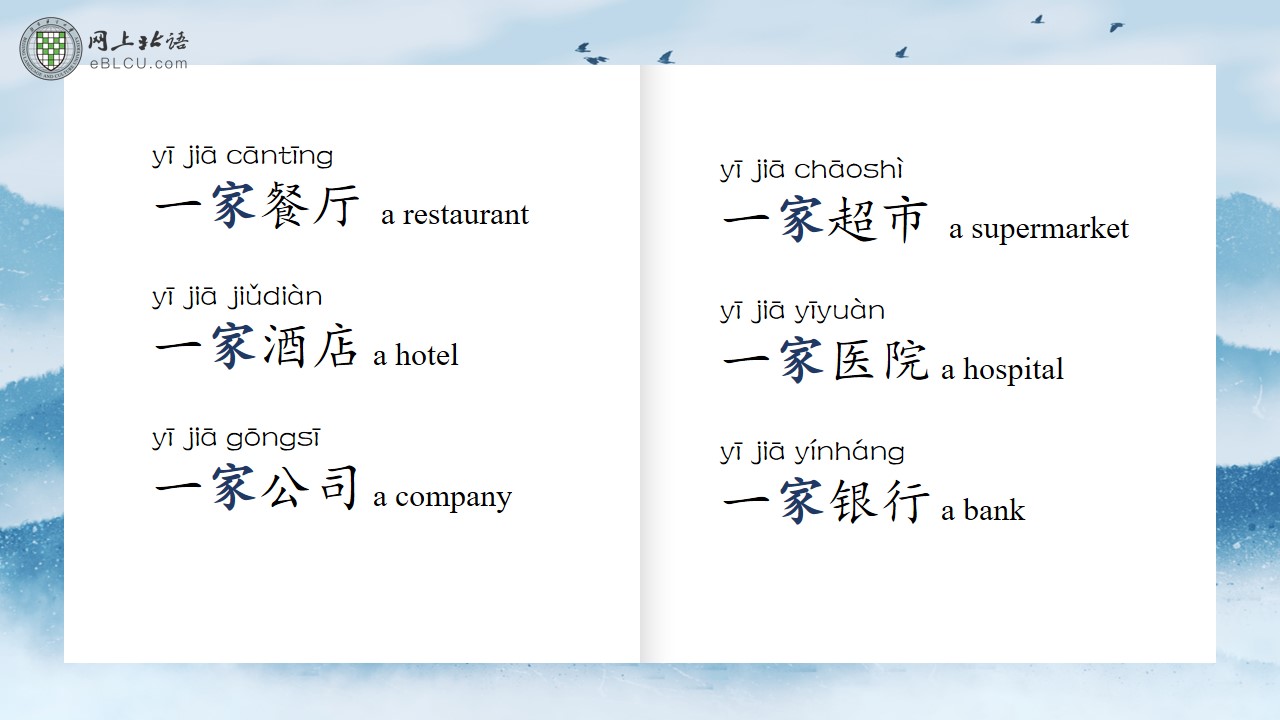
What is the Chinese Measure Word 家 Used For?
The Chinese measure word 家 (jiā) is primarily used to count or quantify households, families, businesses, or institutions. It is commonly applied to entities that represent a collective or organized group, often related to living spaces or commercial establishments.
- Families or households: Used when referring to the number of families in a community.
- Companies or businesses: Applied when counting enterprises, shops, or corporations.
- Institutions or organizations: Used for schools, hospitals, or other formal establishments.
Examples of 家 as a Measure Word for Families
When referring to families or households, 家 helps specify the quantity in a structured manner.
- 三家邻居 (sān jiā línjū) - Three neighboring families.
- 五家住户 (wǔ jiā zhùhù) - Five resident households.
- 十家村民 (shí jiā cūnmín) - Ten village families.
How 家 is Used for Businesses and Companies
In commercial contexts, 家 quantifies businesses, emphasizing their organizational nature.
- 两家餐厅 (liǎng jiā cāntīng) - Two restaurants.
- 四家银行 (sì jiā yínháng) - Four banks.
- 一家工厂 (yī jiā gōngchǎng) - One factory.
家 as a Measure Word for Institutions
For institutions or large organizations, 家 provides clarity in enumeration.
- 三家医院 (sān jiā yīyuàn) - Three hospitals.
- 六家学校 (liù jiā xuéxiào) - Six schools.
- 两家博物馆 (liǎng jiā bówùguǎn) - Two museums.
Common Mistakes When Using 家 as a Measure Word
Learners often misuse 家 by applying it to inappropriate nouns. Here are key errors to avoid:
- Incorrect for individuals: Never use 家 for single people (e.g., 一家老师 is wrong).
- Overgeneralization: Avoid using it for non-group entities (e.g., 一家书 is incorrect).
- Confusing with other measure words: Unlike 个 (gè), 家 is specific to collectives.
Why do Chinese use measure words?
The Historical Origins of Chinese Measure Words
The use of measure words in Chinese dates back to ancient times, evolving as a linguistic necessity to clarify and specify nouns. Unlike English, where measure words are optional (e.g., a piece of paper), Chinese requires them for grammatical accuracy. This system reflects the language's classifier tradition, where objects are categorized based on shared characteristics.
- Ancient Chinese texts show early examples of measure words, linking them to trade and inventory.
- The Shang Dynasty (1600–1046 BCE) used measure words for recording goods.
- Over time, measure words became grammaticalized, embedding deeply into the language.
Grammatical Necessity in Chinese
Measure words are mandatory in Chinese because they bridge numerals or demonstratives (e.g., this, that) with nouns. Without them, sentences sound incomplete or unnatural. This structure ensures precision and avoids ambiguity when quantifying objects.
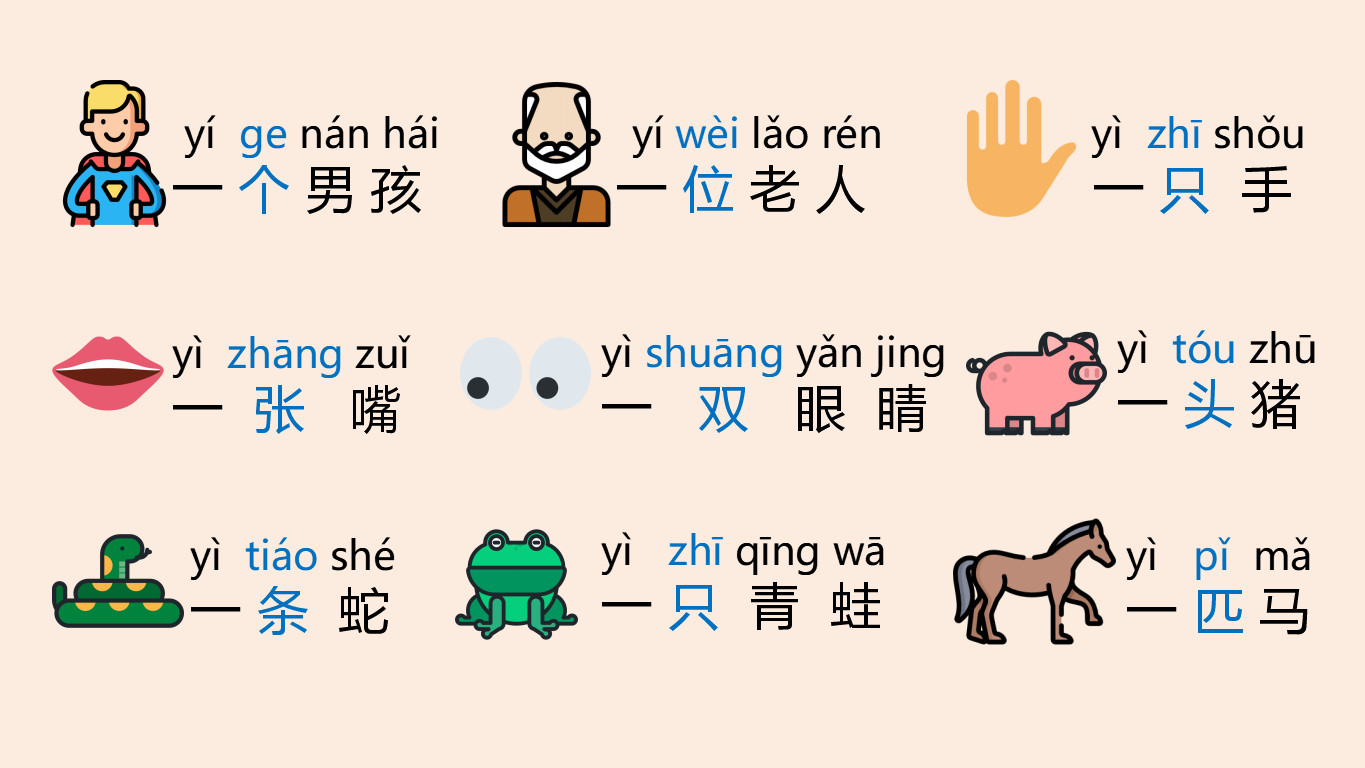
- English can say three books, but Chinese requires 三本书 (sān běn shū), where 本 (běn) is the measure word.
- Measure words classify nouns by shape, function, or animacy (e.g., 条 for long objects like ropes).
- Omitting measure words makes speech sound non-native or overly simplistic.
Cultural and Cognitive Influences
Chinese measure words reflect cultural perspectives on categorization. They highlight how speakers perceive relationships between objects, such as grouping flat items (e.g., 张 for paper) or animals (e.g., 只 for small creatures). This system mirrors cognitive patterns unique to Chinese thought.
- Measure words often align with traditional Chinese values, like harmony and order.
- They emphasize respect for objects (e.g., 位 for honored people).
- Some measure words derive from historical artifacts (e.g., 册 for bound books).
Comparison with Other Languages
While English and many European languages use measure words sparingly, Chinese relies heavily on them. This distinction stems from linguistic typology—Chinese is analytic, relying on word order and particles, whereas Indo-European languages often use inflection.
- English measure words (e.g., a cup of tea) are optional and less numerous.
- Japanese and Korean also use classifiers but with different rules.
- Chinese measure words are more systematic, with over 100 common ones.
Practical Benefits of Measure Words
Measure words enhance clarity and efficiency in communication. They prevent misunderstandings by specifying quantities and types of objects, which is especially useful in high-context conversations.
- They help distinguish homophones (e.g., 花 can mean flower or spend).
- Measure words aid in language learning by reinforcing noun categories.
- They streamline technical or formal descriptions (e.g., contracts, recipes).
What is the meaning of measure of words?

What Does Measure of Words Mean in Communication?
The measure of words refers to the deliberate selection and arrangement of language to convey meaning effectively. It involves evaluating the impact, precision, and appropriateness of words in a given context. Key aspects include:
- Clarity: Ensuring the message is easily understood without ambiguity.
- Conciseness: Avoiding unnecessary words to maintain focus.
- Tone: Aligning word choice with the intended emotional or formal tone.
How Does the Measure of Words Affect Writing Quality?
A well-measured selection of words enhances the quality of writing by improving readability and engagement. Important considerations are:
- Audience: Tailoring language to the reader's comprehension level.
- Purpose: Choosing words that align with the text's goal (e.g., persuasive, informative).
- Flow: Structuring sentences for smooth transitions and coherence.
Why Is the Measure of Words Important in Public Speaking?
In public speaking, the measure of words determines how effectively a message resonates with the audience. Critical factors include:
- Impact: Using powerful words to leave a lasting impression.
- Pacing: Balancing speed and pauses for emphasis.
- Adaptability: Adjusting vocabulary based on audience feedback.
What Role Does the Measure of Words Play in Professional Settings?
In workplaces, the measure of words ensures professionalism and avoids miscommunication. Key elements are:
- Precision: Avoiding vague terms in emails or reports.
- Diplomacy: Using tactful language in sensitive discussions.
- Efficiency: Conveying information succinctly in meetings.
How Can One Improve Their Measure of Words?
Enhancing the measure of words requires practice and awareness. Effective strategies include:
- Reading: Studying well-written texts to observe word usage.
- Editing: Revising drafts to eliminate redundancies.
- Feedback: Seeking input from peers to refine language.
Frequently Asked Questions (FAQ)
What are measure words in English?
Measure words, also known as counters or classifiers, are words used to quantify or specify nouns, especially when dealing with uncountable nouns or objects that require a unit of measurement. Unlike languages like Chinese or Japanese, English uses measure words less frequently, but they are still essential for clarity. Examples include a piece of cake, a cup of coffee, or a loaf of bread. These words help define the amount or form of the noun being referenced.
Why are measure words important in English?
Measure words play a crucial role in making sentences precise and grammatically correct, particularly with uncountable nouns like liquids, grains, or abstract concepts. For instance, saying a glass of water is more accurate than just a water, which sounds incomplete. They also help avoid ambiguity, ensuring the listener or reader understands the exact quantity or type of object being discussed.
Can you give examples of common English measure words?
Some of the most common measure words in English include a slice of pizza, a sheet of paper, a bar of soap, and a drop of rain. These phrases illustrate how measure words pair with specific nouns to convey meaning effectively. For example, a grain of rice emphasizes a single unit, while a bag of rice refers to a larger quantity.
How do measure words differ from regular quantifiers?
While both measure words and quantifiers indicate quantity, they serve different purposes. Quantifiers like some, many, or few describe general amounts, whereas measure words specify the unit or container holding the noun. For example, some milk is vague, but a bottle of milk clarifies the measurement. Measure words are often more descriptive and context-dependent.
Leave a Reply
Related Posts