
Focusing on radicals, character components and building blocks

Understanding Chinese characters can seem daunting, but breaking them down into radicals, components, and building blocks simplifies the process. Radicals, the foundational elements of characters, often hint at meaning or pronunciation, serving as essential clues for learners. Character components, whether semantic or phonetic, combine to form more complex characters, revealing patterns that make memorization easier. By focusing on these structural elements, learners can decode unfamiliar characters systematically. This approach not only enhances recognition but also deepens comprehension of the language’s logic. Whether you're a beginner or refining your skills, mastering radicals and components unlocks the door to efficient and meaningful Chinese literacy.
- Understanding Radicals, Character Components, and Building Blocks in Language Learning
- What does a radical do in a character?
- What is the difference between Chinese character components and radicals?
- Is it worth learning Chinese radicals?
- What are the building blocks of Chinese characters?
- Frequently Asked Questions (FAQ)
Understanding Radicals, Character Components, and Building Blocks in Language Learning
The Role of Radicals in Chinese Characters
Radicals are the foundational elements of Chinese characters, often providing clues to a character's meaning or pronunciation. They serve as building blocks that help learners decode and remember complex characters. For example, the radical 氵 (water) appears in characters like 河 (river) and 湖 (lake), indicating a connection to water. Understanding radicals simplifies the process of learning and recognizing characters.
| Radical | Meaning | Example Characters |
|---|---|---|
| 氵 (water) | Related to water | 河 (river), 湖 (lake) |
| 木 (wood) | Related to trees/wood | 林 (forest), 桌 (table) |
How Character Components Enhance Memorization
Character components are smaller units within a character that contribute to its overall structure. These components can be radicals or other recurring elements. For instance, the character 明 (bright) combines the components 日 (sun) and 月 (moon), making it easier to remember. Breaking characters into components aids in pattern recognition and retention.
See AlsoPreply Review - Just Another Italki? Or Something Different?| Component | Function | Example Character |
|---|---|---|
| 日 (sun) | Semantic (meaning) | 明 (bright) |
| 月 (moon) | Semantic (meaning) | 明 (bright) |
Building Blocks: The Structural Units of Characters
Building blocks refer to the smallest meaningful units in a character, which can include strokes, radicals, or components. Mastering these units allows learners to construct and deconstruct characters efficiently. For example, the character 好 (good) is made of 女 (woman) and 子 (child), illustrating how building blocks work together.
| Building Block | Role | Example Character |
|---|---|---|
| 女 (woman) | Semantic component | 好 (good) |
| 子 (child) | Semantic component | 好 (good) |
Common Radicals and Their Meanings
Some radicals appear frequently and carry consistent meanings. For example, the radical 心 (heart) often relates to emotions, as seen in 想 (think) and 愛 (love). Learning these common radicals accelerates vocabulary acquisition and comprehension.
| Radical | General Meaning | Example Characters |
|---|---|---|
| 心 (heart) | Emotions/mind | 想 (think), 愛 (love) |
| 口 (mouth) | Speech/actions | 叫 (shout), 吃 (eat) |
Strategies for Learning Radicals and Components
Effective strategies include grouping characters by shared radicals, practicing writing, and using flashcards. For example, studying all characters with the 扌 (hand) radical, like 打 (hit) and 拉 (pull), reinforces connections. Consistent practice and exposure are key to mastery.
See AlsoChina’s Goths Unite in Protest| Strategy | Description | Example |
|---|---|---|
| Grouping | Study characters with the same radical | 扌 (hand): 打 (hit), 拉 (pull) |
| Flashcards | Review radicals and components regularly | Use apps or physical cards |
What does a radical do in a character?

What is the Role of a Radical in a Character?
A radical in a character, particularly in logographic writing systems like Chinese or Japanese, serves as a fundamental component that often indicates meaning or pronunciation. Radicals are building blocks that help organize and categorize characters, making them easier to learn and recognize. Here’s how they function:
- Semantic clues: Radicals often hint at the general meaning of the character, such as water-related characters containing the water radical (氵).
- Pronunciation hints: Some radicals provide phonetic clues, though this isn’t always consistent.
- Dictionary indexing: Radicals are used to sort and look up characters in dictionaries, streamlining the search process.
How Do Radicals Help in Learning Characters?
Radicals simplify the process of memorizing and understanding characters by breaking them down into manageable parts. Here’s why they’re invaluable for learners:
See AlsoThe grand listening cycle: Improve your Chinese listening ability- Pattern recognition: Recognizing radicals helps identify recurring themes, like the person radical (亻) in words related to people.
- Memory aid: Associating radicals with meanings or sounds makes recalling characters easier.
- Systematic learning: Grouping characters by radicals allows for structured study, reducing overwhelm.
What Are the Different Types of Radicals?
Radicals can be categorized based on their position or function within a character. Here’s a breakdown of common types:
- Semantic radicals: Provide meaning, like the tree radical (木) in characters related to wood or plants.
- Phonetic radicals: Suggest pronunciation, though exceptions exist.
- Positional radicals: Appear in specific parts of a character, such as left (⻊) or top (宀).
Why Are Radicals Important in Dictionary Lookup?
Radicals are essential for navigating dictionaries, especially in languages like Chinese. Here’s how they streamline the process:
- Indexing system: Characters are grouped by their primary radical, reducing search time.
- Stroke count: Radicals often have a fixed stroke count, aiding in precise lookup.
- Consistency: Even complex characters can be found by identifying their radical first.
How Do Radicals Influence Character Meaning?
Radicals play a pivotal role in shaping the meaning of a character, often acting as a thematic anchor. Here’s how they contribute:
See AlsoNew Chinese Buzzword: Dalonga Candy Game/Challenge- Thematic grouping: Characters with the same radical often share related concepts, like the heart radical (心) in emotional terms.
- Contextual clues: Radicals narrow down possible interpretations of unfamiliar characters.
- Cultural insights: Radicals reflect historical and cultural associations embedded in the language.
What is the difference between Chinese character components and radicals?
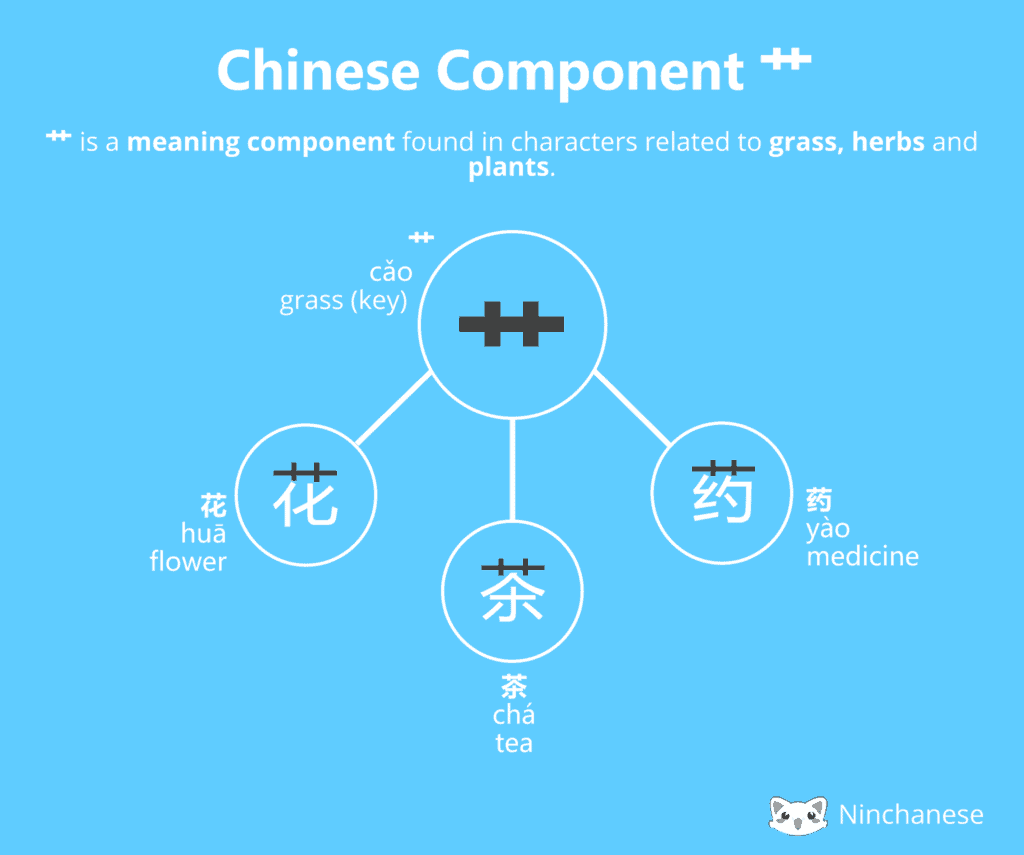
Understanding Chinese Character Components
Chinese character components are the building blocks that make up a character. They can be standalone characters or smaller graphical units that contribute to the meaning or pronunciation of the larger character. Unlike radicals, components do not necessarily have a standardized classification system. Here are key points about components:
- Functional role: Components can serve as semantic indicators (hinting at meaning) or phonetic clues (suggesting pronunciation).
- Flexibility: A single character may contain multiple components, and their arrangement can vary (e.g., left-right, top-bottom).
- Non-standardized: Unlike radicals, components aren't systematically categorized in dictionaries.
Defining Radicals in Chinese Characters
Radicals are a subset of components specifically used for organizing characters in dictionaries. They often represent a broad category of meaning or serve as an indexing tool. Key distinctions include:
- Dictionary function: Radicals help locate characters in traditional dictionaries, acting as section headers.
- Standardized set: There are 214 classical radicals, each with a fixed position and role.
- Semantic emphasis: Many radicals hint at a character's general meaning (e.g., 水 for water-related characters).
Key Differences Between Components and Radicals
While all radicals are components, not all components are radicals. The primary differences are:
- Purpose: Components aid in character construction, while radicals streamline dictionary lookup.
- Classification: Radicals follow a fixed system; components are more fluid and numerous.
- Frequency: A radical appears in every character (as its header), but components may be optional.
How Radicals and Components Work Together
Radicals and components collaborate to form characters. For example, the character 河 (river) includes:
- Radical: 水 (water) on the left, indicating the meaning.
- Component: 可 (kě) on the right, providing phonetic guidance.
- Combined role: The radical categorizes the character, while components complete its form and sound.
Practical Applications in Learning Chinese
Understanding components and radicals accelerates language acquisition. Here’s how:
- Memorization: Breaking characters into components simplifies learning complex shapes.
- Dictionary use: Radicals enable efficient character lookup.
- Meaning deduction: Recognizing radicals helps infer definitions (e.g., 言 often relates to speech).
Is it worth learning Chinese radicals?
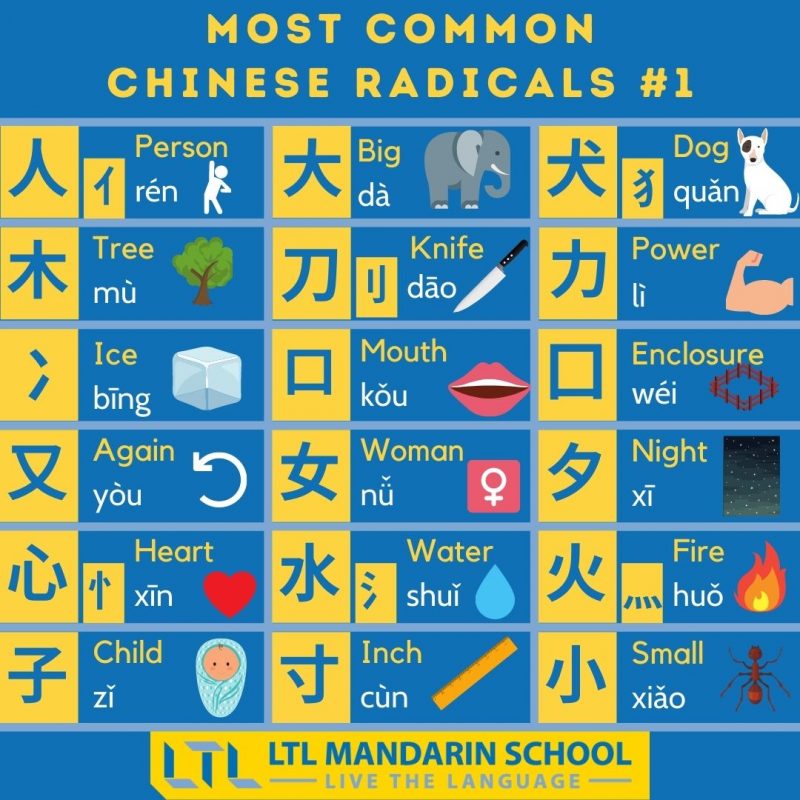
Why Are Chinese Radicals Important for Learning Characters?
Chinese radicals are the building blocks of characters, providing clues about meaning and pronunciation. Learning them helps in:
- Decoding characters more efficiently by recognizing patterns.
- Memorizing complex characters by breaking them into smaller components.
- Expanding vocabulary since many radicals repeat across characters.
Do Radicals Improve Reading and Writing Skills?
Yes, understanding radicals enhances both reading comprehension and writing accuracy. Benefits include:
- Faster recognition of unfamiliar characters by identifying radicals.
- Reduced errors when writing, as radicals guide stroke order.
- Contextual understanding of words, even without knowing every character.
How Do Radicals Help With Dictionary Lookup?
Radicals are essential for using traditional dictionaries and some digital tools. They assist in:
- Locating characters by radical index systems.
- Filtering search results when the pronunciation is unknown.
- Navigating character databases more effectively.
Are Radicals Useful for Beginners or Advanced Learners?
Radicals benefit learners at all levels:
- Beginners grasp foundational character structures.
- Intermediate learners accelerate vocabulary acquisition.
- Advanced students refine nuances in meaning and usage.
What Are the Challenges of Learning Radicals?
While valuable, radicals present some difficulties:
- Variations in form across different characters.
- Multiple meanings for the same radical in different contexts.
- Memorization requires consistent practice.
What are the building blocks of Chinese characters?
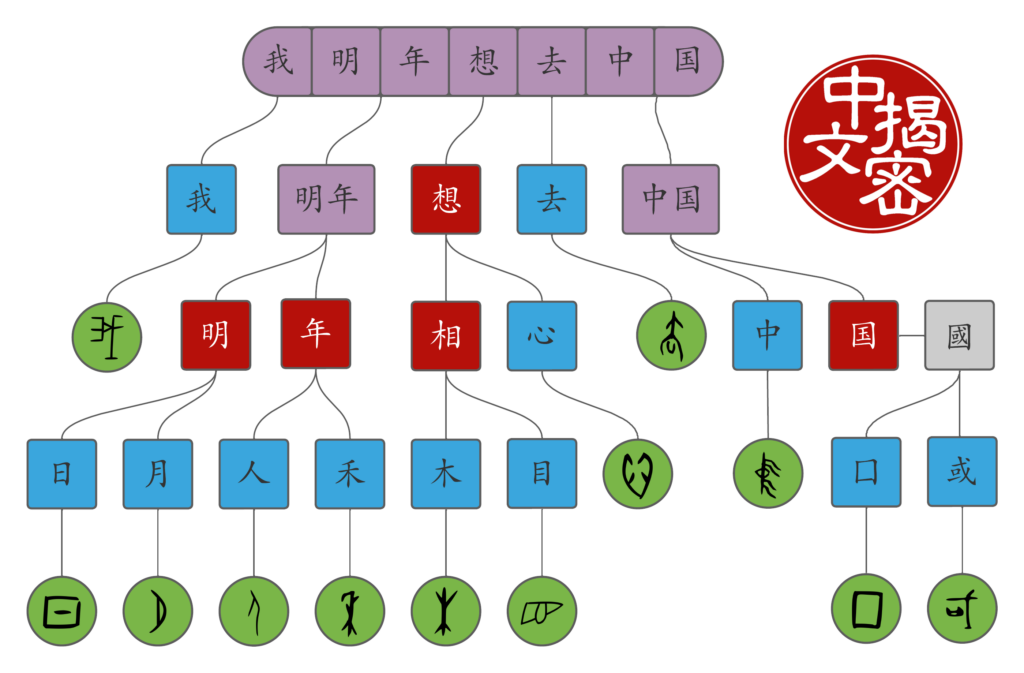
Radicals: The Fundamental Components
Chinese characters are built using radicals, which are the foundational elements that often indicate meaning or pronunciation. There are 214 traditional radicals, each serving as a semantic or phonetic clue. For example:
- The radical 氵 (water) appears in characters like 河 (river) and 湖 (lake).
- 木 (wood) is used in characters such as 林 (forest) and 桌 (table).
- Some radicals, like 口 (mouth), can appear in different positions within a character.
Strokes: The Basic Writing Units
Each Chinese character is composed of strokes, the individual brush or pen movements required to write them. There are eight basic stroke types, including:
- Horizontal stroke (一): The simplest stroke, as seen in the character 一 (one).
- Vertical stroke (丨): Used in characters like 十 (ten).
- Dot stroke (丶): Found in characters such as 主 (master).
Phonetic Components: Sound Clues
Many characters include phonetic components that hint at pronunciation. For example:
- The character 妈 (mā, mother) uses 马 (mǎ) as its phonetic component.
- 清 (qīng, clear) shares its phonetic with 青 (qīng).
- Not all phonetic components perfectly match the pronunciation due to historical changes.
Compound Characters: Combining Elements
Most Chinese characters are compound characters, formed by combining radicals and other components. Examples include:
- 休 (rest): Combines 亻 (person) and 木 (tree).
- 明 (bright): Merges 日 (sun) and 月 (moon).
- 好 (good): Joins 女 (woman) and 子 (child).
Simplified vs. Traditional Characters
Modern Chinese uses both simplified and traditional characters, differing in complexity. Key differences:
- Simplified characters (e.g., 国) have fewer strokes than traditional (國).
- Some radicals are merged or altered, like 讠 (speech) replacing 言.
- Simplified forms are standard in mainland China, while traditional characters are used in Taiwan and Hong Kong.
Frequently Asked Questions (FAQ)
What are radicals in Chinese characters and why are they important?
Radicals are the foundational building blocks of Chinese characters, often providing clues about a character's meaning or pronunciation. They are essential for organizing dictionaries and aiding in memorization. By focusing on radicals, learners can break down complex characters into manageable parts, making it easier to recognize and recall them. For example, the radical 氵 (water) appears in characters like 河 (river) and 海 (sea), linking them thematically.
How do character components help in learning Chinese?
Character components are smaller units within a Chinese character that contribute to its overall structure and meaning. Unlike radicals, which are standardized, components can be any recurring part of a character. Learning these components helps learners identify patterns, such as the 扌 (hand) component in action-related characters like 打 (hit) or 拉 (pull). This systematic approach accelerates vocabulary acquisition and improves reading fluency.
What is the difference between radicals and character building blocks?
While radicals are a specific subset of character parts used for dictionary classification, building blocks refer to any recurring element that forms a character. For instance, the radical 女 (female) is also a building block in characters like 妈 (mother) or 姐 (older sister). However, non-radical components like 巴 in 把 (grasp) are still crucial building blocks but don’t serve as radicals. Understanding both concepts enhances character deconstruction.
Can focusing on radicals and components improve writing skills?
Absolutely. Mastering radicals and components allows learners to deconstruct and reconstruct characters more effectively. For example, knowing that 言 (speech) is a radical helps in writing related characters like 说 (speak) or 话 (words). This method reduces reliance on rote memorization and fosters a deeper understanding of character formation, leading to more accurate and confident writing.
Leave a Reply
Related Posts