
The Ten Most Common Surnames in China

China, with its vast population and rich history, boasts a diverse array of surnames that reflect its cultural heritage. Among the hundreds in use, a few stand out as the most common, carried by millions across the country. These surnames often trace their origins back centuries, linked to ancient clans, dynasties, or geographic regions. Understanding these names offers insight into China’s social structure and familial traditions. From Wang to Li, these top surnames dominate demographic records, revealing patterns of migration and lineage. This article explores the ten most prevalent Chinese surnames, their historical significance, and their enduring prevalence in modern society.
The Ten Most Common Surnames in China
1. The Origins of Chinese Surnames
Chinese surnames, or family names, have a history spanning over 4,000 years. The majority of Chinese surnames are derived from ancient clans, occupations, or geographical locations. The top ten surnames are deeply rooted in China's feudal and dynastic past, reflecting the country's long-standing cultural and social structures.
2. The Most Popular Surname: Wang
Wang (王) is the most common surname in China, with over 100 million people sharing it. It translates to king or monarch, indicating noble origins. The surname is prevalent across all regions, particularly in northern and eastern China.
See AlsoHow and why to learn and teach Chinese through games| Surname | Meaning | Estimated Population |
|---|---|---|
| Wang | King | ~101 million |
3. Li and Zhang: The Second and Third Most Common Surnames
Li (李) and Zhang (张) follow closely behind Wang. Li, meaning plum, is associated with the Tang Dynasty's imperial family. Zhang, meaning archer or stretch, has ancient military roots.
| Surname | Meaning | Estimated Population |
|---|---|---|
| Li | Plum | ~93 million |
| Zhang | Archer | ~87 million |
4. Regional Distribution of Common Surnames
Certain surnames dominate specific regions. For example, Chen (陈) is highly concentrated in Fujian and Guangdong, while Liu (刘) is widespread in northern provinces. These patterns reflect historical migration and clan settlements.
| Surname | Dominant Region |
|---|---|
| Chen | Southern China |
| Liu | Northern China |
5. The Cultural Significance of Chinese Surnames
Chinese surnames are a cornerstone of family identity and ancestral worship. They are often passed down patrilineally and carry deep historical meaning. The top ten surnames collectively represent nearly 40% of China's population, highlighting their cultural dominance.
See AlsoLanguage Exchange: How to Find a Partner?| Surname | Cultural Association |
|---|---|
| Zhao (赵) | Imperial Song Dynasty |
| Yang (杨) | Scholarly and military heritage |
What is China's most common surname?
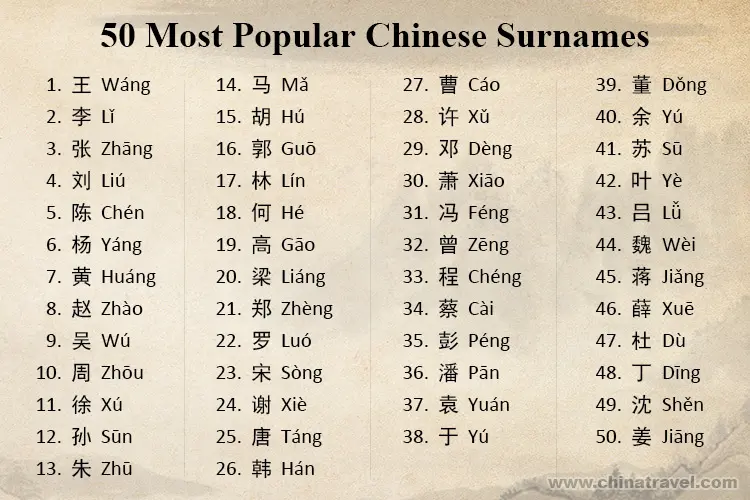
The most common surname in China is Wang (王), which is shared by over 101.5 million people, according to recent data. It holds the top position among Chinese surnames, followed closely by Li (李) and Zhang (张).
The Origin of the Surname Wang
The surname Wang has ancient roots, dating back to the Zhou Dynasty (1046–256 BCE). It originally denoted a connection to royalty or nobility, as Wang translates to king or monarch in Chinese.
See AlsoThe 10 best free Chinese listening resources for beginner, intermediate and advanced learners- Derived from the title of rulers during the Zhou Dynasty.
- Associated with descendants of royalty or high-ranking officials.
- Spread widely due to its prestigious connotations.
Geographical Distribution of Wang in China
The surname Wang is most prevalent in Northern China, particularly in provinces like Shandong, Henan, and Hebei.
- Highest concentration in Shandong Province.
- Common in urban areas due to historical migration patterns.
- Also found among overseas Chinese communities.
Famous Historical Figures with the Surname Wang
Many influential figures in Chinese history bore the surname Wang, contributing to its prominence.
- Wang Xizhi – A legendary calligrapher from the Jin Dynasty.
- Wang Anshi – A renowned reformist politician of the Song Dynasty.
- Wang Yangming – A prominent philosopher during the Ming Dynasty.
Cultural Significance of the Surname Wang
The surname Wang carries deep cultural and social weight in Chinese society.
- Symbolizes authority and leadership due to its meaning.
- Frequently appears in Chinese literature and folklore.
- Represents a sense of heritage and continuity.
Comparison with Other Common Chinese Surnames
While Wang is the most common, other surnames like Li and Zhang also have significant populations.
- Li (李) – Second most common, associated with the Tang Dynasty.
- Zhang (张) – Third most common, often linked to scholars and military leaders.
- Liu (刘) – Historically tied to the Han Dynasty emperors.
What are the Chinese royalty surnames?
Historical Background of Chinese Royal Surnames
The Chinese royalty surnames trace their origins to ancient dynasties, where family names were tied to power and legitimacy. These surnames often symbolized divine mandate or noble lineage. Key historical points include:
- Ying (嬴): The surname of the Qin Dynasty, including China's first emperor, Qin Shi Huang.
- Liu (劉): Dominated the Han Dynasty, one of China's longest-ruling imperial families.
- Li (李): Associated with the Tang Dynasty, a golden age of Chinese culture and expansion.
Most Prominent Royal Surnames in Chinese History
Several imperial surnames stand out due to their influence and longevity in ruling China. Notable examples are:
- Zhao (趙): The ruling family of the Song Dynasty, known for advancements in arts and sciences.
- Zhu (朱): The Ming Dynasty's surname, credited for restoring Han Chinese rule after Mongol occupation.
- Aisin Gioro (愛新覺羅): The Manchu clan name of the Qing Dynasty, China's last imperial family.
Regional Variations in Royal Surnames
Chinese royal surnames often reflected regional power centers or ethnic origins. Examples include:
- Chen (陳): Prominent in southern dynasties like the Chen Dynasty during the Six Dynasties period.
- Tuoba (拓跋): A Xianbei clan that ruled the Northern Wei Dynasty, blending Han and nomadic cultures.
- Wu (吳): Linked to regional kingdoms like Eastern Wu during the Three Kingdoms era.
Symbolism and Legacy of Imperial Surnames
The royal surnames carried deep cultural and political significance, often associated with:
- Mandate of Heaven: Surnames like Liu or Li were seen as divinely chosen for rule.
- Cultural Patronage: Families like the Song's Zhao sponsored monumental works in literature and philosophy.
- Ethnic Identity: Surnames such as Aisin Gioro highlighted Manchu dominance during the Qing era.
Modern Descendants and Preservation Efforts
Today, Chinese royal surnames persist among descendants and historical societies. Key aspects include:
- Genealogical Records: Families like the Kong (孔) (descendants of Confucius) maintain detailed lineage archives.
- Cultural Festivals: Events honoring dynasties like the Tang (Li) or Ming (Zhu) celebrate their heritage.
- Academic Research: Scholars study surnames like Ying to understand early Chinese state formation.
What is the order of Chinese surnames?
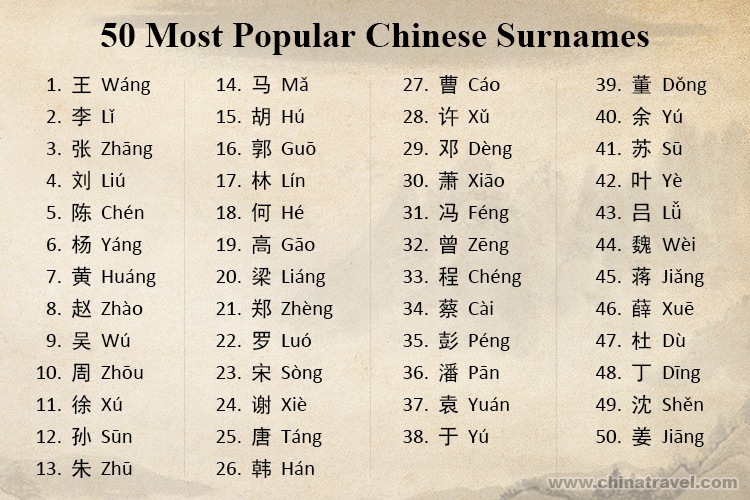
The Traditional Order of Chinese Surnames
In Chinese culture, the surname (or family name) always comes before the given name. This order reflects the importance of family and ancestry in Chinese society. For example, in the name Zhang Wei, Zhang is the surname, and Wei is the given name. This structure is consistent across formal and informal contexts.
- Surname first: The family name precedes the given name.
- No middle names: Traditional Chinese names do not include middle names.
- Generational names: Some families use a shared character in given names to indicate generational order.
Common Chinese Surnames and Their Prevalence
The most common Chinese surnames are often referred to as the Hundred Family Surnames (百家姓). A few, like Wang, Li, Zhang, Liu, and Chen, dominate due to their historical significance and large populations.
- Wang (王): The most common surname in China.
- Li (李): Historically linked to the Tang Dynasty.
- Zhang (张): Widespread, with deep cultural roots.
Historical Origins of Chinese Surnames
Chinese surnames often trace back to ancient clans, occupations, or locations. For example, the surname Jiang (姜) originates from the legendary Yan Emperor, while Simā (司马) was tied to military roles.
- Clan-based: Many surnames derive from ancestral tribes.
- Occupational: Names like Tao (陶) (potter) reflect professions.
- Geographical: Surnames like Shān (山) (mountain) denote origins.
Modern Usage and Western Adaptations
In Western contexts, Chinese names are sometimes reversed to match the given name first convention. However, this can cause confusion, as the original order holds cultural significance.
- Reversed order: Some diaspora communities adapt to local norms.
- Hyphenation: Surnames may be hyphenated (e.g., Zhang-Wei) for clarity.
- Legal documents: Official records often preserve the traditional order.
Cultural Significance of Surnames in China
Chinese surnames are deeply tied to identity, heritage, and social structure. They often indicate regional origins, historical lineage, and even social status.
- Ancestral worship: Surnames connect individuals to their ancestors.
- Marriage customs: Traditionally, women retain their surnames after marriage.
- Naming taboos: Some surnames avoid characters used by emperors.
What is the rarest last name in China?
The rarest last name in China is Ku (库), with only around 100 people bearing this surname. It originates from ancient minority groups and is exceptionally uncommon due to its historical and regional isolation. Other extremely rare surnames include Nan (难) and Shan (山), each with fewer than 1,000 recorded individuals.
Why are some Chinese surnames so rare?
Several factors contribute to the rarity of certain Chinese surnames:
- Historical extinction: Many surnames disappeared due to wars, migrations, or assimilation.
- Minority origins: Some surnames belong to small ethnic groups with limited populations.
- Simplification: Complex characters were phased out, reducing their usage.
How are rare Chinese surnames preserved?
Preservation efforts for rare surnames include:
- Genealogical records: Families document lineage to maintain their heritage.
- Government initiatives: Cultural projects aim to protect endangered surnames.
- Academic research: Linguists and historians study their origins.
Which regions in China have the rarest surnames?
Rare surnames are often concentrated in:
- Remote areas: Like Yunnan or Guizhou, where minority groups reside.
- Historical enclaves: Such as ancient villages with unbroken traditions.
- Border regions: Where cultural exchange led to unique naming practices.
What challenges do people with rare surnames face?
Individuals with rare surnames encounter issues like:
- Mispronunciation: Others often struggle to read or spell the name correctly.
- Identity verification: Bureaucratic systems may not recognize the surname.
- Social curiosity: Constant explanations about their name's origin.
Are there efforts to revive extinct Chinese surnames?
Yes, revival attempts include:
- Cultural campaigns: Promoting awareness of endangered surnames.
- Legal changes: Allowing rare characters in official documents.
- Family reunions: Descendants reconnect to reclaim lost surnames.
Frequently Asked Questions (FAQ)
What are the ten most common surnames in China?
The ten most common surnames in China, in order of prevalence, are Wang, Li, Zhang, Liu, Chen, Yang, Huang, Zhao, Wu, and Zhou. These surnames dominate the population, with Wang being the most widespread, accounting for over 100 million people. The distribution reflects historical migrations, cultural influences, and dynastic legacies. These names have deep roots in Chinese history, often linked to ancient clans or geographical origins.
Why are some Chinese surnames more common than others?
The prevalence of certain Chinese surnames stems from historical factors, including imperial patronage, clan expansion, and population growth. For example, Li was the royal surname during the Tang Dynasty, leading to its widespread adoption. Similarly, Wang, meaning king, was associated with nobility. Over centuries, these names proliferated due to large families and societal structures favoring patrilineal naming traditions. Regional dominance also played a role, as some clans settled in highly populated areas.
How do Chinese surnames reflect cultural heritage?
Chinese surnames are deeply tied to cultural heritage, often indicating ancestral origins, occupations, or social status. For instance, Zhang may trace back to archery-related roles in ancient times, while Chen is linked to the ancient Chen state. Many surnames also derive from Confucian values or historical events, preserving stories of migration or alliances. The repetition of certain names across generations underscores the importance of family continuity and collective identity in Chinese society.
Are there regional variations in the distribution of common Chinese surnames?
Yes, the distribution of common Chinese surnames varies by region due to historical migration patterns and local demographics. For example, Li is highly concentrated in southern provinces like Guangdong, while Wang dominates northern regions such as Hebei. Coastal areas might have higher instances of Chen or Lin, reflecting maritime trade influences. These regional differences highlight how geography and historical events shaped surname prevalence across China’s diverse landscape.
Leave a Reply
Related Posts