
The Most Difficult Sounds in Chinese to Master

Mastering Chinese pronunciation can be a daunting challenge for learners, especially when encountering sounds that don’t exist in their native language. From the infamous zh, ch, and sh sounds to the subtle distinctions between x, q, and j, Chinese presents a unique set of phonetic hurdles. Tones add another layer of complexity, turning what seems like a simple syllable into multiple meanings. This article explores the most difficult sounds in Chinese to master, breaking down their articulation and offering practical tips to overcome these challenges. Whether you're a beginner or an advanced learner, understanding these sounds is key to achieving fluency and clear communication.
The Most Difficult Sounds in Chinese to Master
Chinese pronunciation can be challenging for learners, especially due to its tonal nature and unique sounds not found in many other languages. Below, we explore the most difficult sounds in Chinese and provide tips to master them.
1. The Infamous Zh, Ch, and Sh Sounds
The retroflex sounds zh, ch, and sh are particularly tricky because they require curling the tongue back toward the roof of the mouth. Many learners mistakenly substitute them with softer sounds like j, q, and x. Practice by exaggerating the tongue position and listening to native speakers.
See AlsoIf you want to master Chinese, make long-term investments| Sound | Example | Tip |
|---|---|---|
| zh | 中国 (Zhōngguó) | Curling tongue backward |
| ch | 吃饭 (Chīfàn) | Stronger aspiration |
| sh | 上海 (Shànghǎi) | Hold tongue close to palate |
2. Mastering the Ü Vowel Sound
The ü sound, as in 女 (nǚ) or 绿 (lǜ), doesn’t exist in English. To produce it, round your lips as if saying oo (like in food) while trying to say ee. It’s a hybrid sound that requires precise lip positioning.
| Sound | Example | Tip |
|---|---|---|
| ü | 女 (nǚ) | Combine ee and rounded lips |
3. The Challenging R Sound
The Chinese r is pronounced differently from the English r. It’s closer to the French j or a soft zh sound, as in 日 (rì). The tongue should lightly touch the roof of the mouth without rolling.
| Sound | Example | Tip |
|---|---|---|
| r | 热 (rè) | Softer, no tongue roll |
4. The Aspirated vs. Unaspirated Consonants
Chinese distinguishes between aspirated (strong breath) and unaspirated (no breath) consonants, like p vs. b or t vs. d. Mispronouncing these can change word meanings. For example, 怕 (pà) (fear) vs. 八 (bā) (eight).
See AlsoReading aloud in Chinese is really hard| Type | Example | Difference |
|---|---|---|
| Aspirated | 怕 (pà) | Strong puff of air |
| Unaspirated | 八 (bā) | No breath |
5. The Neutral Tone: Subtle but Crucial
The neutral tone is a light, unstressed syllable that appears in words like 妈妈 (māma). It’s shorter and softer than the other four tones. Misplacing stress can make speech sound unnatural.
| Tone | Example | Tip |
|---|---|---|
| Neutral | 妈妈 (māma) | Light and quick |
What are the hardest Chinese sounds?

The Most Challenging Chinese Consonants for English Speakers
Mandarin Chinese contains several consonants that are particularly difficult for English speakers due to their unique articulation. Here are the most problematic ones:
See AlsoHow to figure out how good your Chinese is- Retroflex sounds (zh, ch, sh, r): These require curling the tongue back, unlike anything in English.
- Palatal sounds (j, q, x): Produced with the tongue against the hard palate, often confused with English j or ch.
- Aspirated vs. unaspirated stops (e.g., b/p, d/t, g/k): The distinction relies on breathiness, not voicing.
Tricky Chinese Vowels and Tones
Vowels and tones add another layer of complexity. Key challenges include:
- Ü (as in nǚ): A rounded front vowel absent in English, resembling French u.
- Retroflex vowels (e.g., er): Combine vowel sounds with a curled tongue position.
- The four tones: Mispronouncing tones (e.g., mā vs. mà) can change word meanings entirely.
Common Sound Combinations That Cause Confusion
Certain syllable combinations trip up learners due to unfamiliar phonotactics:
- Zhi, chi, shi, ri: Retroflex consonants + vowel-like sounds.
- Xiong, qiong: Palatal consonants + nasal endings.
- Lüe, nüe: Ü vowel + rapid glide.
Regional Variations and Accent Pitfalls
Dialectal influences can further complicate pronunciation:
- Southern accents merging n and l: E.g., nán (south) sounding like lán.
- Northern retroflex overuse: Exaggerated erhua (儿化音) endings.
- Confusion between h and f: Common in Fujian dialects.
Tips to Master Difficult Chinese Sounds
Strategies to overcome these hurdles:
- Minimal pair drills: Practice contrasting sounds like jī vs. zhī.
- Tone sandhi exercises: Focus on third-tone changes and neutral tones.
- Mouth positioning videos: Visual guides for retroflex and palatal sounds.
What is the most difficult Chinese dialect?

What Makes a Chinese Dialect Difficult to Learn?
The difficulty of a Chinese dialect depends on factors like phonetics, tones, and grammatical complexity. For non-native speakers, dialects with more tones or irregular pronunciation rules are harder to master.
- Tonal variations: Some dialects have up to 9 tones, making pronunciation extremely challenging.
- Lack of standardized materials: Fewer learning resources exist for less common dialects.
- Regional slang and idioms: Unique expressions can be confusing even for fluent Mandarin speakers.
Which Chinese Dialect Has the Most Complex Tones?
Hakka and Min Nan are known for their intricate tonal systems, but Teochew (Chaozhou) is often considered the most complex due to its 8 distinct tones.
- Teochew: Uses 8 tones, with subtle pitch differences that change word meanings.
- Hakka: Features 6 tones, requiring precise vocal control.
- Cantonese: Though popular, its 6-9 tones (depending on region) pose a steep learning curve.
How Does Vocabulary Differ in Hard-to-Learn Dialects?
Dialects like Wenzhounese or Shanghainese have vocabulary that diverges significantly from Mandarin, creating additional hurdles.
- Ancient Chinese roots: Some dialects retain archaic words no longer used in Mandarin.
- Loanwords from other languages: For example, Cantonese incorporates English and Portuguese terms.
- Context-dependent meanings: Words may shift definitions based on tone or sentence structure.
Why Is Wenzhounese Called The Devil’s Language?
Wenzhounese earns its nickname due to its unintelligibility even to other Chinese speakers and its highly irregular pronunciation.
- Extreme phonetic shifts: Sounds differ drastically from Mandarin or Cantonese.
- Limited mutual intelligibility: Even neighboring dialects struggle to understand it.
- Rapid speech patterns: Native speakers often talk at a pace that’s hard to follow.
Are There Dialects Harder Than Mandarin for Native Speakers?
Yes, native Mandarin speakers often find Min Bei or Hokkien dialects challenging due to their divergent grammar and unique lexicon.
- Min Bei: Uses grammatical structures absent in Mandarin.
- Hokkien: Incorporates Middle Chinese elements, unfamiliar to modern speakers.
- Gan dialect: Features consonant endings that Mandarin lacks.
What is the hardest word to learn in Chinese?
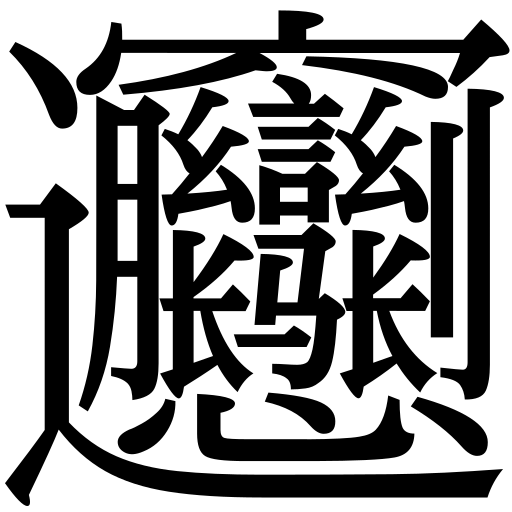
Why Are Some Chinese Words Considered Hard to Learn?
Chinese is known for its complex characters, tones, and lack of phonetic clues, making certain words particularly challenging for learners. The difficulty often stems from:
- Character complexity: Some characters have many strokes, like biáng (a noodle dish), which has over 50 strokes.
- Tonal variations: Words like ma can mean mother, hemp, horse, or scold depending on the tone.
- Homophones: Many words sound identical but have different meanings and characters, such as shì (是 - to be) and shì (事 - thing).
What Makes the Word Biáng So Difficult?
The word biáng (used in biáng biáng noodles) is often cited as the hardest due to its:
- Stroke count: With over 50 strokes, it’s one of the most complex characters in modern Chinese.
- Rarity: It’s rarely used outside regional cuisine, making it hard to practice.
- Unconventional structure: The character combines multiple radicals and components in an unusual way.
How Do Tones Affect Word Difficulty in Chinese?
Tones add a layer of complexity, as mispronouncing them can change a word’s meaning entirely. For example:
- Mā (妈): Means mother (first tone).
- Má (麻): Means hemp (second tone).
- Mǎ (马): Means horse (third tone).
- Mà (骂): Means scold (fourth tone).
Are There Hard-to-Learn Words Due to Cultural Context?
Some words are tough because they rely on cultural nuances or historical references, such as:
- Yǎn (眼): Means eye but is used in idioms like 火眼金睛 (sharp eyesight, from folklore).
- Lóng (龙): Means dragon, a symbol deeply tied to Chinese mythology.
- Xǐ (喜): Means joy, often seen in weddings but hard to translate contextually.
Which Commonly Used Words Are Surprisingly Hard?
Even everyday words can be tricky due to their multiple meanings or usage rules, like:
- Le (了): A particle indicating completed action, but its usage is highly context-dependent.
- De (的, 得, 地): Three homophones with different grammatical functions.
- Zhe (着): Indicates ongoing action but is easily confused with other particles.
Frequently Asked Questions (FAQ)
What are the most challenging consonant sounds in Chinese for English speakers?
Chinese consonants like zh, ch, sh, and r are particularly difficult for English speakers because they don’t have direct equivalents in English. The retroflex sounds (produced with the tongue curled back) require a tongue position that feels unnatural to many learners. For example, the Mandarin r sound is not the same as the English r—it’s closer to a mix between r and zh, adding to the confusion. Mispronouncing these can change word meanings entirely, such as confusing shī (lion) with xī (west).
Why are the Chinese j, q, and x sounds so hard to pronounce correctly?
The palatal sounds j, q, and x are tricky because they require the tongue to press against the hard palate, a position uncommon in English. For instance, the Mandarin j sounds like a softer dgee, while q resembles a breathy chee with strong aspiration. Many learners accidentally substitute them with English j, ch, or sh, leading to errors like saying je (incorrect) instead of jiē (street). Practice with minimal pairs (e.g., qī vs. chī) is essential to master these distinctions.
How does Mandarin's tonal system complicate sound mastery for beginners?
Unlike English, Mandarin uses four tones (plus a neutral tone) to differentiate meaning, making pronunciation exponentially harder. For example, mā (mother) and mà (scold) sound identical except for their pitch contours. Beginners often struggle with the third tone (a dipping tone) or confuse the high-flat first tone with the rising second tone. Since tones are integral to comprehension, mispronouncing them can render words unintelligible, even if consonants and vowels are correct.
What makes the Chinese ü vowel so difficult for non-native speakers?
The ü sound (as in lǜ for green) is uncommon in English and requires rounding the lips tightly while positioning the tongue forward, like saying ee with an oo mouth shape. Many learners default to u or i, distorting words like nǚ (woman) into nu (anger). This vowel appears in syllables with j, q, x, and y (e.g., xué), compounding the difficulty. Exaggerated lip rounding and listening to native speakers are key to mastering this sound.
Leave a Reply
Related Posts